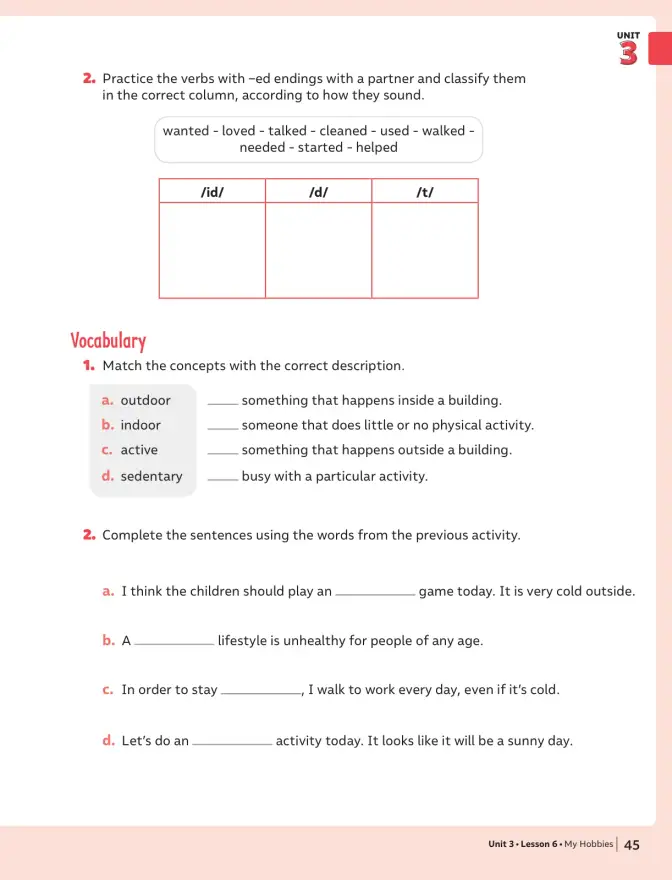
Ejercicio 2
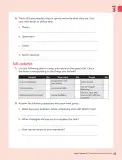
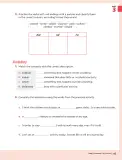
Practice the verbs with -ed endings with a partner and classify them in the correct column, according to how they sound.
- Identifico la terminación del verbo base para aplicar la regla de pronunciación de -ed.
- Regla: si el verbo termina en /t/ o /d/ → /ɪd/; si termina en sonido sordo (excepto /t/) → /t/; si termina en sonido sonoro (excepto /d/) → /d/.
- Clasifico cada verbo:
- wanted (want → /t/) → /ɪd/
- needed (need → /d/) → /ɪd/
- started (start → /t/) → /ɪd/
- loved (love → /v/ sonoro) → /d/
- cleaned (clean → /n/ sonoro) → /d/
- used (use → /z/ sonoro) → /d/
- talked (talk → /k/ sordo) → /t/
- walked (walk → /k/ sordo) → /t/
- helped (help → /p/ sordo) → /t/
Vocabulary 1
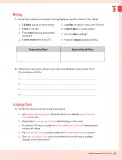
Match the concepts with the correct description.
- Leo cada concepto y cada descripción.
- Asocio por significado:
- outdoor → something that happens outside a building.
- indoor → something that happens inside a building.
- active → busy with a particular activity.
- sedentary → someone that does little or no physical activity.
Respuesta:
a. outdoor — something that happens outside a building. b. indoor — something that happens inside a building. c. active — busy with a particular activity. d. sedentary — someone that does little or no physical activity.
Vocabulary 2
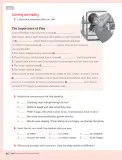
Complete the sentences using the words from the previous activity.
- Analizo el contexto de cada oración para elegir la palabra adecuada.
- a) "It is very cold outside" indica que el juego debe ser bajo techo → indoor.
- b) Un estilo de vida con poca actividad física es unhealthy → sedentary.
- c) Caminar para mantenerse en movimiento → active.
- d) "It looks like it will be a sunny day" sugiere actividad al aire libre → outdoor.
Respuesta:
a. indoor b. sedentary c. active d. outdoor
Respuesta
| /ɪd/ | /d/ | /t/ |
|---|---|---|
| wanted | loved | talked |
| needed | cleaned | walked |
| started | used | helped |