Saltar al contenido
MisLibrosTexto
Ad
Ingles 3° · 2024
Libro de Inglés 3 BGU

Ministerio de Educación del Ecuador

30/34

Mastering "th" sound: pronunciación de la "th" inglesa

📄 teoria ingles 🎓 bachillerato · 3° BGU Ecuador 🇪🇨 EC 🗣 Español
Página 30
30 de 34
Página 30 de Ingles 3° · 2024
Anterior Página 30 / 34 Siguiente

Respuesta rápida

  1. Lengua contra dientes superiores + exhalar suavemente → sonido de silbido. 2) Dos variantes: /θ/ voiceless (think) y /ð/ voiced (this). 3a) think, math = /θ/; this, that = /ð/. 3b) Se escribe "th" para el sonido escuchado.
📚 theory ingles ⭐⭐ Dificultad 2/5 ⏱ 4 min lectura

Solución — Página 30

Ingles 3° · 2024

1
Ejercicio 1

Describir cómo producir el sonido "th" sin voz (/θ/), como en "think" o "math".

  1. Colocar la punta de la lengua contra los dientes frontales superiores, como si se asomara un poco la lengua.
  2. Exhalar suavemente, dejando que el aire fluya entre la lengua y los dientes.
  3. Esto produce un sonido suave de silbido, como el aire que escapa al soplar una vela.
Respuesta

Colocar la punta de la lengua contra los dientes superiores, exhalar suavemente y producir un sonido de silbido suave, como al soplar una vela.

2
Ejercicio 2

Distinguir las dos variantes del sonido "th" en inglés.

  1. El sonido "th" sin voz (voiceless) se representa con el símbolo /θ/ y aparece en palabras como "think" y "math".
  2. El sonido "th" con voz (voiced) se representa con el símbolo /ð/ y corresponde a la otra variante (como en "this" o "mother").
  3. Ambos se producen con la lengua y los dientes, pero el voiced /ð/ involucra la vibración de las cuerdas vocales.
Respuesta

Hay dos variantes: voiceless /θ/ (ej. "think") y voiced /ð/ (ej. "this"); la diferencia es la vibración de las cuerdas vocales.

3
Ejercicio 3

(Preguntas de la página: Performance indicators)

a
Parte 3.a

Reconocer palabras con sonidos "th" y pronunciarlos correctamente.

  1. Identificar palabras con "th": think, math, three, this, that.
  2. Clasificar: think, math, three → voiceless /θ/; this, that → voiced /ð/.
  3. Practicar la pronunciación usando los pasos descritos.
Respuesta

Palabras voiceless: think, math, three (/θ/). Palabras voiced: this, that (/ð/). Se pronuncian aplicando la posición de lengua y dientes descrita.

b
Parte 3.b

Escribir algunas palabras solo al escucharlas (dictado).

  1. Escuchar atentamente la palabra pronunciada con "th".
  2. Identificar si el sonido es /θ/ o /ð/ según la vibración de las cuerdas vocales.
  3. Escribir la palabra usando "th" para representar el sonido escuchado.
Respuesta

Se escribe "th" para representar el sonido escuchado, distinguiendo entre /θ/ y /ð/ según corresponda.

Contenido de la página

WORKSHEET 6

PRONUNCIATION

General objective Develop clear and effective English pronunciation skills, enabling learners to communicate confidently and be readily understood in both academic and real-world contexts.
Learning objective Understand and correctly pronounce words with "th" sound in English to communicate clearly.
Descriptor Recognize and differentiate sounds and letters for correct spelling and pronunciation while appreciating the value of clear and precise communication to understand others.
Performance indicators Recognize words with "th" sounds and pronounce the sounds correctly. Write some words just by listening to them.

TITLE: MASTERING "th" SOUND

The "th" sound in English is made with your tongue and your teeth. There are two variations of the "th" sound: the voiceless "th" (/θ/) and the voiced "th" (/ð/).

Voiceless "th" (/θ/):

To produce the voiceless "th" sound (as in words like "think" or "math"), follow these steps:

  • Place the tip of your tongue against your upper front teeth, almost like you're sticking your tongue out just a bit.
  • Exhale gently, allowing the air to flow between your tongue and your teeth.
  • This should create a soft, hissing "th" sound, like the sound of air escaping when you blow out a candle.

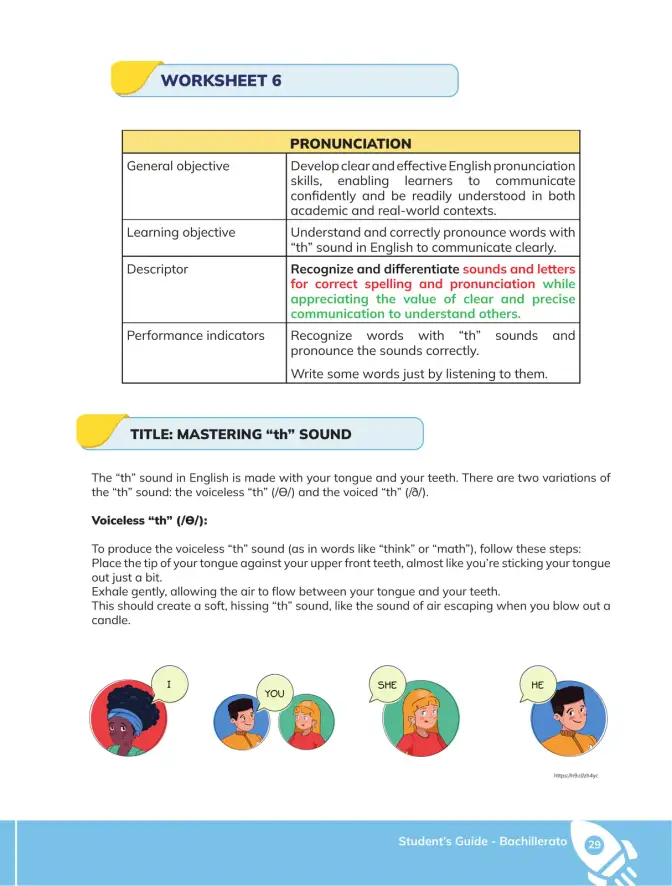
Ilustraciones con globos de diálogo: I, YOU, SHE, HE

Fuente: https://h9.cl/zh4yc

Student's Guide - Bachillerato (pág. 29)

Ejemplos resueltos

Producir el sonido voiceless "th" como en "think".

  1. Colocar la punta de la lengua contra los dientes frontales superiores. 2. Exhalar suavemente dejando que el aire fluya. 3. Se produce un sonido suave de silbido, como soplar una vela.

Tabla

Categoría Contenido
General objective Develop clear and effective English pronunciation skills...
Learning objective Understand and correctly pronounce words with "th" sound...
Descriptor Recognize and differentiate sounds and letters for correct spelling and pronunciation...
Performance indicators Recognize words with "th" sounds and pronounce them correctly; write words by listening.

Fórmulas y ecuaciones

Voiceless "th" = /\theta/

Voiced "th" = /\ð/

Glosario (4)

Voiceless
Sonido producido sin vibración de las cuerdas vocales (sord o).
Voiced
Sonido producido con vibración de las cuerdas vocales (sonoro).
Pronunciation
Forma de articular los sonidos de un idioma.
Exhale
Soplar o echar el aire hacia afuera.

Preguntas para practicar

¿Cómo produzco el sonido voiceless "th"?

Coloca la punta de la lengua contra los dientes superiores, exhala suavemente y producirás un sonido de silbido suave, como al soplar una vela.

¿Qué diferencia hay entre /θ/ y /ð/?

/θ/ es sin voz (voiceless, ej. think) y /ð/ es con voz (voiced, ej. this); la diferencia es la vibración de las cuerdas vocales.

Temas y conceptos clave

Pronunciación del sonido "th" en inglésSonido voiceless /θ/Sonido voiced /ð/Objetivos de aprendizaje de pronunciaciónvoiceless th /θ/voiced th /ð/pronunciaciónphoneticstongue and teeth positionexhale

Fuentes y referencias

  • https://h9.cl/zh4yc
¿Te fue útil esta página?

Figuras de la página (4)

Banner amarillo con el encabezado WORKSHEET 6.
Figura 2 image
Figura 3 de Ingles 3° · 2024
Figura 3 image
Figura 4 de Ingles 3° · 2024
Figura 4 image
Figura 5 de Ingles 3° · 2024
Figura 5 image

Preguntas que la gente también hace

¿Cómo se produce el sonido voiceless "th" (/θ/) en inglés?
Consulta la solución completa arriba o explora el libro entero para temas relacionados.
¿Cuál es la diferencia entre el sonido "th" voiceless y voiced?
Consulta la solución completa arriba o explora el libro entero para temas relacionados.
¿Qué palabras en inglés tienen el sonido "th" sin voz?
Consulta la solución completa arriba o explora el libro entero para temas relacionados.
📌 Antes de leer esto
  • • Alfabeto inglés y sonidos básicos
  • • Conocer los fonemas /θ/ y /ð/
  • • Haber visto el alfabeto fonético internacional (IPA)
Siguiente tema sugerido
Práctica de palabras con el sonido "th" voiced (/ð/) y ejercicios de escucha y dictado
📝 Transcripción de la página (texto seleccionable) 1304 caracteres

/ WORKSHEET 6 )

General objective Develop clear and effective English pronunciation skills, enabling learners to communicate confidently and be readily understood in both academic and real-world contexts.

Learning objective Understand and correctly pronounce words with “th” sound in English to communicate clearly.

Descriptor Recognize and differentiate sounds and letters for correct spelling and pronunciation while appreciating the value of clear and precise communication to understand others.

Performance indicators Recognize words with “th” sounds and pronounce the sounds correctly.

Write some words just by listening to them.

7 me MASTERING “th” SOUND )

The “th” sound in English is made with your tongue and your teeth. There are two variations of the “th” sound: the voiceless “th” (/8/) and the voiced “th” (/8/).

Voiceless “th” (/0/):

To produce the voiceless “th” sound (as in words like “think” or “math”), follow these steps: Place the tip of your tongue against your upper front teeth, almost like you're sticking your tongue out just a bit.

Exhale gently, allowing the air to flow between your tongue and your teeth.

This should create a soft, hissing “th” sound, like the sound of air escaping when you blow out a

candle. https://n9.clízháyc

Student's Guide - Bachillerato

Ad

Otros libros recomendados

Ver todos →
Ad

Usamos cookies propias y de terceros para personalizar contenido, mostrar publicidad y analizar el tráfico. Las cookies necesarias siempre están activas.