
Página — Ingles 6 (pág. 225)
Solución no disponible aún
Esta página está en proceso de revisión.
Pídela y la resolveremos antes. Sin registro.
📝 Transcripción de la página (texto seleccionable) 5123 caracteres
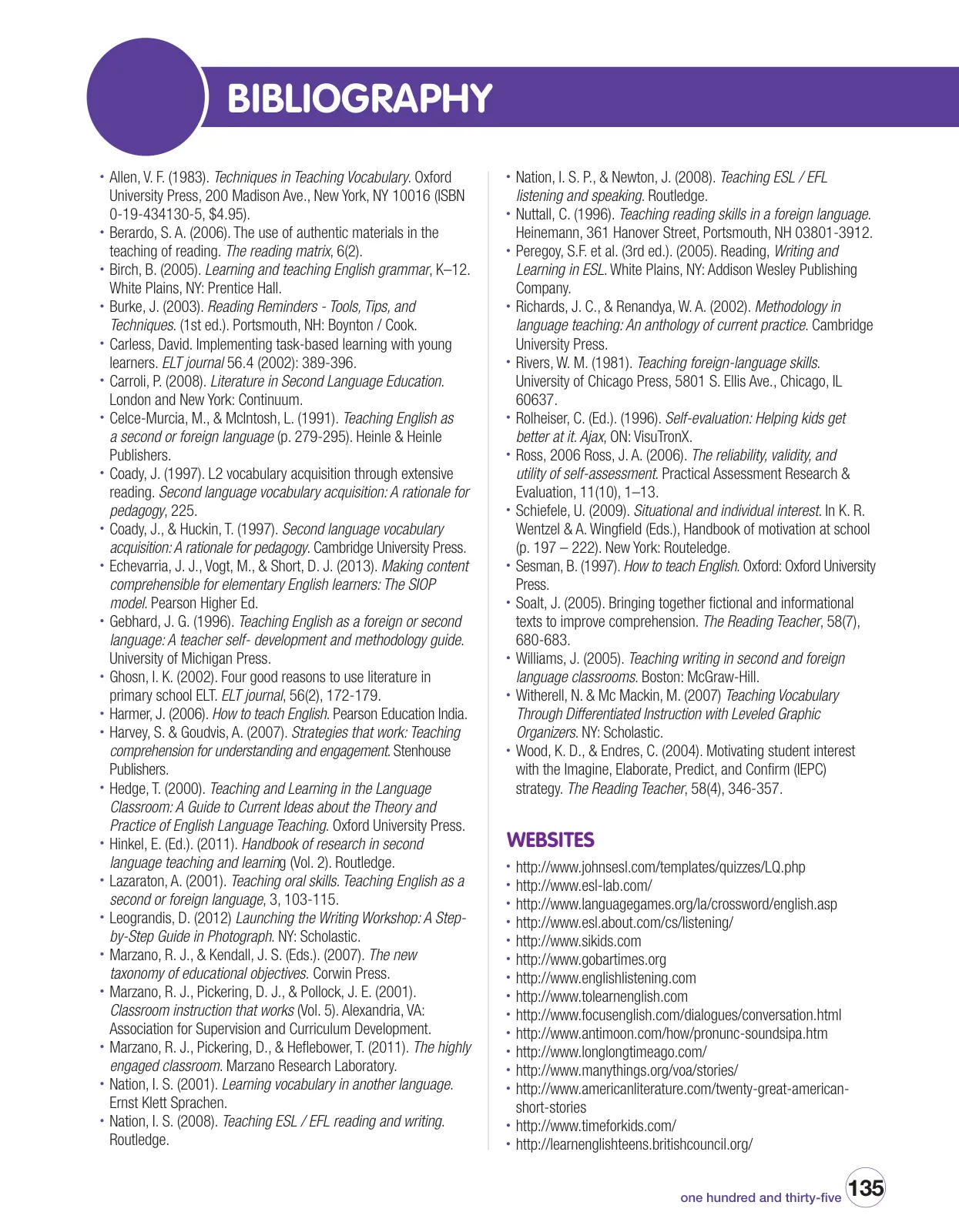
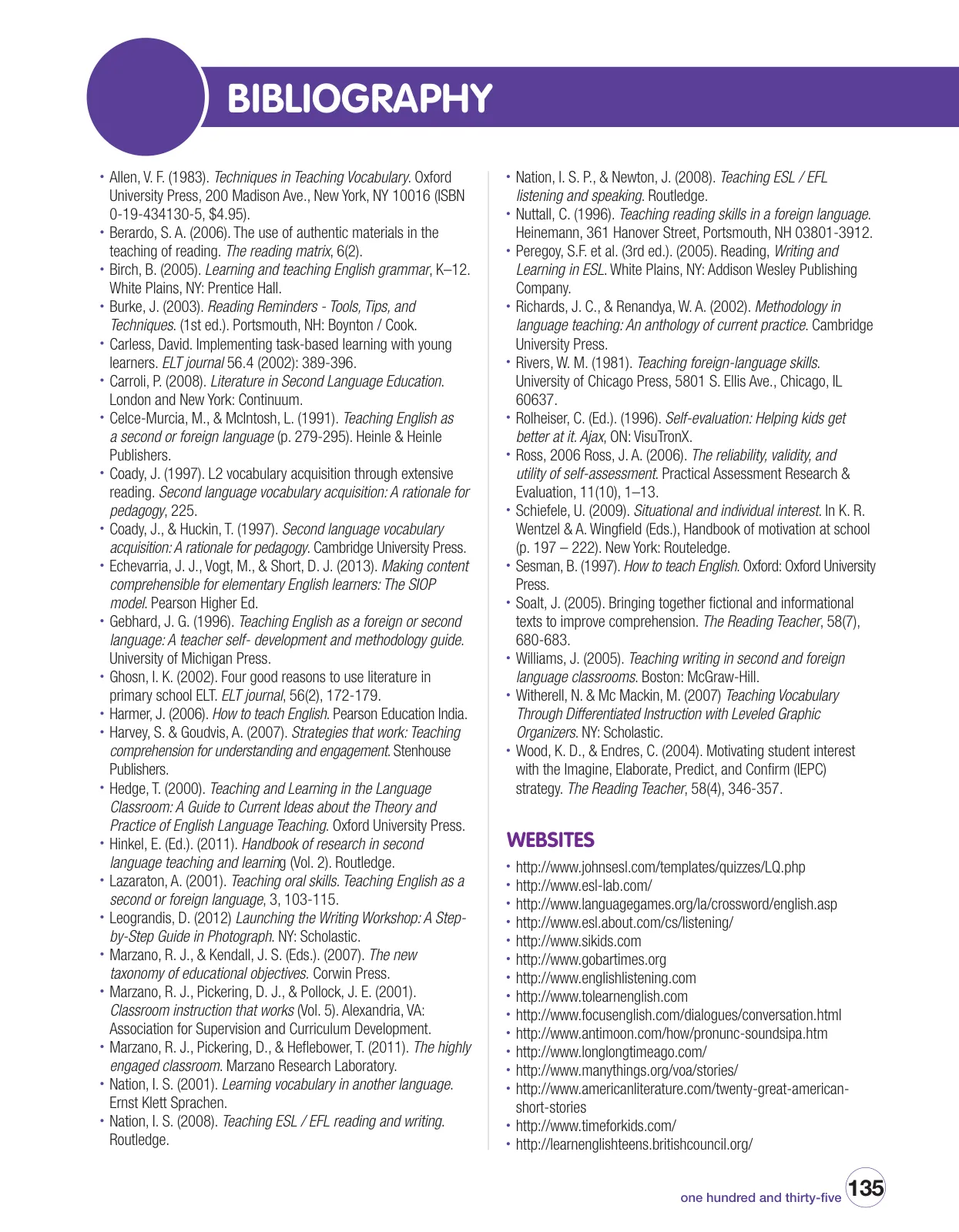
• Allen, V. F. (1983). Techniques in Teaching Vocabulary. Oxford University Press, 200 Madison Ave., New York, NY 10016 (ISBN 0-19-434130-5,$4.95).
• Berardo, S. A. (2006). The use of authentic materials in the teaching of reading. The reading matrix, 6(2).
• Birch, B. (2005). Learning and teaching English grammar, K–12.White Plains, NY: Prentice Hall.
• Burke, J. (2003). Reading Reminders – Tools, Tips, and Techniques. (1st ed.). Portsmouth, NH: Boynton / Cook.
• Carless, David. Implementing task-based learning with young learners. ELTjourna/56.4 (2002): 389-396
Carroli, P. (2008). Literature in Second Language Education.London and New York: Continuum.
• Celce-Murcia, M., & Mclntosh, L. (1991). Teaching English as a second or foreign language (p. 279-295). Heinle & Heinle Publishers.
Coady, J. (1997). L2 vocabulary acquisition through extensive reading. Second language vocabulary acquisition: A rationale for pedagogy, 225.
• Coady, J., & Huckin, T. (1997). Second language vocabulary acquisition: A rationale for pedagogy. Cambridge University Press.
• Echevarria, J. J., Vogt, M., & Short, D. J. (2013). Making content comprehensible for elementary English learners: The SIOP model. Pearson Higher Ed.
• Gebhard, J. G. (1996). Teaching English as a foreign or second language: A teacher self- development and methodology guide.University of Michigan Press.
• Ghosn, I. K. (2002). Four good reasons to use literature in primary school ELT. ELT journal, 56(2), 172-179.
• Harmer, J. (2006). How to teach English. Pearson Education India.• Harvey, S. & Goudvis, A. (2007). Strategies that work: Teaching comprehension for understanding and engagement. Stenhouse Publishers.
• Hedge, T. (2000). Teaching and Learning in the Language Classroom: A Guide to Current Ideas about the Theory and Practice of English Language Teaching. Oxford University Press.
•Hinkel, E. (Ed.). (2011). Handbook of research in second language teaching and learning (Vol. 2). Routledge.
Lazaraton, A. (2001). Teaching oral skills. Teaching English as a second or foreign language, 3, 103-115.
Leograndis, D. (2012) Launching the Writing Workshop: A Stepby-Step Guide in Photograph. NY: Scholastic.
• Marzano, R. J., & Kendall, J. S. (Eds.). (2007). The new taxonomy of educational objectives. Corwin Press.
• Marzano, R. J., Pickering, D. J., & Pollock, J. E. (2001).Classroom instruction that works (Vol. 5). Alexandria, VA:Association for Supervision and Curriculum Deyelopment
• Marzano, R. J., Pickering, D., & Heflebower, T. (2011). The highly engaged classroom. Marzano Research Laboratory.
• Nation, I. S. (2001). Learning vocabulary in another language.Ernst Klett Sprachen.
• Nation, I. S. (2008). Teaching ESL /EFL reading and writing Routledge.
· Nation, I.S. P.. & Newton, J. (2008). Teaching ESL/EFL listening and speaking. Routledge.
• Nuttall, C. (1996). Teaching reading skills in a foreign language.Heinemann, 361 Hanover Street, Portsmouth, NH 03801-3912.
Peregoy, S.F. et al.(3rd ed.). (2005). Reading, Writing and Learning in ESL. White Plains, NY: Addison Wesley Publishing Company.
· Richards, J. C., & Renandya, W. A. (2002). Methodology in language teaching: An anthology of current practice. Cambridge University Press.
• Rivers, W. M. (1981). Teaching foreign-language skills.University of Chicago Press, 5801 S. Ellis Ave., Chicago, IL 60637.
• Rolheiser, C. (Ed.). (1996). Self-evaluation: Helping kids get better at it. Ajax, ON: VisuTronX.
• Ross, 2006 Ross, J. A. (2006). The reliability, validity, and utility of self-assessment. Practical Assessment Research &Evaluation, 11(10), 1–13.
• Schiefele, U. (2009). Situational and individual interest. In K. R.Wentzel & A. Wingfield (Eds.), Handbook of motivation at school (p. 197 –222). New York: Routeledge.
• Sesman, B. (1997). How to teach English. Oxford: Oxford University Press.
·Soalt, J. (2005). Bringing together fictional and informational texts to improve comprehension. The Reading Teacher, 58(7),680-683.
· Williams, J. (2005). Teaching writing in second and foreign language classrooms. Boston: McGraw-Hill.
• Witherell, N. & Mc Mackin, M. (2007) Teaching Vocabulary Through Differentiated Instruction with Leveled Graphic Organizers. NY:Scholastic.
• Wood, K. D., & Endres, C. (2004). Motivating student interest with the Imagine, Elaborate, Predict, and Confirm (IEPC) strategy. The Reading Teacher, 58(4), 346-357.
WEBSITES
•http://www.johnsesl.com/templates/quizzes/LQ.php
·http://www.languagegames.org/la/crossword/english.asp
• http://www.esl.about.com/cs/istening/
·http://www.englishlistening.com
http://www.focusenglish.com/dialogues/conversation.html
·http://www.antimoon.com/how/pronunc-soundsipa.htm
·http://www.longlongtimeago.com/
http://www.manythings.org/voa/stories/
•http://www.americanliterature.com/twenty-great-americanshort-stories
• http://learnenglishteens.britishcouncil.org/
の
BIBLIOGRAPHY
one hundred and thirty-five
135

Otros libros recomendados
Matemática – Sexto Básico | Texto del Estudiante MINEDUC – Descargar PDF · 2024
MINEDUC
156 págs.
Matemática – Sexto Básico | Texto del Estudiante MINEDUC – Descargar PDF · 2024
MINEDUC
256 págs.
Matemática – Sexto Básico | Texto del Estudiante MINEDUC – Descargar PDF · 2024
MINEDUC
256 págs.
Lenguaje y Comunicación – Sexto Básico | Texto del Estudiante MINEDUC – Descargar PDF · 2024
MINEDUC
258 págs.
Lenguaje y Comunicación – Sexto Básico | Texto del Estudiante MINEDUC – Descargar PDF · 2024
MINEDUC
258 págs.

Inglés – Sexto Básico | Student’s Book MINEDUC – Descargar PDF · 2024
MINEDUC
76 págs.
Inglés – Sexto Básico | Student’s Book MINEDUC – Descargar PDF · 2024
MINEDUC
240 págs.

Inglés – Sexto Básico | Student’s Book MINEDUC – Descargar PDF · 2024
MINEDUC
132 págs.