

Página — Ingles 8 (pág. 73)
Solución no disponible aún
Esta página está en proceso de revisión.
Pídela y la resolveremos antes. Sin registro.
📝 Transcripción de la página (texto seleccionable) 2225 caracteres
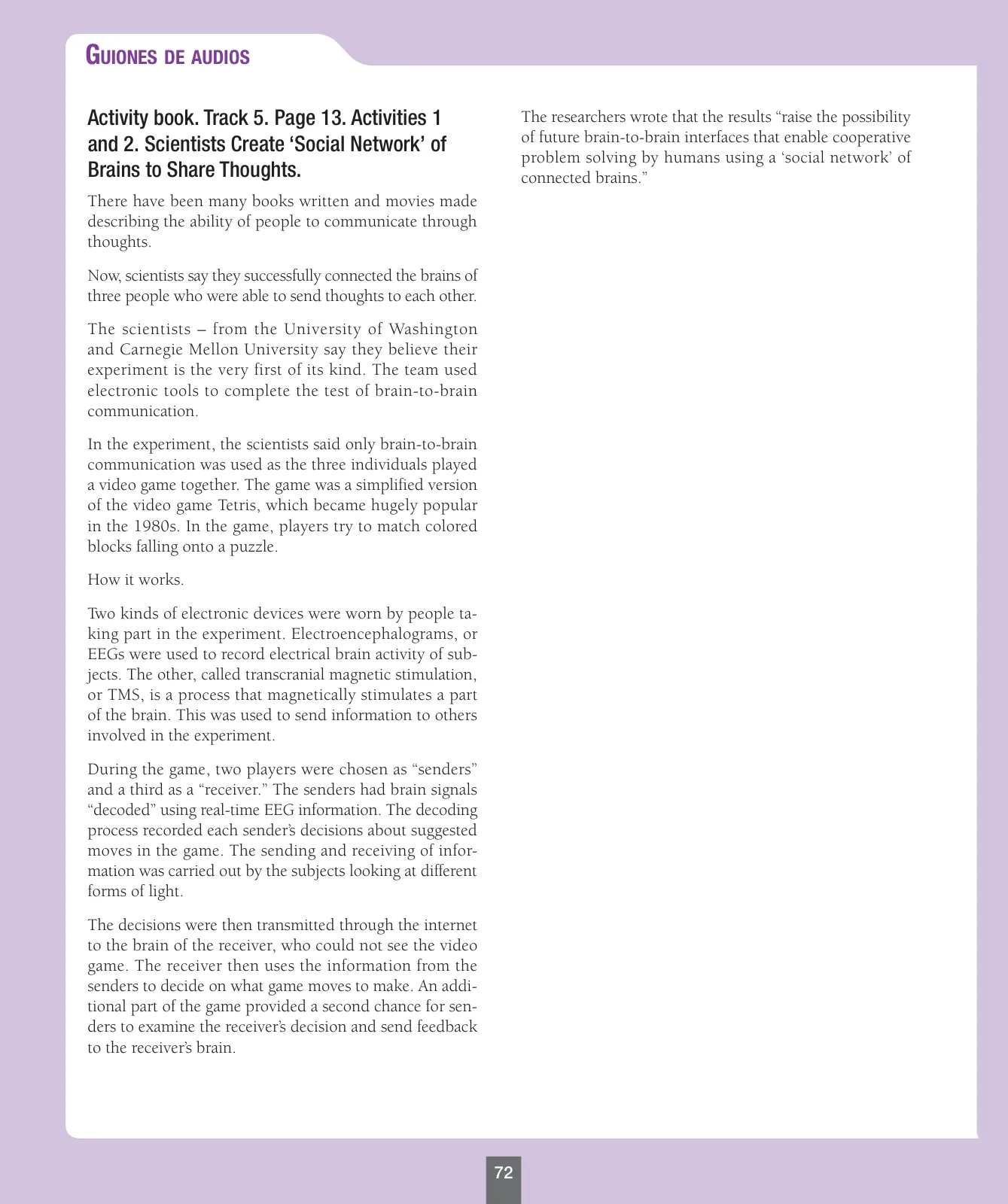
Activity book. Track 5. Page 13. Activities 1and 2. Scientists Create'Social Network' of Brains to Share Thoughts.
There have been many books written and movies made describing the ability of people to communicate through thoughts.
Now, scientists say they successfully connected the brains of three people who were able to send thoughts to each other.
The scientists — from the University of Washington and Carnegie Mellon University say they believe their experiment is the very first of its kind. The team used electronic tools to complete the test of brain-to-brain communication.
In the experiment, the scientists said only brain-to-brain communication was used as the three individuals played a video game together. The game was a simplified version of the video game Tetris, which became hugely popular in the 1980s. In the game, players try to match colored blocks falling onto a puzzle.
How it works.
Two kinds of electronic devices were worn by people taking part in the experiment. Electroencephalograms, or EEGs were used to record electrical brain activity of subjects. The other, called transcranial magnetic stimulation,or TMS, is a process that magnetically stimulates a part of the brain. This was used to send information to others involved in the experiment.
During the game, two players were chosen as "senders"and a third as a "receiver." The senders had brain signals "decoded" using real-time EEG information. The decoding process recorded each sender's decisions about suggested moves in the game. The sending and receiving of information was carried out by the subjects looking at different forms of light.
The decisions were then transmitted through the internet to the brain of the receiver, who could not see the video game. The receiver then uses the information from the senders to decide on what game moves to make. An additional part of the game provided a second chance for senders to examine the receiver's decision and send feedback to the receiver's brain.
The researchers wrote that the results "raise the possibility of future brain-to-brain interfaces that enable cooperative problem solving by humans using a 'social network' of connected brains."
GUIONES DE AUDIOS
72





Otros libros recomendados

Lengua y Literatura – Octavo Básico | Texto del Estudiante MINEDUC – Descargar PDF · 2024
MINEDUC
243 págs.

Lengua y Literatura – Octavo Básico | Texto del Estudiante MINEDUC – Descargar PDF · 2024
MINEDUC
249 págs.

Matemática – Octavo Básico | Texto del Estudiante MINEDUC – Descargar PDF · 2024
MINEDUC
155 págs.

Matemática – Octavo Básico | Texto del Estudiante MINEDUC – Descargar PDF · 2024
MINEDUC
235 págs.

Matemática – Octavo Básico | Texto del Estudiante MINEDUC – Descargar PDF · 2024
MINEDUC
211 págs.

Inglés – Octavo Básico | Student’s Book MINEDUC – Descargar PDF · 2024
MINEDUC
124 págs.

Inglés – Octavo Básico | Student’s Book MINEDUC – Descargar PDF · 2024
MINEDUC
82 págs.

Inglés – Octavo Básico | Student’s Book MINEDUC – Descargar PDF · 2024
MINEDUC
162 págs.