Saltar al contenido
MisLibrosTexto
Ad
Inglés – Sexto Básico | Activity Book MINEDUC – Descargar PDF · 2023
Libro de Inglés 6

MINEDUC

57/76

Topic Review: Pablo Picasso, past simple y sopa de letras de animales y profesiones

📄 ejercicios ingles 🎓 otro · 6° BASICA Chile 🇨🇱 CL 🗣 Español
Página 57
57 de 76
Página 57 de Inglés – Sexto Básico | Activity Book MINEDUC – Descargar PDF · 2023
Anterior Página 57 / 76 Siguiente

Respuesta rápida

  1. was, studied, created, painted, lived. 14) Las 13 palabras están en la sopa de letras. Think back: respuestas personales del estudiante.
📚 exercise ingles ⭐⭐ Dificultad 2/5 ⏱ 8 min lectura

Solución — Página 57

Inglés – Sexto Básico | Activity Book MINEDUC – Descargar PDF · 2023

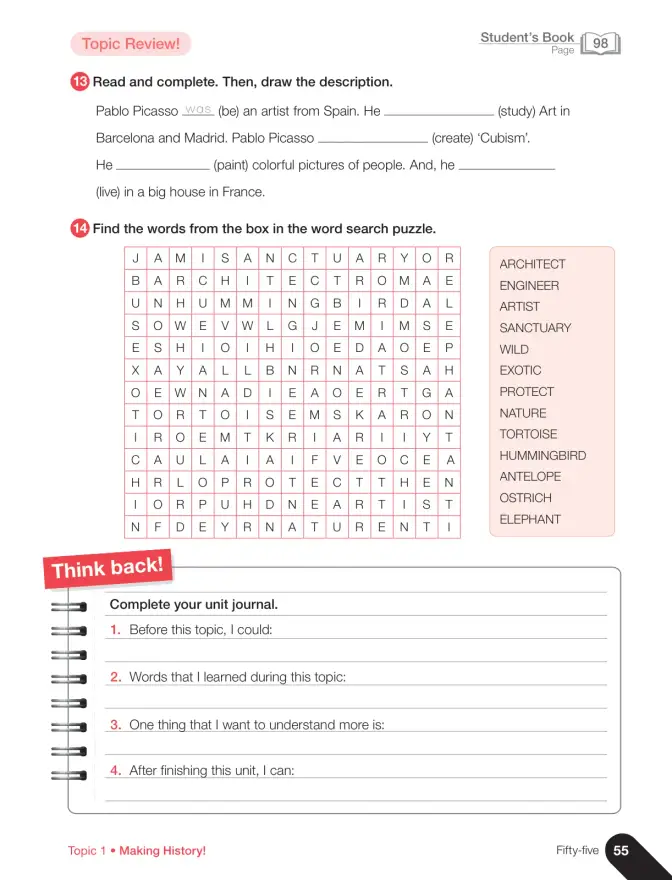
13
Ejercicio 13

Read and complete. Then, draw the description. (Lee y completa. Luego, dibuja la descripción.)

  1. Identifico que la biografía usa past simple porque habla de acciones terminadas en el pasado.
  2. Verbos regulares: agrego -ed. Verbos irregulares: uso su forma propia (be → was).
  3. Completo cada espacio:
    • Pablo Picasso was (be) an artist from Spain.
    • He studied (study) Art in Barcelona and Madrid.
    • Pablo Picasso created (create) 'Cubism'.
    • He painted (paint) colorful pictures of people.
    • And, he lived (live) in a big house in France.
  4. Para el dibujo: represento a un pintor con paleta y pincel, junto a formas geométricas (cubismo) y colores vivos.
Respuesta

was – studied – created – painted – lived.
14
Ejercicio 14

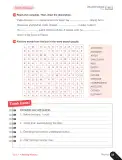
Find the words from the box in the word search puzzle. (Encuentra las palabras del recuadro en la sopa de letras.)

  1. Leo la lista: ARCHITECT, ENGINEER, ARTIST, SANCTUARY, WILD, EXOTIC, PROTECT, NATURE, TORTOISE, HUMMINGBIRD, ANTELOPE, OSTRICH, ELEPHANT.
  2. Busco cada palabra en horizontal, vertical y diagonal, en ambos sentidos.
  3. Ubicaciones encontradas en la cuadrícula:
    • ARCHITECT: fila 2, columnas 2–10 (horizontal).
    • ENGINEER: fila 3, columnas 3–10 (horizontal).
    • ARTIST: fila 12, columnas 10–15 (horizontal).
    • SANCTUARY: fila 1, columnas 5–13 (horizontal).
    • WILD: fila 4, columnas 3–6 (horizontal).
    • EXOTIC: fila 5, columnas 2–7 (horizontal).
    • PROTECT: fila 11, columnas 5–11 (horizontal).
    • NATURE: fila 13, columnas 9–14 (horizontal).
    • TORTOISE: fila 8, columnas 2–9 (horizontal).
    • HUMMINGBIRD: fila 3, columnas 3–13 (horizontal).
    • ANTELOPE: fila 6, columnas 10–17 (horizontal).
    • OSTRICH: fila 10, columnas 3–9 (horizontal).
    • ELEPHANT: fila 9, columnas 10–17 (horizontal).

Think back!

Complete your unit journal. (Completa tu diario de la unidad.)

Respuesta

Las 13 palabras están en la sopa de letras; se listan sus ubicaciones arriba.

1
Ejercicio 1

Before this topic, I could: …

Respuesta orientativa: Before this topic, I could describe people and animals using simple present and basic adjectives.

Ad
2
Ejercicio 2

Words that I learned during this topic: …

Respuesta orientativa: Words that I learned during this topic: architect, engineer, artist, sanctuary, wild, exotic, protect, nature, tortoise, hummingbird, antelope, ostrich, elephant.

3
Ejercicio 3

One thing that I want to understand more is: …

Respuesta orientativa: One thing that I want to understand more is how to use irregular verbs in the past simple correctly.

4
Ejercicio 4

After finishing this unit, I can: …

Respuesta orientativa: After finishing this unit, I can talk about famous people and animals in the past using the past simple.

Contenido de la página

Topic Review!

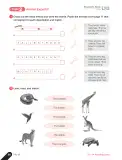
13 Read and complete. Then, draw the description.

Pablo Picasso was (be) an artist from Spain. He studied (study) Art in Barcelona and Madrid. Pablo Picasso created (create) 'Cubism'. He painted (paint) colorful pictures of people. And, he lived (live) in a big house in France.

14 Find the words from the box in the word search puzzle.

Word box: ARCHITECT, ENGINEER, ARTIST, SANCTUARY, WILD, EXOTIC, PROTECT, NATURE, TORTOISE, HUMMINGBIRD, ANTELOPE, OSTRICH, ELEPHANT.

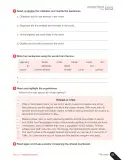
Think back!

Complete your unit journal.

  1. Before this topic, I could:
  2. Words that I learned during this topic:
  3. One thing that I want to understand more is:
  4. After finishing this unit, I can:

Ejemplos resueltos

Pablo Picasso ___ (be) an artist from Spain.

El verbo be es irregular en past simple: I/he/she/it → was. Sujeto Pablo Picasso = he → was.

He ___ (study) Art in Barcelona and Madrid.

study termina en consonante + y → se cambia la y por i y se agrega -ed: studied.

Glosario (13)

architect
arquitecto/a: persona que diseña edificios
engineer
ingeniero/a: profesional que diseña o construye máquinas y estructuras
artist
artista: persona que crea obras de arte
sanctuary
santuario: lugar protegido para animales
wild
salvaje: que vive libre en la naturaleza
exotic
exótico: extraño o proveniente de tierras lejanas
protect
proteger: cuidar de algo o alguien
nature
naturaleza: el mundo natural
tortoise
tortuga: reptil de caparazón duro
hummingbird
colibrí: ave pequeña que bate sus alas muy rápido
antelope
antílope: mamífero veloz de cuernos largos
ostrich
avestruz: ave grande que no vuela
elephant
elefante: mamífero grande con trompa

Preguntas para practicar

Before this topic, I could:

Before this topic, I could describe people and animals using simple present and basic adjectives.

Words that I learned during this topic:

Words that I learned during this topic: architect, engineer, artist, sanctuary, wild, exotic, protect, nature, tortoise, hummingbird, antelope, ostrich, elephant.

One thing that I want to understand more is:

One thing that I want to understand more is how to use irregular verbs in the past simple correctly.

After finishing this unit, I can:

After finishing this unit, I can talk about famous people and animals in the past using the past simple.

Temas y conceptos clave

Past simpleBiografía de Pablo PicassoSopa de letras de vocabularioDiario de aprendizajewas / wereverbos regulares en -edverbos irregularesvocabulario de profesionesvocabulario de animalesautoevaluación
¿Te fue útil esta página?

Preguntas que la gente también hace

¿Cómo se completa la biografía de Pablo Picasso en past simple?
Consulta la solución completa arriba o explora el libro entero para temas relacionados.
¿Dónde están las palabras de la sopa de letras de animales y profesiones?
Consulta la solución completa arriba o explora el libro entero para temas relacionados.
¿Qué verbos irregulares aparecen en la página 57 del libro de inglés?
Consulta la solución completa arriba o explora el libro entero para temas relacionados.
¿Cómo se responde el diario de aprendizaje Think back!?
Consulta la solución completa arriba o explora el libro entero para temas relacionados.
📌 Antes de leer esto
  • • Reconocer el verbo to be en pasado (was/were)
  • • Formar el past simple de verbos regulares con -ed
  • • Conocer vocabulario básico de animales y profesiones
Siguiente tema sugerido
Past simple: preguntas y negaciones (did / didn't)
📝 Transcripción de la página (texto seleccionable) 2820 caracteres

Topic Review!

13Read and complete. Then, draw the description.

Pablo Picasso was (be) an artist from Spain. He (study) Art in Barcelona and Madrid. Pablo Picasso (create)'Cubism'.

He (paint) colorful pictures of people. And, he

(live) in a big house in France.

14Find the words from the box in the word search puzzle.

Think back!

Complete your unit journal.

  1. Before this topic, I could:

  2. Words that I learned during this topic:

  3. One thing that I want to understand more is:

  4. After finishing this unit, I can:

JAM一AARYORARCHITECT ENGINEER ARTIST SANCTUARY WILD EXOTIC PROTECT NATURE TORTOISE HUMMINGBIRD ANTELOPE OSTRICH ELEPHANT
(dAUH-bRoMAE
HUMM一NGB/RDAL
WEVW√GJEM/MSE
H一O一H/OEDAOEP
ALLTdSAH
OWNADOERTGA
ToRTO一KON
一ROEMT-AR一一YT
ULAA:F√E。CEAd:
LoPRoTECTTHEN
一ORPU工DNRT/ST
DEYRTURENT一

Student's Book Page

98

Topic 1 · Making History!

Fifty-five

55

Ad

Otros libros recomendados

Ver todos →
Ad

Usamos cookies propias y de terceros para personalizar contenido, mostrar publicidad y analizar el tráfico. Las cookies necesarias siempre están activas.