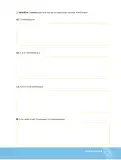

















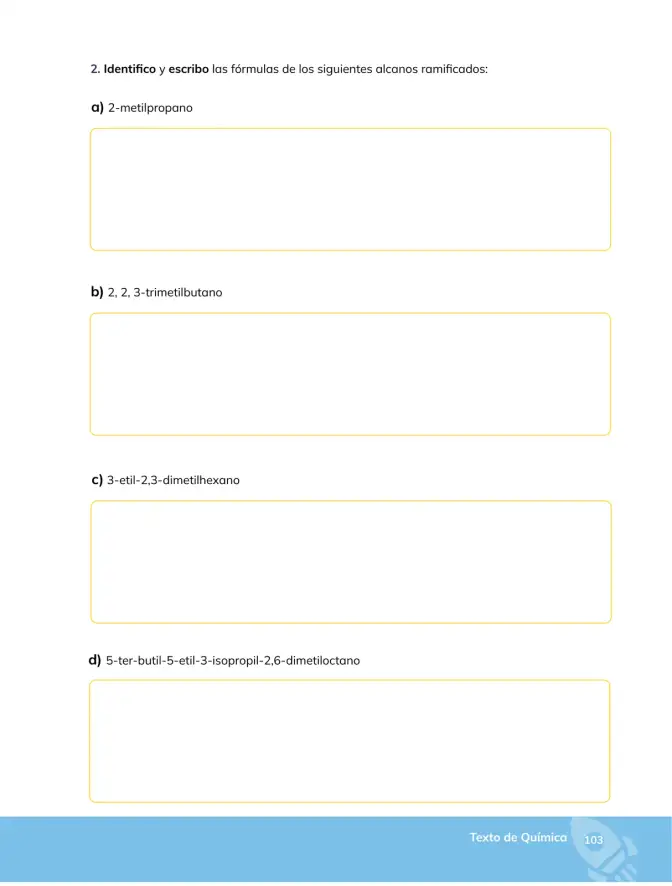
Identifico y escribo las fórmulas de los siguientes alcanos ramificados.
2-metilpropano
- La cadena principal es el propano: 3 carbonos enlazados: \text{C}-\text{C}-\text{C}.
- Sustituyente: un grupo metil (-\text{CH}_{3}) en el carbono 2: \text{CH}_{3}-\text{CH}(\text{CH}_{3})-\text{CH}_{3}.
- Se completa cada carbono con hidrógenos hasta 4 enlaces (el carbono 2 ya tiene 3 enlaces, le falta 1 H).
- Fórmula molecular: \text{C}_{4}\text{H}_{10}, coincide con la fórmula general de los alcanos \text{C}_{n}\text{H}_{2n+2} con n=4: \text{C}_{4}\text{H}_{2(4)+2}=\text{C}_{4}\text{H}_{10}.
\text{CH}_{3}-\text{CH}(\text{CH}_{3})-\text{CH}_{3}; \text{C}_{4}\text{H}_{10} (fórmula condensada completa: \text{CH}_{3}\text{CH}(\text{CH}_{3})\text{CH}_{3}).
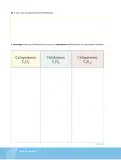
2,2,3-trimetilbutano
- Cadena principal: butano, 4 carbonos: \text{C}_{1}-\text{C}_{2}-\text{C}_{3}-\text{C}_{4}.
- Sustituyentes: dos metilos en \text{C}_{2} y un metil en \text{C}_{3}.
- Estructura: (\text{CH}_{3})_{3}\text{C}-\text{CH}(\text{CH}_{3})-\text{CH}_{3}; el \text{C}_{2} lleva tres \text{CH}_{3} (dos ramificados más la \text{C}_{1}) y no tiene hidrógeno; el \text{C}_{3} lleva un \text{CH}_{3} ramificado y un H.
- Carbonos: 4\ (\text{cadena}) + 3\ (\text{metilos}) = 7, hidrógenos: 2(7)+2 = 16.
- Comprobación: \text{C}_{7}\text{H}_{16}.
(\text{CH}_{3})_{3}\text{C}-\text{CH}(\text{CH}_{3})_{2}; \text{C}_{7}\text{H}_{16}.
3-etil-2,3-dimetilhexano
- Cadena principal: hexano, 6 carbonos: \text{C}_{1}-\text{C}_{2}-\text{C}_{3}-\text{C}_{4}-\text{C}_{5}-\text{C}_{6}.
- Sustituyentes: un metil en \text{C}_{2}, un metil y un etil en \text{C}_{3}.
- Estructura: \text{CH}_{3}-\text{CH}(\text{CH}_{3})-\text{C}(\text{CH}_{3})(\text{C}_{2}\text{H}_{5})-\text{CH}_{2}-\text{CH}_{2}-\text{CH}_{3}.
- El \text{C}_{3} está cuaternario: 4 enlaces con carbonos, sin hidrógenos; el \text{C}_{2} es terciario con un H.
- Carbonos: 6\ (\text{cadena}) + 2\ (\text{dimetil}) + 2\ (\text{etil}) = 10; hidrógenos: 2(10)+2 = 22.
- Comprobación: \text{C}_{10}\text{H}_{22}.
\text{CH}_{3}-\text{CH}(\text{CH}_{3})-\text{C}(\text{CH}_{3})(\text{C}_{2}\text{H}_{5})-\text{CH}_{2}-\text{CH}_{2}-\text{CH}_{3}; \text{C}_{10}\text{H}_{22}.
5-ter-butil-5-etil-3-isopropil-2,6-dimetiloctano
- Cadena principal: octano, 8 carbonos: \text{C}_{1}-\text{C}_{2}-\cdots-\text{C}_{8}.
- Sustituyentes: -\text{CH}_{3} en \text{C}_{2} y \text{C}_{6}; -\text{CH}(\text{CH}_{3})_{2} (isopropil) en \text{C}_{3}; -\text{C}(\text{CH}_{3})_{3} (ter-butil) y -\text{C}_{2}\text{H}_{5} (etil) en \text{C}_{5}.
- Estructura condensada:
\text{CH}_{3}-\text{CH}(\text{CH}_{3})-\text{CH}[\text{CH}(\text{CH}_{3})_{2}]-\text{CH}_{2}-\text{C}[\text{C}(\text{CH}_{3})_{3}](\text{C}_{2}\text{H}_{5})-\text{CH}(\text{CH}_{3})-\text{CH}_{2}-\text{CH}_{3}
- El \text{C}_{5} es cuaternario (4 enlaces con C, sin H).
- Carbonos totales: 8\ (\text{octano}) + 2\ (\text{2,6-dimetil}) + 3\ (\text{isopropil}) + 4\ (\text{ter-butil}) + 2\ (\text{etil}) = 19.
- Hidrógenos por la fórmula general: 2(19)+2 = 40.
- Comprobación: \text{C}_{19}\text{H}_{40}.
Resumen de fórmulas moleculares: \text{C}_{4}\text{H}_{10}, \text{C}_{7}\text{H}_{16}, \text{C}_{10}\text{H}_{22} y \text{C}_{19}\text{H}_{40} (todas cumplen \text{C}_{n}\text{H}_{2n+2}).
\text{CH}_{3}-\text{CH}(\text{CH}_{3})-\text{CH}[\text{CH}(\text{CH}_{3})_{2}]-\text{CH}_{2}-\text{C}[\text{C}(\text{CH}_{3})_{3}](\text{C}_{2}\text{H}_{5})-\text{CH}(\text{CH}_{3})-\text{CH}_{2}-\text{CH}_{3}; \text{C}_{19}\text{H}_{40}.