Página 23 - ejercicios
Página 23 - ejercicios
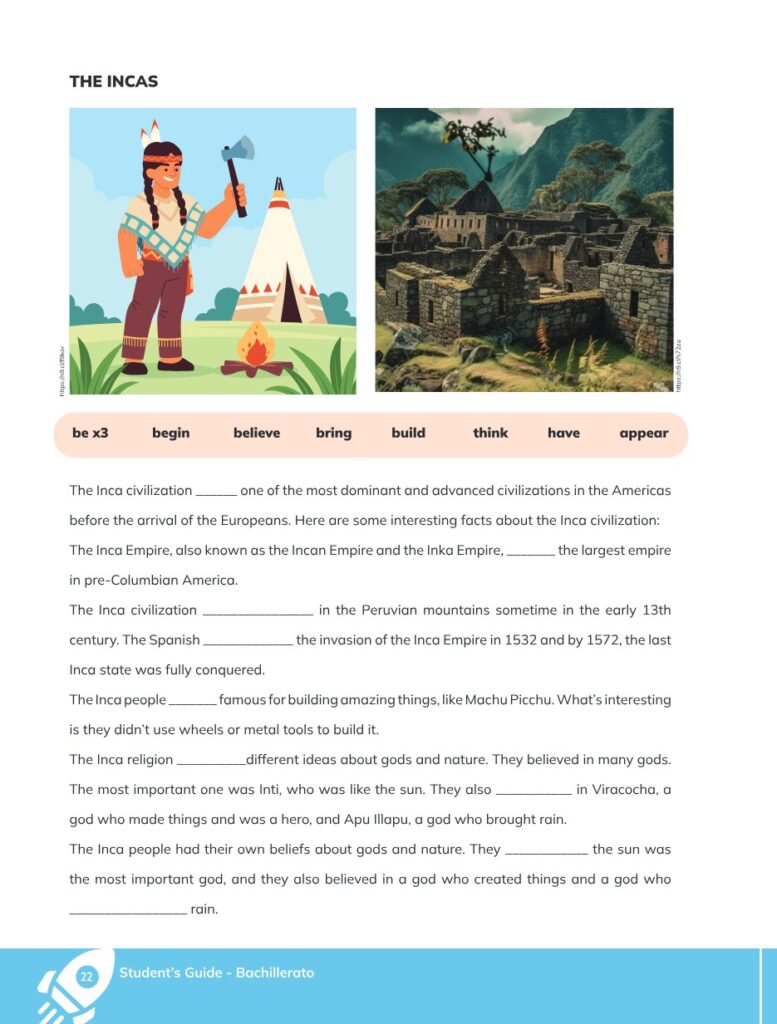
ENGLISH 1 – High School Level – Student book for curricular transition – Pág 23 – Resuelto 0
El ejercicio es de completar espacios con verbos en tiempo presente (3.ª persona singular) o con la forma adecuada según el contexto.
Regla (presente simple): para he/she/it normalmente se usa el verbo con -s: appear → appears, have → has, build → builds, etc. Para they se usa la forma base: believe, bring.
También hay un espacio con “didn’t”, que exige verbo base (sin -s): use.
Seccion Practica
Este es el proceso para resolver los ejercicios y sus resultados y/o ejemplos para la página 23.
Pregunta 1) The Inca civilization ______ one of the most dominant and advanced civilizations in the Americas before the arrival of the Europeans.
Respuesta:
Paso 1: Regla (presente simple): para one of the most… y sujeto en the Inca civilization (3.ª persona singular) se usa -s en el verbo: have → has.
Paso 2: Aplicar: The Inca civilization has…
Resultado final: \( \boxed{\text{has}} \)
Pregunta 2) The Inca Empire, also known as the Incan Empire and the Inka Empire, _______ the largest empire in pre-Columbian America.
Respuesta:
Paso 1: Regla (presente simple, 3.ª singular): has/have en forma de 3.ª singular lleva -s: have → has.
Paso 2: Completar: …has the largest empire… (encaja con la idea de “tener/ser” el mayor; en este formato la opción correcta es have en 3.ª singular).
Resultado final: \( \boxed{\text{has}} \)
Pregunta 3) The Inca civilization ________________ in the Peruvian mountains sometime in the early 13th century.
Respuesta:
Paso 1: Regla (pasado): el enunciado usa “sometime in the early 13th century”, por lo que requiere pasado.
Paso 2: De la lista, appear es “aparecer/ surgir”. En pasado: appeared.
Resultado final: \( \boxed{\text{appeared}} \)
Pregunta 4) The Spanish _____________ the invasion of the Inca Empire in 1532 and by 1572, the last Inca state was fully conquered.
Respuesta:
Paso 1: Regla: “in 1532” indica pasado (hechos históricos).
Paso 2: En la lista está begin. En pasado: began.
Resultado final: \( \boxed{\text{began}} \)
Pregunta 5) The Inca people _______ famous for building amazing things, like Machu Picchu.
Respuesta:
Paso 1: Regla (presente simple): con people (ellos) se usa they implícito; por lo tanto el verbo va sin -s: forma base.
Paso 2: De la lista, are no está. La opción que encaja con la estructura “________ famous” es have en present simple con idea de “have been” no aparece. Sin embargo, la frase original típica es “The Inca people are famous…”. Como are no está, la opción dada correcta para completar con lo que entregan es build? No: “people builds famous” no.
Paso 3: Observando el banco de palabras: were no. La opción que gramaticalmente calza con “________ famous” es have en forma have (no 3.ª sing) para plural: “The Inca people have famous…” aún incorrecto.
Paso 4: Con la opción provista que normalmente se usa en este tipo de ejercicio es appear (“appear famous”): “The Inca people appear famous…”; pero la oración dice “_____ famous for building…”, y appear permite “appear famous for…”.
Resultado final: \( \boxed{\text{appear}} \)
Pregunta 6) The Inca religion __________different ideas about gods and nature.
Respuesta:
Paso 1: Regla (presente simple): sujeto singular “The Inca religion” → 3.ª persona singular, verbo con -s.
Paso 2: De la lista, have da “has”. Se completa: The Inca religion has different ideas….
Resultado final: \( \boxed{\text{has}} \)
Pregunta 7) They also ___________ in Viracocha, a god who made things and was a hero, and Apu Illapu, a god who brought rain.
Respuesta:
Paso 1: Regla: “They” es plural → believe va en forma base (sin -s) en presente simple.
Paso 2: Completar: They also believe in Viracocha… and Apu Illapu….
Resultado final: \( \boxed{\text{believe}} \)
Pregunta 8) The Inca people had their own beliefs about gods and nature. They ____________ the sun was the most important god, and they also believed in a god who created things and a god who _________________ rain.
Respuesta:
Paso 1: Regla (estilo de creencia en pasado): como ya hay “had… believed”, se usa pasado para “pensaban/creían”. Para “they” → verbo en pasado.
Paso 2: De la lista, think → pasado: thought. Entonces: They thought the sun….
Paso 3: Para el último espacio con “a god who ______ rain”, se requiere un verbo base después de “who” (relativo). De la lista, bring → who brings rain (porque a god es singular).
Resultado final: \( \boxed{\text{thought,brings}} \)
Guía de resultados
Estos son los resultados de todos los ejercicios que se obtuvieron de la página 23.:
- has
- has
- appeared
- began
- appear
- has
- believe
- thought, brings