Saltar al contenido
MisLibrosTexto
Ad
Inglés – Quinto Básico | Texto del Estudiante MINEDUC – Descargar PDF · 2023
Libro de Inglés 5

MINEDUC

116/125

Lesson 2 CLIL – Maps, coordinates and symbols

📄 ejercicios ingles 🎓 otro · 5° BASICA Chile 🇨🇱 CL 🗣 Español
Página 116
116 de 125
Página 116 de Inglés – Quinto Básico | Texto del Estudiante MINEDUC – Descargar PDF · 2023
Anterior Página 116 / 125 Siguiente

Respuesta rápida

16: towns orange, forests green; rivers blue, roads red; nature reserve = bird; 14 elements. 17: a) A1,A4,F4 b) F1 c) B1,C6 d) A5,A6 e) B1,C4 f) A1-A3,B1-B3,E1-E3,F1-F3. 18: 1) two 2) No 3) three 4) No 5) near C3-D3 6) D2 and F5.

📚 exercise ingles ⭐⭐ Dificultad 2/5 ⏱ 12 min lectura

Solución — Página 116

Inglés – Quinto Básico | Texto del Estudiante MINEDUC – Descargar PDF · 2023

16
Ejercicio 16

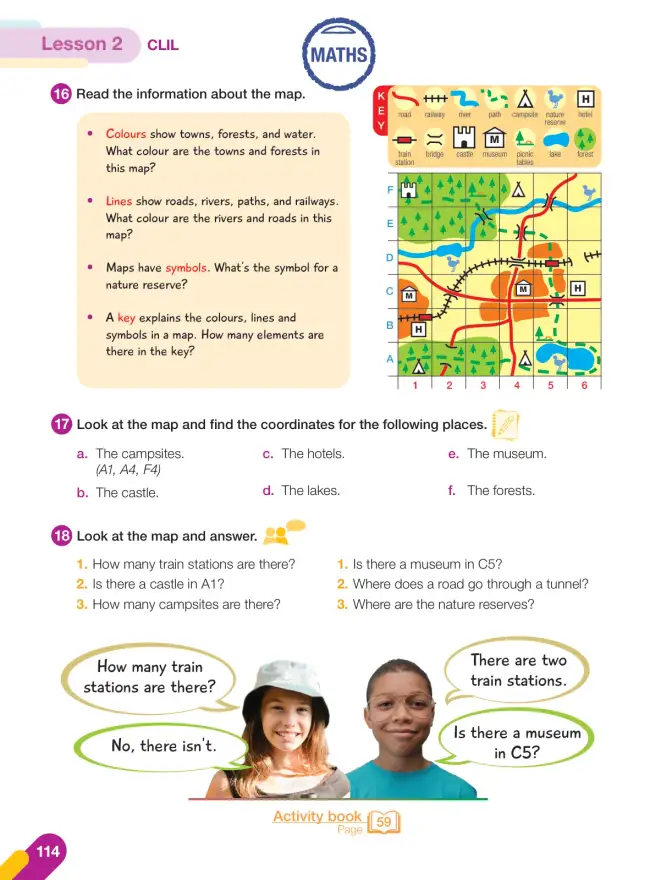
Read the information about the map.

  1. Colours: towns are orange (the built-up areas) and forests are green (the tree symbols).
  2. Lines: rivers are blue and roads are red.
  3. Symbols: the symbol for a nature reserve is a blue bird.
  4. Key: counting the elements in the key (road, railway, river, path, campsite, nature reserve, hotel, train station, bridge, castle, museum, picnic tables, lake, forest) there are 14 elements.
Respuesta

Towns = orange; forests = green. Rivers = blue; roads = red. Nature reserve = blue bird. The key has 14 elements.
17
Ejercicio 17

Look at the map and find the coordinates for the following places.

a
Parte 17.a
  1. Campsites are marked with a triangle symbol.
  2. Triangles appear at A1, A4 and F4.
Respuesta

A1, A4, F4.

b
Parte 17.b
  1. The castle symbol is a tower shape.
  2. It appears at F1.
Respuesta

F1.

c
Parte 17.c
  1. The hotel symbol is a square with the letter H.
  2. H squares appear at B1 and C6.
Respuesta

B1, C6.

d
Parte 17.d
  1. The lake symbol is a blue oval.
  2. Lakes appear at A5 and A6.
Respuesta

A5, A6.

e
Parte 17.e
  1. The museum symbol is a square with the letter M.
  2. M squares appear at B1 and C4.
Respuesta

B1, C4.

f
Parte 17.f
  1. Forests are shown with green tree symbols.
  2. Green areas cover A1, A2, A3, B1, B2, B3, E1, E2, E3, F1, F2, F3.
Respuesta

A1–A3, B1–B3, E1–E3, F1–F3.

18
Ejercicio 18

Look at the map and answer.

Ad
18
Ejercicio 18

1

  1. Train stations use the symbol of a train on a line.
  2. They appear at B1 and C6.
Respuesta

There are two train stations.

18
Ejercicio 18

2

  1. Look at cell A1.
  2. A1 contains a campsite and forest, not a castle.
Respuesta

No, there isn't.

18
Ejercicio 18

3

  1. Campsites are triangles.
  2. Triangles appear at A1, A4 and F4.
Respuesta

There are three campsites.

Ad
18
Ejercicio 18

4

  1. Look at cell C5.
  2. C5 contains a road and part of a town, not a museum.
Respuesta

No, there isn't.

18
Ejercicio 18

5

  1. A tunnel is shown where a road passes under a bridge symbol.
  2. This happens along the road near C3–D3.
Respuesta

The road goes through a tunnel near C3–D3.

18
Ejercicio 18

6

  1. Nature reserves are marked with a blue bird.
  2. Birds appear at D2 and F5.
Respuesta

The nature reserves are at D2 and F5.

Contenido de la página

Lesson 2 CLIL – MATHS

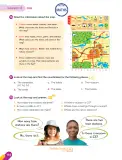
16 Read the information about the map.

  • Colours show towns, forests, and water. What colour are the towns and forests in this map?
  • Lines show roads, rivers, paths, and railways. What colour are the rivers and roads in this map?
  • Maps have symbols. What's the symbol for a nature reserve?
  • A key explains the colours, lines and symbols in a map. How many elements are there in the key?

KEY: road, railway, river, path, campsite, nature reserve, hotel, train station, bridge, castle, museum, picnic tables, lake, forest.

17 Look at the map and find the coordinates for the following places.

a. The campsites. (A1, A4, F4) b. The castle. c. The hotels. d. The lakes. e. The museum. f. The forests.

18 Look at the map and answer.

  1. How many train stations are there?
  2. Is there a castle in A1?
  3. How many campsites are there?
  4. Is there a museum in C5?
  5. Where does a road go through a tunnel?
  6. Where are the nature reserves?

Speech bubbles:

  • How many train stations are there? → There are two train stations.
  • Is there a museum in C5? → No, there isn't.

Ejemplos resueltos

How many train stations are there?

Se busca el símbolo del tren en la cuadrícula: aparece en B1 y C6. Hay 2 estaciones.

Is there a museum in C5?

Se revisa la casilla C5: contiene camino y parte del pueblo, no el símbolo M. Respuesta: No, there isn't.

Tabla

Symbol Meaning
Red line road
Blue line river
Triangle campsite
Blue bird nature reserve
H hotel
M museum
Train train station
Trees forest

Glosario (6)

key
leyenda que explica los colores, líneas y símbolos de un mapa
campsite
zona de camping, representada con un triángulo
nature reserve
reserva natural, representada con un pájaro azul
tunnel
túnel por donde pasa un camino o vía
railway
vía de tren
coordinates
par letra-número que indica una casilla en la cuadrícula

Preguntas para practicar

Why is a key important in a map?

A key is important because it explains what each colour, line and symbol means, so we can understand the map correctly.

Temas y conceptos clave

Lectura de mapasCoordenadas en cuadrículaSímbolos y leyendaThere is / There areMap keyGrid coordinatesSymbolsColours and lines on a mapNature reserveCampsite
¿Te fue útil esta página?

Preguntas que la gente también hace

¿Cómo se leen las coordenadas en un mapa de cuadrícula?
Consulta la solución completa arriba o explora el libro entero para temas relacionados.
¿Qué diferencia hay entre there is y there are?
Consulta la solución completa arriba o explora el libro entero para temas relacionados.
¿Para qué sirve la leyenda o key de un mapa?
Consulta la solución completa arriba o explora el libro entero para temas relacionados.
📌 Antes de leer esto
  • • Vocabulario básico de lugares: castle, museum, lake, forest, campsite, hotel
  • • Uso de there is / there are en inglés
  • • Lectura de coordenadas letra-número
Siguiente tema sugerido
Describir la ubicación de lugares usando preposiciones de lugar (next to, between, opposite)
📝 Transcripción de la página (texto seleccionable) 1017 caracteres

Lesson 2CLIL

Read the information about the map.

Colours show towns, forests, and water.What colour are the towns and forests in this map?

Lines show roads, rivers, paths, and railways.What colour are the rivers and roads in this map?

Maps have symbols. What's the symbol for a nature reserve?

A key explains the colours, lines and symbols in a map. How many elements are there in the key?

Look at the map and find the coordinates for the following places.

a.The campsites.(A1, A4, F4)

c. The hotels.

e. The museum.

b. The castle.

d. The lakes.

f. The forests.

Look at the map and answer.

  1. How many train stations are there?1. Is there a museum in C5?
  2. Is there a castle in A1?2. Where does a road go through a tunnel?
  3. How many campsites are there?3. Where are the nature reserves?

![](page=0,bbox=[547, 27, 683, 161])

![](page=0,bbox=[681, 153, 1094, 708])

![](page=0,bbox=[892, 742, 946, 800])

![](page=0,bbox=[477, 941, 555, 990])

![](page=0,bbox=[107, 1157, 1077, 1455])

114

Ad

Otros libros recomendados

Ver todos →
Ad

Usamos cookies propias y de terceros para personalizar contenido, mostrar publicidad y analizar el tráfico. Las cookies necesarias siempre están activas.