


















Text Types and Useful Language: Quantifiers, Opinions and Directions
Respuesta rápida
Cuantificadores: a lot of (positivo, contables y no contables), all (plurales y no contables). Opinión: I'm sure, I don't think, In my opinion, I believe, I suppose. Direcciones: Is there...? / How do I get to...? / Where is...? → Yes, there is one / You can go / There is one.
Solución — Página 81
Inglés – Octavo Básico | Student’s Book MINEDUC – Descargar PDF · 2024
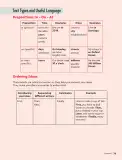
Página de teoría: Text Types and Useful Language
Esta página es un apéndice de referencia. No contiene ejercicios con enunciado numerado; su función es modelar estructuras de uso frecuente. A continuación se explica y traduce cada bloque.
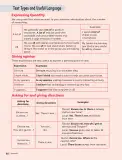
Expressing Quantity (Expresar cantidad)
Se usan quantifiers (cuantificadores) para informar sobre la cantidad de algo.
| Cuantificador | Regla de uso | Ejemplo |
|---|---|---|
| A lot of | Se usa en estructuras positivas. Acompaña sustantivos contables y no contables. Significa gran cantidad o número. | I watch a lot of videos on my smartphone. → Veo muchos videos en mi smartphone. |
| All | Se usa con sustantivos plurales contables y no contables. Se refiere a cada persona o cosa del mundo o del grupo del que se habla. | My tablet is a learning tool that is very useful for all my classes. → Mi tablet es una herramienta de aprendizaje muy útil para todas mis clases. |
Giving Opinion (Dar opinión)
Estas expresiones sirven para manifestar un punto de vista personal.
| Expresión | Ejemplo | Traducción |
|---|---|---|
| I'm sure... | I'm sure recycling is an excellent idea. | Estoy seguro de que reciclar es una excelente idea. |
| I don't think... | I don't think you need a robot to help you clean your house. | No creo que necesites un robot para ayudarte a limpiar tu casa. |
| In my opinion, ... | In my opinion, visiting museums is a very interesting activity. | En mi opinión, visitar museos es una actividad muy interesante. |
| I believe... | I believe that technology is advancing very fast. | Creo que la tecnología avanza muy rápido. |
| I suppose... | I suppose that this computer is old. | Supongo que este computador es antiguo. |
Asking for and Giving Directions (Pedir y dar direcciones)
| Pedir direcciones | Dar direcciones | Ejemplo |
|---|---|---|
| Excuse me. Is there...? | Yes. There is one... | Tourist: Excuse me. Is there a subway station near here? / Local: Yes. There is one two blocks from here. |
| Excuse me. How do I get to...? | You can... / Go... | Tourist: Excuse me. How do I get to the National Theater? / Local: You can go by taxi. It takes 10 minutes from here. |
| Excuse me. Where is...? | There is one... | Tourist: Excuse me. Where is the nearest café? / Local: There is one across from the bank. |
Respuesta orientativa: Para pedir direcciones se usa Excuse me + pregunta con Is there / How do I get to / Where is. Para responder se emplean Yes, there is one..., You can go... o There is one..., indicando distancia o referencia (two blocks from here, across from the bank).
Contenido de la página
Text Types and Useful Language
Expressing Quantity
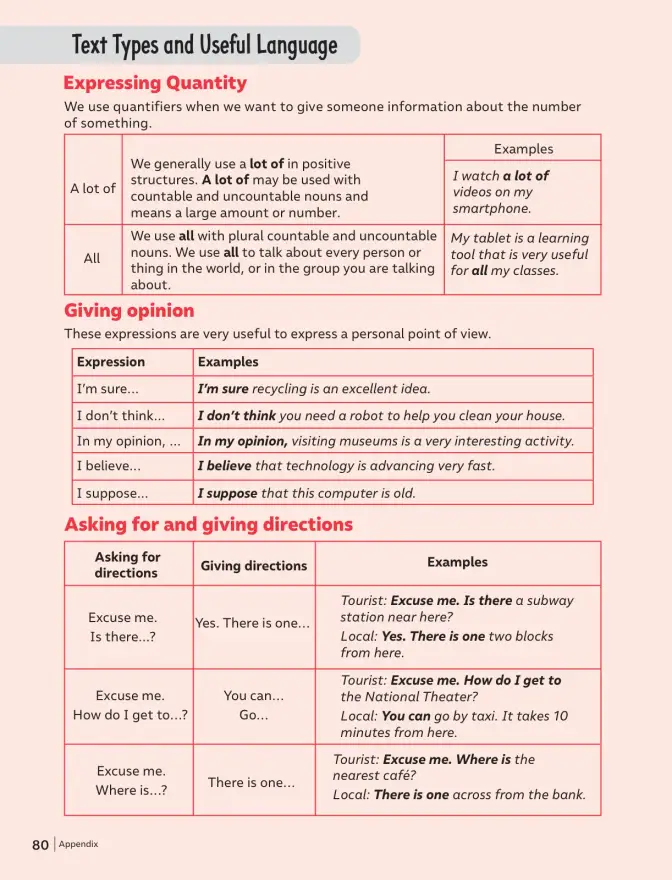
We use quantifiers when we want to give someone information about the number of something.
| Quantifier | Rule | Examples |
|---|---|---|
| A lot of | We generally use a lot of in positive structures. A lot of may be used with countable and uncountable nouns and means a large amount or number. | I watch a lot of videos on my smartphone. |
| All | We use all with plural countable and uncountable nouns. We use all to talk about every person or thing in the world, or in the group you are talking about. | My tablet is a learning tool that is very useful for all my classes. |
Giving opinion
These expressions are very useful to express a personal point of view.
| Expression | Examples |
|---|---|
| I'm sure... | I'm sure recycling is an excellent idea. |
| I don't think... | I don't think you need a robot to help you clean your house. |
| In my opinion, ... | In my opinion, visiting museums is a very interesting activity. |
| I believe... | I believe that technology is advancing very fast. |
| I suppose... | I suppose that this computer is old. |
Asking for and giving directions
| Asking for directions | Giving directions | Examples |
|---|---|---|
| Excuse me. Is there...? | Yes. There is one... | Tourist: Excuse me. Is there a subway station near here? / Local: Yes. There is one two blocks from here. |
| Excuse me. How do I get to...? | You can... / Go... | Tourist: Excuse me. How do I get to the National Theater? / Local: You can go by taxi. It takes 10 minutes from here. |
| Excuse me. Where is...? | There is one... | Tourist: Excuse me. Where is the nearest café? / Local: There is one across from the bank. |
80 | Appendix
Ejemplos resueltos
Completa con a lot of o all: I watch ___ videos on my smartphone.
El sustantivo videos es contable plural y la oración es positiva, por lo que corresponde a lot of. → I watch a lot of videos on my smartphone.
Da una opinión sobre reciclar usando I'm sure.
Se usa la estructura I'm sure + oración. → I'm sure recycling is an excellent idea.
Pide direcciones para llegar al teatro nacional y responde.
Excuse me. How do I get to the National Theater? — You can go by taxi. It takes 10 minutes from here.
Tablas (3)
| Quantifier | Rule | Examples |
|---|---|---|
| A lot of | Positive structures; countable and uncountable nouns; large amount or number | I watch a lot of videos on my smartphone. |
| All | Plural countable and uncountable nouns; every person or thing | My tablet is a learning tool that is very useful for all my classes. |
| Expression | Examples |
|---|---|
| I'm sure... | I'm sure recycling is an excellent idea. |
| I don't think... | I don't think you need a robot to help you clean your house. |
| In my opinion, ... | In my opinion, visiting museums is a very interesting activity. |
| I believe... | I believe that technology is advancing very fast. |
| I suppose... | I suppose that this computer is old. |
| Asking for directions | Giving directions | Examples |
|---|---|---|
| Excuse me. Is there...? | Yes. There is one... | Tourist: Excuse me. Is there a subway station near here? / Local: Yes. There is one two blocks from here. |
| Excuse me. How do I get to...? | You can... / Go... | Tourist: Excuse me. How do I get to the National Theater? / Local: You can go by taxi. It takes 10 minutes from here. |
| Excuse me. Where is...? | There is one... | Tourist: Excuse me. Where is the nearest café? / Local: There is one across from the bank. |
Diagrama
graph TD
  A[Useful Language] --> B[Expressing Quantity]
  A --> C[Giving Opinion]
  A --> D[Asking for and Giving Directions]
  B --> B1[A lot of: positive, countable and uncountable]
  B --> B2[All: plural countable and uncountable]
  C --> C1[I'm sure...]
  C --> C2[I don't think...]
  C --> C3[In my opinion, ...]
  C --> C4[I believe...]
  C --> C5[I suppose...]
  D --> D1[Is there...? → Yes, there is one...]
  D --> D2[How do I get to...? → You can... / Go...]
  D --> D3[Where is...? → There is one...]
Glosario (7)
- quantifier
- Palabra que indica cantidad (a lot of, all, some, any).
- countable noun
- Sustantivo que se puede contar y tiene forma plural (video/videos).
- uncountable noun
- Sustantivo que no se cuenta en unidades (information, water).
- point of view
- Punto de vista u opinión personal.
- subway station
- Estación de metro.
- block
- Cuadra o manzana de una ciudad.
- across from
- Al frente de, enfrente de.
Preguntas para practicar
¿En qué se diferencian *a lot of* y *all*?
*A lot of* indica una gran cantidad o número y se usa en oraciones positivas con sustantivos contables y no contables. *All* se refiere a la totalidad de un grupo o del mundo, y se usa con plurales contables y no contables.
¿Qué expresiones usarías para dar tu opinión sobre la tecnología?
Se pueden usar *I'm sure*, *I don't think*, *In my opinion*, *I believe* o *I suppose*, seguidas de una oración que exprese el punto de vista personal, por ejemplo: *I believe that technology is advancing very fast.*
¿Cómo pedirías y darías direcciones para llegar a una estación de metro?
Se pregunta con *Excuse me. Is there a subway station near here?* y se responde con *Yes. There is one two blocks from here.* También se puede usar *How do I get to...?* o *Where is...?*
Temas y conceptos clave
Preguntas que la gente también hace
¿Cuál es la diferencia entre a lot of y all en inglés?
¿Cómo se pide y se da direcciones en inglés?
¿Qué expresiones sirven para dar una opinión en inglés?
- • Sustantivos contables y no contables
- • Presente simple
- • Vocabulario básico de lugares de la ciudad
📝 Transcripción de la página (texto seleccionable) 2030 caracteres
Text Types and Useful Language
Expressing Quantity
We use quantifiers when we want to give someone information about the number of something.
Giving opinion
| Alot of | We generally use a lot of in positive structures. A lot of may be used with countable and uncountable nouns and means a large amount or number. | Examples I watch a lot of videos on my |
| All | We use all with plural countable and uncountable nouns. We use all to talk about every person or thing in the world, or in the group you are talking about. | smartphone. My tablet is a learning tool that is very useful for all my classes. |
These expressions are very useful to express a personal point of view.
| Expression | Examples |
| I'm sure... | I'm sure recycling is an excellent idea. |
| I don't think... | I don't think you need a robot to help you clean your house. |
| In my opinion, … | In my opinion, visiting museums is a very interesting activity. |
| I believe... | I believe that technology is advancing very fast. |
| I suppose.….. | I suppose that this computer is old. |
Asking for and giving directions
| Asking for directions | Giving directions | Examples |
| Excuse me. Is there..? | Yes. There is one... | Tourist: Excuse me. Is there a subway station near here? Local: Yes. There is one two blocks from here. |
| Excuse me. How do I get to..? | You can.... Go. | Tourist: Excuse me. How do I get to the National Theater? Local: You can go by taxi. It takes 10 minutes from here. |
| Excuse me. Where is..? | There is one... | Tourist: Excuse me. Where is the nearest café? Local: There is one across from the bank. |
80
Appendix

Otros libros recomendados

Lengua y Literatura – Octavo Básico | Texto del Estudiante MINEDUC – Descargar PDF · 2024
MINEDUC
243 págs.

Lengua y Literatura – Octavo Básico | Texto del Estudiante MINEDUC – Descargar PDF · 2024
MINEDUC
249 págs.

Matemática – Octavo Básico | Texto del Estudiante MINEDUC – Descargar PDF · 2024
MINEDUC
155 págs.

Matemática – Octavo Básico | Texto del Estudiante MINEDUC – Descargar PDF · 2024
MINEDUC
235 págs.

Matemática – Octavo Básico | Texto del Estudiante MINEDUC – Descargar PDF · 2024
MINEDUC
211 págs.

Inglés – Octavo Básico | Student’s Book MINEDUC – Descargar PDF · 2024
MINEDUC
124 págs.

Inglés – Octavo Básico | Student’s Book MINEDUC – Descargar PDF · 2024
MINEDUC
162 págs.

Inglés – Octavo Básico | Student’s Book MINEDUC – Descargar PDF · 2024
MINEDUC
162 págs.