
















Ejercicio 2
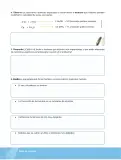
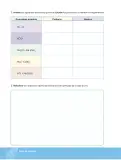
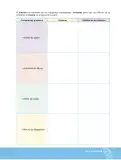
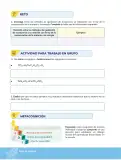
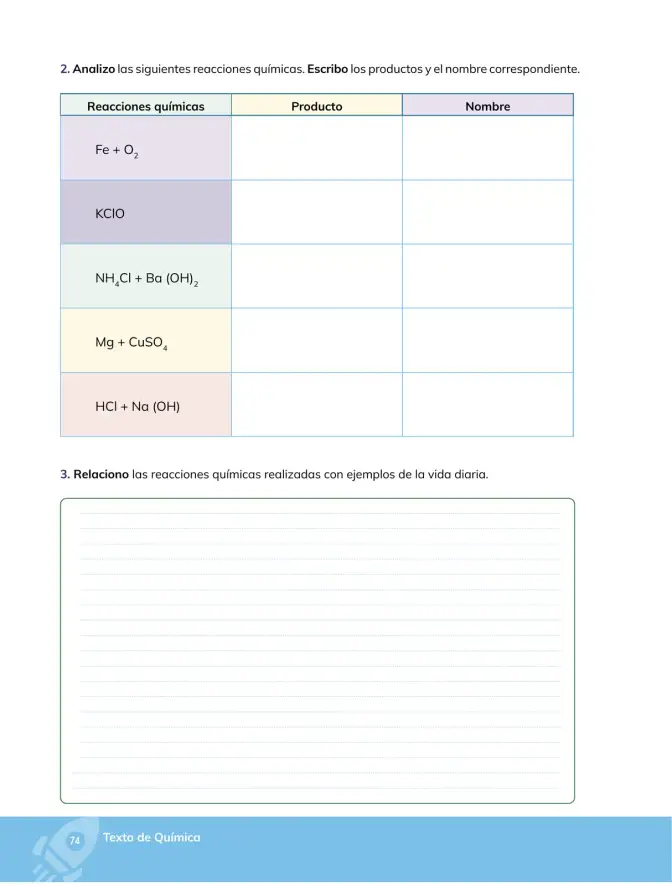
Analizo las siguientes reacciones químicas. Escribo los productos y el nombre correspondiente.
Parte 2.a
\(\mathrm{Fe} + \mathrm{O}_2\) (combinación / síntesis)
- El hierro se combina con el oxígeno gaseoso y forma un único producto sólido.
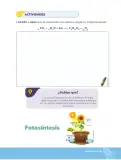
- Se balancea: se necesitan 3 átomos de Fe y 4 átomos de O (dos moléculas de (\mathrm{O}_2)): 3\,\mathrm{Fe} + 2\,\mathrm{O}_2 \rightarrow \mathrm{Fe}_3\mathrm{O}_4
- (\mathrm{Fe}_3\mathrm{O}_4) es un óxido mixto de hierro (estado de oxidación +2 y +3).
Respuesta
Producto: (\mathrm{Fe}_3\mathrm{O}_4). Nombre: óxido de hierro(II,III) u óxido magnético.
Parte 2.b
\(\mathrm{KClO}\) (hipoclorito de potasio, descomposición)
- El hipoclorito de potasio se descompone en cloruro de potasio y oxígeno.
- Balance: 2 unidades de (\mathrm{KClO}) liberan 2 de (\mathrm{KCl}) y una molécula (\mathrm{O}_2): 2\,\mathrm{KClO} \rightarrow 2\,\mathrm{KCl} + \mathrm{O}_2
- (Nota: si el reactivo fuera clorato, (\mathrm{KClO}_3), la reacción sería \(2\,\mathrm{KClO}_3 \rightarrow 2\,\mathrm{KCl} + 3\,\mathrm{O}_2).)
Respuesta
Productos: (\mathrm{KCl} + \mathrm{O}_2). Nombres: cloruro de potasio y oxígeno.
Parte 2.c
\(\mathrm{NH_4Cl} + \mathrm{Ba(OH)_2}\) (doble descomposición / metátesis)
- Los iones se intercambian: (\mathrm{Ba^{2+}}) con (\mathrm{Cl^-}) y (\mathrm{NH_4^+}) con (\mathrm{OH^-}).
- (\mathrm{BaCl_2}) permanece en solución; el hidróxido de amonio formado es inestable y se descompone en amoníaco y agua.
- Reacción balanceada: 2\,\mathrm{NH_4Cl} + \mathrm{Ba(OH)_2} \rightarrow \mathrm{BaCl_2} + 2\,\mathrm{NH_3}\uparrow + 2\,\mathrm{H_2O}
Respuesta
Productos: (\mathrm{BaCl_2} + \mathrm{NH_3} + \mathrm{H_2O}). Nombres: cloruro de bario, amoníaco y agua.
Parte 2.d
\(\mathrm{Mg} + \mathrm{CuSO_4}\) (desplazamiento simple)
- El magnesio es más reactivo que el cobre, por lo que lo desplaza de su solución.
- Reacción balanceada ya de por sí (1:1): \mathrm{Mg} + \mathrm{CuSO_4} \rightarrow \mathrm{MgSO_4} + \mathrm{Cu}
- Se observa cobre metálico depositado y la solución pierde su color azul.
Respuesta
Productos: (\mathrm{MgSO_4} + \mathrm{Cu}). Nombres: sulfato de magnesio y cobre.
Parte 2.e
\(\mathrm{HCl} + \mathrm{Na(OH)}\) (neutralización)
- Ácido más base: el (\mathrm{H^+}) del ácido se une al (\mathrm{OH^-}) de la base.
- Reacción balanceada: \mathrm{HCl} + \mathrm{NaOH} \rightarrow \mathrm{NaCl} + \mathrm{H_2O}
- Producto de sal: cloruro de sodio (sal de mesa) y agua.
| Reacción química | Reacción balanceada | Productos | Nombre |
|---|---|---|---|
| (\mathrm{Fe} + \mathrm{O_2}) | \(3\,\mathrm{Fe} + 2\,\mathrm{O_2} \rightarrow \mathrm{Fe_3O_4}) | (\mathrm{Fe_3O_4}) | Óxido de hierro(II,III) |
| (\mathrm{KClO}) | \(2\,\mathrm{KClO} \rightarrow 2\,\mathrm{KCl} + \mathrm{O_2}) | (\mathrm{KCl} + \mathrm{O_2}) | Cloruro de potasio y oxígeno |
| (\mathrm{NH_4Cl} + \mathrm{Ba(OH)_2}) | \(2\,\mathrm{NH_4Cl} + \mathrm{Ba(OH)_2} \rightarrow \mathrm{BaCl_2} + 2\,\mathrm{NH_3} + 2\,\mathrm{H_2O}) | (\mathrm{BaCl_2} + \mathrm{NH_3} + \mathrm{H_2O}) | Cloruro de bario, amoníaco y agua |
| (\mathrm{Mg} + \mathrm{CuSO_4}) | (\mathrm{Mg} + \mathrm{CuSO_4} \rightarrow \mathrm{MgSO_4} + \mathrm{Cu}) | (\mathrm{MgSO_4} + \mathrm{Cu}) | Sulfato de magnesio y cobre |
| (\mathrm{HCl} + \mathrm{Na(OH)}) | (\mathrm{HCl} + \mathrm{NaOH} \rightarrow \mathrm{NaCl} + \mathrm{H_2O}) | (\mathrm{NaCl} + \mathrm{H_2O}) | Cloruro de sodio y agua |
Respuesta
Productos: (\mathrm{NaCl} + \mathrm{H_2O}). Nombres: cloruro de sodio y agua.