Saltar al contenido
MisLibrosTexto
Ad
Ingles 7° · 2024
Libro de Inglés 7 EGB

Ministerio de Educación del Ecuador

20/50

The Emperor Penguin: lectura y actividades de Verdadero o Falso

📄 ejercicios ingles 🎓 primaria · 7° EGB Ecuador 🇪🇨 EC 🗣 Español
Página 20
20 de 50
Página 20 de Ingles 7° · 2024
Anterior Página 20 / 50 Siguiente

Respuesta rápida

  1. True, 2. True, 3. True, 4. False, 5. False, 6. True, 7. False, 8. True.
📚 exercise ingles ⭐ Dificultad 1/5 ⏱ 8 min lectura

Solución — Página 20

Ingles 7° · 2024

1
Ejercicio 1

Comprensión lectora: The Emperor Penguin

Resumen del texto (traducción orientativa): Los pingüinos emperador son pingüinos especiales que viven en la muy fría Antártida. Son los pingüinos más grandes, casi tan altos como un niño de seis años. Ponen un solo huevo y el papá se queda con el huevo manteniéndolo caliente mientras la mamá busca comida en el mar. Tienen muchas plumas y grasa para mantenerse calientes y se juntan en grandes grupos. Están en peligro por el cambio climático, que hace desaparecer su hogar y su comida. Además, son grandes nadadores y usan llamadas especiales para comunicarse.

READ THE INFORMATION AND CHOOSE TRUE OR FALSE

1
Ejercicio 1

Habitats are places where animals and plants live and provide everything they need to survive.

  1. Un hábitat es el lugar donde viven los seres vivos y les ofrece todo lo que necesitan para sobrevivir (alimento, agua, refugio).
  2. Esta es la definición estándar de hábitat, consistente con la información de la página.
Respuesta

True** (Verdadero)

2
Ejercicio 2

Habitats can be found in various natural environments like forests and deserts.

  1. Los hábitats existen en distintos entornos naturales.
  2. Ejemplos comunes: bosques, desiertos, océanos, tundra antártica (el hábitat del pingüino emperador).
Respuesta

True** (Verdadero)

Ad
3
Ejercicio 3

A habitat includes living and non-living things.

  1. Un hábitat incluye factores bióticos (seres vivos: plantas, animales) y abióticos (no vivos: agua, roca, temperatura, hielo).
  2. En la Antártida, el hielo y el mar (no vivos) y los pingüinos (vivos) forman parte del hábitat.
Respuesta

True** (Verdadero)

4
Ejercicio 4

Emperor penguins are the smallest of all penguin species.

  1. El texto dice: "They are the biggest penguins, almost as tall as a six-year-old".
  2. "Biggest" (más grandes) se opone a "smallest" (más pequeños).
Respuesta

False** (Falso)

5
Ejercicio 5

Emperor penguins lay more than one egg each winter.

  1. El texto dice: "They lay one egg" (ponen un solo huevo).
  2. "One egg" contradice "more than one egg" (más de un huevo).
Respuesta

False** (Falso)

Ad
6
Ejercicio 6

Emperor penguins huddle together to stay warm in the cold Antarctic winter.

  1. El texto dice: "They stay close together in a big group to stay warm" (se quedan juntos en un gran grupo para mantenerse calientes).
  2. "Stay close together" = se abrigan juntos (huddle), acción típica en el invierno antártico.
Respuesta

True** (Verdadero)

7
Ejercicio 7

Emperor penguins are not affected by climate change.

  1. El texto dice: "these penguins are in danger because of climate change" (están en peligro por el cambio climático).
  2. "In danger because of" contradice "not affected by" (no se ven afectados por).
Respuesta

False** (Falso)

8
Ejercicio 8

Emperor penguins use special calls to communicate with each other.

  1. El texto dice: "They have special calls to talk to each other" (tienen llamadas especiales para comunicarse entre sí).
  2. "Special calls to talk to each other" = se comunican mediante llamadas especiales.
Respuesta

True** (Verdadero)

Contenido de la página

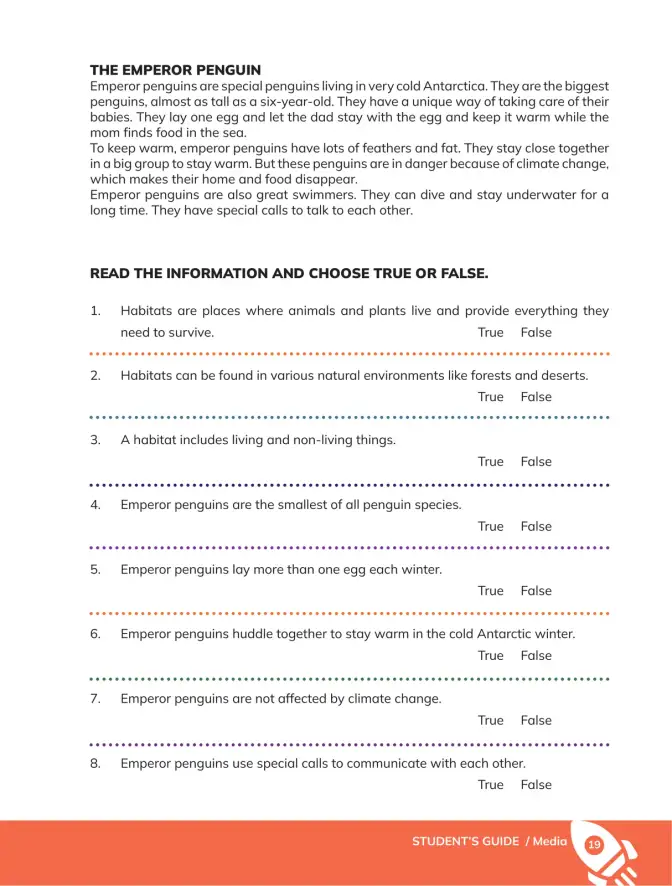
THE EMPEROR PENGUIN

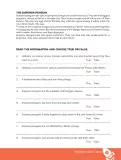
Emperor penguins are special penguins living in very cold Antarctica. They are the biggest penguins, almost as tall as a six-year-old. They have a unique way of taking care of their babies. They lay one egg and let the dad stay with the egg and keep it warm while the mom finds food in the sea.

To keep warm, emperor penguins have lots of feathers and fat. They stay close together in a big group to stay warm. But these penguins are in danger because of climate change, which makes their home and food disappear.

Emperor penguins are also great swimmers. They can dive and stay underwater for a long time. They have special calls to talk to each other.

READ THE INFORMATION AND CHOOSE TRUE OR FALSE.

  1. Habitats are places where animals and plants live and provide everything they need to survive. — True / False
  2. Habitats can be found in various natural environments like forests and deserts. — True / False
  3. A habitat includes living and non-living things. — True / False
  4. Emperor penguins are the smallest of all penguin species. — True / False
  5. Emperor penguins lay more than one egg each winter. — True / False
  6. Emperor penguins huddle together to stay warm in the cold Antarctic winter. — True / False
  7. Emperor penguins are not affected by climate change. — True / False
  8. Emperor penguins use special calls to communicate with each other. — True / False

Traducción orientativa del texto: Los pingüinos emperador son pingüinos especiales que viven en la muy fría Antártida. Son los pingüinos más grandes, casi tan altos como un niño de seis años. Tienen una forma única de cuidar a sus crías: ponen un solo huevo y el papá se queda con el huevo manteniéndolo caliente mientras la mamá busca comida en el mar. Para mantenerse calientes tienen muchas plumas y mucha grasa, y se quedan juntos en un gran grupo. Pero estos pingüinos están en peligro por el cambio climático, que hace desaparecer su hogar y su comida. Además, son grandes nadadores: pueden sumergirse y permanecer bajo el agua mucho tiempo, y tienen llamadas especiales para comunicarse entre sí.

Ejemplos resueltos

Ejemplo de True/False basado en el texto: "Emperor penguins live in Antarctica." (Los pingüinos emperador viven en la Antártida.)

  1. El texto indica: "Emperor penguins are special penguins living in very cold Antarctica".
  2. La afirmación coincide con la información del texto.

Respuesta: True.

Tabla

Enunciado Respuesta (True/False) Justificación breve
1. Habitats provide everything animals need to survive. True Definición estándar de hábitat.
2. Habitats are found in forests, deserts, etc. True Diversidad de entornos naturales.
3. A habitat includes living and non-living things. True Incluye factores bióticos y abióticos.
4. Emperor penguins are the smallest penguins. False Son los más grandes (biggest).
5. They lay more than one egg each winter. False Ponen un solo huevo (one egg).
6. They huddle together to stay warm. True Se agrupan para mantener el calor.
7. They are not affected by climate change. False Están en peligro por el cambio climático.
8. They use special calls to communicate. True Tienen llamadas especiales para hablar entre sí.

Diagrama

mindmap
  root((The Emperor
  Penguin))
    Habitat
      Antarctica
      Very cold
      Living things
      Non-living things (ice, sea)
    Appearance
      Biggest penguin
      Tall as a 6-year-old
      Feathers and fat
    Reproduction
      Lays one egg
      Dad keeps egg warm
      Mom finds food at sea
    Survival strategies
      Huddle together
      Great swimmers / divers
      Special calls to communicate
    Threat
      Climate change
      Home and food disappear

Glosario (8)

Emperor penguin
Pingüino emperador; la especie de pingüino más grande, que vive en la Antártida.
Antarctica
Antártida; continente muy frío del polo sur, hábitat del pingüino emperador.
Habitat
Hábitat; lugar natural donde viven los seres vivos y que les ofrece todo lo que necesitan para sobrevivir.
Climate change
Cambio climático; alteración del clima global que amenaza el hogar y el alimento de muchas especies.
Feathers
Plumas; cubierta corporal de las aves que ayuda a mantener el calor.
To huddle
Abrigarse / juntarse; quedarse muy cerca de otros individuos para conservar el calor.
Non-living things
Cosas no vivas; elementos abióticos del hábitat como el agua, el hielo o las rocas.
To dive
Sumergirse; meterse en el agua y nadar bajo la superficie.

Preguntas para practicar

Why are emperor penguins in danger? (¿Por qué están en peligro los pingüinos emperador?)

Emperor penguins are in danger because of climate change, which makes their home and food disappear. Global warming melts the ice in Antarctica, so they lose their habitat and the fish they eat. Protecting the environment is essential to save this species.

How do emperor penguins take care of their babies? (¿Cómo cuidan a sus crías los pingüinos emperador?)

The mother lays one egg and then goes to the sea to find food. The father stays with the egg and keeps it warm with his body until the baby is born. It is a unique way of taking care of their babies.

What is a habitat? Give examples. (¿Qué es un hábitat? Da ejemplos.)

A habitat is the natural place where animals and plants live and find everything they need to survive. It includes living things (plants, animals) and non-living things (water, rocks, ice). Examples are forests, deserts, oceans and the Antarctic ice.

What can we do to help animals that are in danger because of climate change? (¿Qué podemos hacer para ayudar a los animales en peligro por el cambio climático?)

We can reduce pollution, save energy, recycle, and plant trees. Also, we can learn about endangered species and share this information. Small daily actions help reduce climate change and protect habitats like Antarctica.

Temas y conceptos clave

Lectura comprensiva en inglés: The Emperor PenguinHábitat: definición y componentesEspecies en peligro y cambio climáticoActividad Verdadero/Falso (True/False)habitatemperor penguinAntarcticaclimate changetrue/false comprehensionliving and non-living things
¿Te fue útil esta página?

Preguntas que la gente también hace

¿Qué es un hábitat y qué incluye?
Consulta la solución completa arriba o explora el libro entero para temas relacionados.
¿Por qué los pingüinos emperador están en peligro?
Consulta la solución completa arriba o explora el libro entero para temas relacionados.
¿Cómo se comunican los pingüinos emperador entre sí?
Consulta la solución completa arriba o explora el libro entero para temas relacionados.
📌 Antes de leer esto
  • • Vocabulario básico en inglés sobre animales y naturaleza (penguin, cold, egg, sea, feathers, fat)
  • • Comprensión de oraciones simples en presente simple
  • • Concepto de hábitat en ciencias naturales
Siguiente tema sugerido
Vocabulario sobre animales en peligro de extinción y actividades de escritura (describir un animal usando adjetivos en inglés).
📝 Transcripción de la página (texto seleccionable) 1404 caracteres

THE EMPEROR PENGUIN

Emperor penguins are special penguins living in very cold Antarctica. They are the biggest penguins, almost as tall as a six-year-old. They have a unique way of taking care of their babies. They lay one egg and let the dad stay with the egg and keep it warm while the mom finds food in the sea.

To keep warm, emperor penguins have lots of feathers and fat. They stay close together in a big group to stay warm. But these penguins are in danger because of climate change, which makes their home and food disappear.

Emperor penguins are also great swimmers. They can dive and stay underwater for a long time. They have special calls to talk to each other.

READ THE INFORMATION AND CHOOSE TRUE OR FALSE.

  1. Habitats are places where animals and plants live and provide everything they need to survive. True False

  2. Habitats can be found in various natural environments like forests and deserts. True False

  3. A habitat includes living and non-living things. True False

  4. Emperor penguins are the smallest of all penguin species. True False

  5. | Emperor penguins lay more than one egg each winter. True False

  6. Emperor penguins huddle together to stay warm in the cold Antarctic winter. True False

  7. _ Emperor penguins are not affected by climate change. True False

  8. Emperor penguins use special calls to communicate with each other.

True False

STUDENT’S GUIDE / Media

Ad

Otros libros recomendados

Ver todos →
Ad

Usamos cookies propias y de terceros para personalizar contenido, mostrar publicidad y analizar el tráfico. Las cookies necesarias siempre están activas.