















Saltar al contenido
MisLibrosTexto
Ad
Ingles 7° · 2024
Libro de Inglés 7 EGB

Ministerio de Educación del Ecuador

8/50

Written Means of Communication: A Letter and Its Parts

📄 teoria ingles 🎓 primaria · 7° EGB Ecuador 🇪🇨 EC 🗣 Español
Página 8
8 de 50
Página 8 de Ingles 7° · 2024
Anterior Página 8 / 50 Siguiente

Respuesta rápida

  1. a) Sí, envío e-mails. b) Sí, entiendo los gestos. c) Sí, entiendo los emojis. d) Sí, escucho atentamente. 2. Carta modelo con fecha, destinatario, introducción, cuerpo, cierre y firma. 3. Partes: Date, Name, Address, Introduction, Body, Closing, Sincerely, Signature.
📚 theory ingles ⭐⭐ Dificultad 2/5 ⏱ 7 min lectura

Solución — Página 8

Ingles 7° · 2024

1
Ejercicio 1

(SPEAKING - Preguntas de conversación)

Enunciado: Responde en grupo pequeñas a estas preguntas sobre tu forma de comunicarte.

a
Parte 1.a

Enunciado: Do you send letters or e-mails to your family or friends? Respuesta orientativa: Yes, I sometimes send e-mails to my family because they live in another city. It's easier than calling because I can include photos.

b
Parte 1.b

Enunciado: Can you see what people want to say with their gestures? Respuesta orientativa: Yes, I can. For example, when someone smiles or waves, I know they are happy or saying hello, even if they don't say anything.

c
Parte 1.c

Enunciado: Do you understand drawings or emojis instead of words? Respuesta orientativa: Yes, most of the time. Emojis like a smiley face or a heart help me understand the feeling behind the message.

d
Parte 1.d

Enunciado: Do you listen attentively when people talk to you? Respuesta orientativa: Yes, I try to listen attentively. I look at the person's eyes, don't interrupt, and ask questions when I don't understand.
2
Ejercicio 2

(WRITE A SHORT LETTER TO YOUR BEST FRIEND)

Enunciado: Escribe una carta corta a tu mejor amigo siguiendo las partes de una carta y usando oraciones cortas y vocabulario conocido.

  1. Primero, identifica las partes de la carta usando el diagrama: la fecha arriba a la derecha, la dirección del destinatario debajo, la introducción (saludo), el cuerpo (mensaje principal), el cierre (despedida) y la firma.
  2. Escribe la introducción: saluda a tu amigo, por ejemplo: "Dear Carlos, How are you? I hope you are doing well."
  3. Escribe el cuerpo: cuenta algo sobre ti, sobre tu escuela o un plan, con oraciones cortas: "Last week I went to the park with my family. It was fun! We played soccer and ate ice cream."
  4. Escribe el cierre: pide una respuesta, por ejemplo: "Please write back soon. I want to know about your trip."
  5. Cierra con una despedida y tu firma: "Sincerely, Your friend Ana."
  6. Finalmente, dobla la carta, ponla en un sobre, pega un sello y envíala por correo.

Respuesta (modelo de carta corta):

Date: May 20, 2024 Mr./Ms./Mrs. Carlos M. Address: Av. 10 de Agosto N34-40, Quito

Dear Carlos, How are you? I hope you are doing well.

Last week I went to the park with my family. It was fun! We played soccer and ate ice cream. Also, I am studying English now, and I like it. What about you? Do you like your new school?

Please write back soon. I want to know about your trip.

Sincerely, Your friend, Ana


3
Ejercicio 3

(PARTS OF A LETTER)

Enunciado: Identifica cada parte de la carta en el diagrama.

  1. En la parte superior derecha aparece la Date (fecha): escribe el día, mes y año en que se escribe la carta.
  2. Debajo a la izquierda aparece la dirección del destinatario: Mr./Ms./Mrs. + Name (nombre) + Address (dirección).
  3. El primer bloque punteado se llama Introduction (introducción): es donde se saluda y se presenta el tema.
  4. El bloque central, marcado como Body (cuerpo), es el mensaje principal de la carta: allí se cuentan las ideas y noticias.
  5. El bloque siguiente, marcado como Closing (cierre), se usa para despedirse y pedir una respuesta.
  6. Al final aparecen Sincerely (despedida formal) y Signature (firma): se firma con el nombre del remitente.
Respuesta

Las partes de una carta, en orden, son: Date, Name/Address del destinatario, Introduction, Body, Closing, Sincerely y Signature.

Contenido de la página

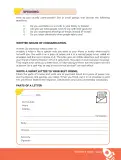
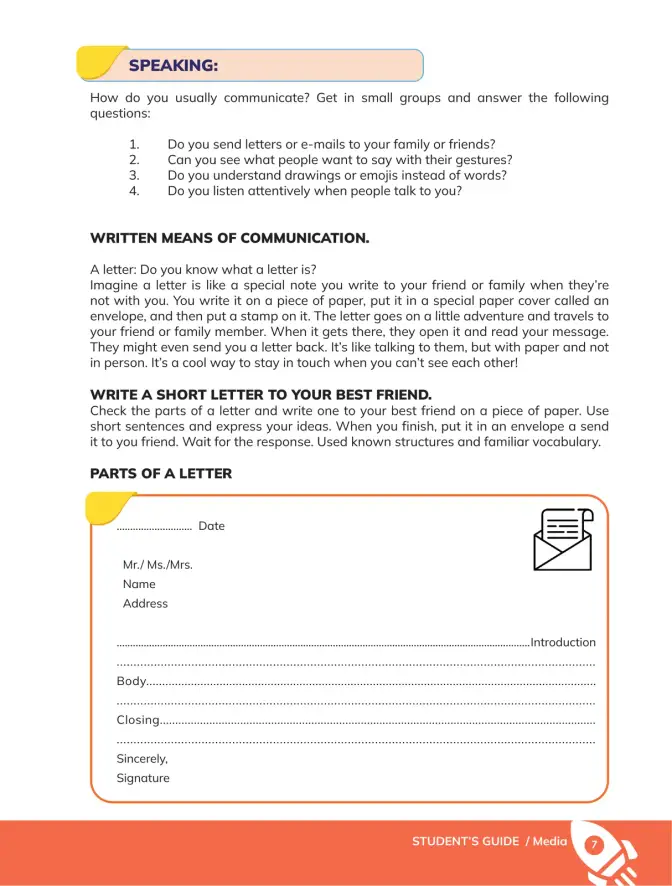
SPEAKING:

How do you usually communicate? Get in small groups and answer the following questions:

  1. Do you send letters or e-mails to your family or friends?
  2. Can you see what people want to say with their gestures?
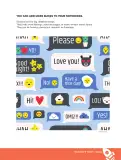
  3. Do you understand drawings or emojis instead of words?
  4. Do you listen attentively when people talk to you?

WRITTEN MEANS OF COMMUNICATION.

A letter: Do you know what a letter is?

Imagine a letter is like a special note you write to your friend or family when they're not with you. You write it on a piece of paper, put it in a special paper cover called an envelope, and then put a stamp on it. The letter goes on a little adventure and travels to your friend or family member. When it gets there, they open it and read your message. They might even send you a letter back. It's like talking to them, but with paper and not in person. It's a cool way to stay in touch when you can't see each other!

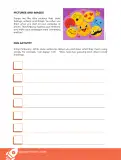
WRITE A SHORT LETTER TO YOUR BEST FRIEND.

Check the parts of a letter and write one to your best friend on a piece of paper. Use short sentences and express your ideas. When you finish, put it in an envelope and send it to your friend. Wait for the response. Use known structures and familiar vocabulary.

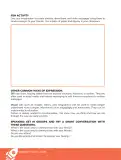
PARTS OF A LETTER

  • ........................... Date
  • Mr./Ms./Mrs.
  • Name
  • Address
  • ........................Introduction
  • Body........................
  • Closing....................
  • Sincerely,
  • Signature

STUDENT'S GUIDE / Media - Page 7

Ejemplos resueltos

Partes de una carta (modelo): escribe una carta corta a un amigo siguiendo la estructura.

Date: May 20, 2024
Mr./Ms./Mrs.: Carlos M.
Address: Av. 10 de Agosto N34-40, Quito

Dear Carlos,
How are you? I hope you are doing well.

Last week I went to the park with my family. It was fun! We played soccer and ate ice cream.

Please write back soon. I want to know about your trip.

Sincerely,
Ana

Tabla

Part of a letter Function
Date Shows the day, month and year the letter was written
Name / Address Identifies the person who will receive the letter
Introduction Greets the reader and introduces the topic
Body Main message: ideas, news and feelings
| Closing | Says goodbye and asks for a reply |

| Sincerely / Signature | Formal sign-off and the writer's name |

Diagrama

flowchart TD
  A[Date: May 20, 2024] --> B[Mr./Ms./Mrs. Carlos M. - Address: Quito]
  B --> C[Introduction: Dear Carlos, How are you?]
  C --> D[Body: Last week I went to the park...]
  D --> E[Closing: Please write back soon.]
  E --> F[Sincerely, Signature: Ana]

Glosario (8)

Letter
Un mensaje escrito en papel que se envía a otra persona.
Envelope
Sobre de papel donde se guarda la carta antes de enviarla.
Stamp
Sello que se pega en el sobre para pagar el envío postal.
Introduction
Primera parte de la carta donde se saluda y se presenta el tema.
Body
Cuerpo de la carta: el mensaje principal con las ideas y noticias.
Closing
Cierre de la carta, donde se despide y se pide una respuesta.
Signature
Firma del remitente al final de la carta.
Date
Fecha (día, mes y año) en que se escribe la carta.

Preguntas para practicar

Do you send letters or e-mails to your family or friends?

Yes, I sometimes send e-mails to my family because they live in another city. It's easier than calling because I can include photos.

Can you see what people want to say with their gestures?

Yes, I can. For example, when someone smiles or waves, I know they are happy or saying hello, even if they don't say anything.

Do you understand drawings or emojis instead of words?

Yes, most of the time. Emojis like a smiley face or a heart help me understand the feeling behind the message.

Do you listen attentively when people talk to you?

Yes, I try to listen attentively. I look at the person's eyes, don't interrupt, and ask questions when I don't understand.
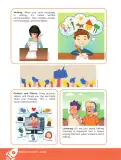
Write a short letter to your best friend using the parts of a letter.

Ver modelo de carta en la solución: Dear Carlos, How are you? ... Please write back soon. Sincerely, Ana.

Temas y conceptos clave

SPEAKING - How do you communicate?Written means of communicationA letterParts of a letterWriting a short letterLetterEnvelopeStampIntroductionBodyClosingSignatureDate

Fuentes y referencias

  • STUDENT'S GUIDE / Media, EGB 7 English, 2024
¿Te fue útil esta página?

Preguntas que la gente también hace

¿Cuáles son las partes de una carta en inglés?
Consulta la solución completa arriba o explora el libro entero para temas relacionados.
¿Qué es una carta y cómo se escribe?
Consulta la solución completa arriba o explora el libro entero para temas relacionados.
¿Cómo escribir una carta formal a un amigo en inglés?
Consulta la solución completa arriba o explora el libro entero para temas relacionados.
📌 Antes de leer esto
  • • Vocabulario básico de familia, amigos y lugares
  • • Oraciones simples en presente
  • • Saludos y despedidas en inglés (Dear, Sincerely)
Siguiente tema sugerido
Formal vs. informal letters and greetings/sign-offs (pág. 9)
📝 Transcripción de la página (texto seleccionable) 1362 caracteres

__/ SPEAKING: )

How do you usually communicate? Get in small groups and answer the following

questions:

  1. Do you send letters or e-mails to your family or friends?
  2. Can you see what people want to say with their gestures?
  3. Do you understand drawings or emojis instead of words?
  4. Do you listen attentively when people talk to you?

WRITTEN MEANS OF COMMUNICATION.

A letter: Do you know what a letter is?

Imagine a letter is like a special note you write to your friend or family when they’re not with you. You write it on a piece of paper, put it in a special paper cover called an envelope, and then put a stamp on it. The letter goes on a little adventure and travels to your friend or family member. When it gets there, they open it and read your message. They might even send you a letter back. It’s like talking to them, but with paper and not in person. It’s a cool way to stay in touch when you can't see each other!

WRITE A SHORT LETTER TO YOUR BEST FRIEND.

Check the parts of a letter and write one to your best friend on a piece of paper. Use short sentences and express your ideas. When you finish, put it in an envelope a send it to you friend. Wait for the response. Used known structures and familiar vocabulary.

PARTS OF A LETTER

SS

Mr./ Ms./Mrs. Name Address

A Introduction

Closing.

Sincerely,

Signature

STUDENTS GUIDE / Media

Ad

Páginas cercanas

Otros libros recomendados

Ver todos →
Ad

Usamos cookies propias y de terceros para personalizar contenido, mostrar publicidad y analizar el tráfico. Las cookies necesarias siempre están activas.