Saltar al contenido
MisLibrosTexto
Ad
Inglés – Séptimo Básico | Student’s Book MINEDUC – Descargar PDF · 2024
Libro de Inglés 7

MINEDUC

9/82

Language Focus: Present Simple, Writing and Speaking Practice

📄 ejercicios ingles 🎓 otro · 7° BASICA Chile 🇨🇱 CL 🗣 Español
Página 9
9 de 82
Página 9 de Inglés – Séptimo Básico | Student’s Book MINEDUC – Descargar PDF · 2024
Anterior Página 9 / 82 Siguiente

Respuesta rápida

1.a plays · 1.b doesn't have · 1.c feel · 1.d know · 1.e doesn't sound / prefer · 1.f don't eat. Writing y Speaking: respuestas personales con presente simple.

📚 exercise ingles ⭐⭐ Dificultad 2/5 ⏱ 6 min lectura

Solución — Página 9

Inglés – Séptimo Básico | Student’s Book MINEDUC – Descargar PDF · 2024

1
Ejercicio 1

— Language Focus

Write the verbs in the correct form to complete the sentences.

a
Parte 1.a

Samantha ______ (play) football with her friends every Sunday.

  1. El sujeto Samantha es tercera persona singular (he/she/it).
  2. En presente simple, los verbos terminan en -s con he/she/it.
  3. play → plays.
Respuesta

Samantha plays football with her friends every Sunday.

b
Parte 1.b

Martin ______ (not / have) lunch at home.

  1. Sujeto Martin = tercera persona singular.
  2. La negación en presente simple se forma con does not (doesn't) + verbo en base.
  3. have → doesn't have.
Respuesta

Martin doesn't have lunch at home.

c
Parte 1.c

I ______ (feel) tired this week. I think I will rest during the weekend.

  1. Sujeto I → primera persona singular.
  2. Con I el verbo va en forma base, sin -s.
  3. feel → feel.
Respuesta

I feel tired this week.

d
Parte 1.d

Do you ______ (know) any good restaurants around town?

  1. Es una pregunta con auxiliar Do.
  2. Después del auxiliar do, el verbo principal va en forma base.
  3. know → know.
Respuesta

Do you know any good restaurants around town?

e
Parte 1.e

That plan ______ (not / sound) very good. I ______ (prefer) to stay home.

  1. That plan = tercera persona singular → negación con doesn't + base: doesn't sound.
  2. I → verbo en forma base: prefer.
Respuesta

That plan doesn't sound very good. I prefer to stay home.

f
Parte 1.f

I ______ (not / eat) fish, or meat. Remember that I'm a vegetarian.

  1. Sujeto I → negación con do not (don't) + base.
  2. eat → don't eat.
Respuesta

I don't eat fish, or meat.
2
Ejercicio 2

— Writing

Write about your habits or routines. Remember to use the present simple tense.

Respuesta orientativa (modelo):

I usually wake up at seven o'clock. I have breakfast with my family and then I go to school by bus. In the afternoon, I do my homework and I play football with my friends. At night, I have dinner and I go to bed at ten.

3
Ejercicio 3

— Writing

Tell about your habits or routines to a partner. As you listen, take notes using the correct form of the verbs.

Respuesta orientativa (notas modelo):

Persona Verbo (3.ª sing.) Rutina
My partner gets up at 6:30 a.m.
My partner studies after school
My partner watches TV at night
My partner goes to bed at 11 p.m.
Ad
4
Ejercicio 4

— Writing

Report what your partner told you to a third partner. Then, in groups, compare your ideas.

Respuesta orientativa:

My partner gets up at 6:30 a.m. He studies after school and he watches TV at night. He goes to bed at 11 p.m. In my group, most students go to bed late, but only one gets up before six.

5
Ejercicio 5

— Speaking

Use the questions to interview a partner. Write his/her answers here.

a
Parte 5.a

What do you usually do on weekends?

Respuesta orientativa: On weekends, I usually visit my grandparents, play video games and go to the park with my friends.

b
Parte 5.b

How many hours do you sleep every night?

Respuesta orientativa: I sleep about eight hours every night, from eleven p.m. to seven a.m.

Contenido de la página

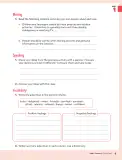
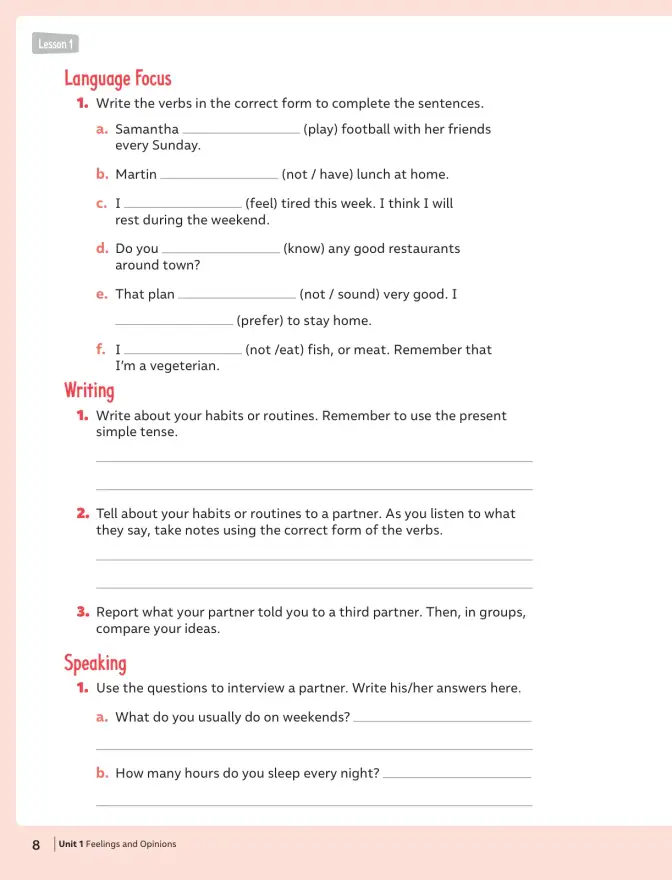
Language Focus

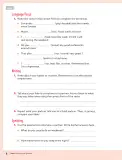
1. Write the verbs in the correct form to complete the sentences.

a. Samantha ______ (play) football with her friends every Sunday.

b. Martin ______ (not / have) lunch at home.

c. I ______ (feel) tired this week. I think I will rest during the weekend.

d. Do you ______ (know) any good restaurants around town?

e. That plan ______ (not / sound) very good. I ______ (prefer) to stay home.

f. I ______ (not / eat) fish, or meat. Remember that I'm a vegetarian.

Writing

1. Write about your habits or routines. Remember to use the present simple tense.

2. Tell about your habits or routines to a partner. As you listen to what they say, take notes using the correct form of the verbs.

3. Report what your partner told you to a third partner. Then, in groups, compare your ideas.

Speaking

1. Use the questions to interview a partner. Write his/her answers here.

a. What do you usually do on weekends?

b. How many hours do you sleep every night?


Lesson 1 · Unit 1 Feelings and Opinions · Página 8

Ejemplos resueltos

Samantha ______ (play) football with her friends every Sunday.

Sujeto en 3.ª persona singular → verbo + s: plays.

Martin ______ (not / have) lunch at home.

Negación 3.ª persona singular → doesn't have.

Tabla

Persona Verbo (3.ª sing.) Rutina
My partner gets up at 6:30 a.m.
My partner studies after school
My partner watches TV at night
My partner goes to bed at 11 p.m.

Glosario (6)

habits
hábitos, cosas que se hacen con regularidad
routines
rutinas, actividades diarias ordenadas
present simple
tiempo verbal para acciones habituales o verdades generales
vegetarian
vegetariano, persona que no come carne
weekends
fines de semana
partner
compañero o compañera de trabajo

Preguntas para practicar

What do you usually do on weekends?

On weekends, I usually visit my grandparents, play video games and go to the park with my friends.

How many hours do you sleep every night?

I sleep about eight hours every night, from eleven p.m. to seven a.m.

Temas y conceptos clave

Presente simpleHábitos y rutinasEscritura descriptivaEntrevista oralTercera persona singular -sAuxiliares do/doesNegación don't/doesn'tVerbo en forma base tras auxiliarPresente simple para rutinas
¿Te fue útil esta página?

Preguntas que la gente también hace

¿Cómo se forma la tercera persona singular en presente simple en inglés?
Consulta la solución completa arriba o explora el libro entero para temas relacionados.
¿Cuándo se usa don't y cuándo doesn't en inglés?
Consulta la solución completa arriba o explora el libro entero para temas relacionados.
¿Cómo describir rutinas diarias en inglés con presente simple?
Consulta la solución completa arriba o explora el libro entero para temas relacionados.
📌 Antes de leer esto
  • • Reconocer pronombres personales en inglés (I, you, he, she, it, we, they)
  • • Conocer verbos básicos de rutina (play, have, eat, feel, know, prefer)
  • • Identificar el sujeto de una oración
Siguiente tema sugerido
Adverbios de frecuencia (always, usually, sometimes, never) con presente simple
📝 Transcripción de la página (texto seleccionable) 954 caracteres

Language Focus

  1. Write the verbs in the correct form to complete the sentences.

a.Samantha (play) football with her friends every Sunday.

b.Martin (not / have) lunch at home.

(feel) tired this week. I think I will rest during the weekend.

d.Do you (know) any good restaurants around town?

e.Thatplan (not / sound) very good.I (prefer) to stay home.

f.I (not /eat) fish, or meat. Remember that I'm a vegeterian.

Writing

  1. Write about your habits or routines. Remember to use the present simple tense.

Tell about your habits or routines to a partner. As you listen to what they say, take notes using the correct form of the verbs.

  1. Report what your partner told you to a third partner. Then, in groups,compare your ideas.

Speaking

  1. Use the questions to interview a partner. Write his/her answers here.

a. What do you usually do on weekends?

b. How many hours do you sleep every night?

Lesson1

8

Unit 1 Feelings and Opinions

Ad

Páginas cercanas

Otros libros recomendados

Ver todos →
Ad

Usamos cookies propias y de terceros para personalizar contenido, mostrar publicidad y analizar el tráfico. Las cookies necesarias siempre están activas.