

















Unlocking Success: Following Instructions in Class
Respuesta rápida
Blancos completados: 1) lesson 2) rules 3) positive 4) rules 5) raise our hands 6) raise our hands 7) others 8) rule 9) carefully 10) teacher 11) differences 12) words 13) gestures 14) misunderstandings 15) eye contact 16) honesty 17) disrespect 18) differences 19) cultures 20) cultures 21) nodding 22) example 23) differences 24) misunderstandings 25) lesson
Solución — Página 13
Ingles 10° · 2024
Texto base (lectura)
La página explica que escuchar y hacer lo que el profesor dice es muy importante en clase: si comprendes y sigues las instrucciones, harás bien tu trabajo escolar y obtendrás buenas notas; además, la clase fluye sin problemas. Se compara con seguir una receta de cocina: si no sigues los pasos, el plato puede no salir bien. Seguir instrucciones te ayuda a aprender cosas nuevas y te prepara para futuros trabajos donde debes hacer lo que tu jefe te indica; también es una forma de ser respetuoso y demostrar responsabilidad.
Exercise 1 (Completar el diálogo)
Completa las partes faltantes de la conversación con la profesora y los estudiantes.
Respuestas sugeridas (en orden):
Teacher: Good morning, class. Please take your seats and get ready for today's 1. lesson. Before we start, I want to remind you of our 2. rules. These rules are important to ensure that we have a safe and 3. positive learning environment.
Can anyone tell me one of our classroom's 4. rules?
Student 1: We should 5. raise our hands before speaking.
Teacher: That's right. We should always 6. raise our hands before speaking to avoid interrupting 7. others. Can anyone tell me another 8. rule?
Student 2: We should listen 9. carefully to our 10. teacher.
Today, we will be talking about respecting 11. differences / cultures. Different cultures use 12. words, 13. gestures, and nonverbal cues in communication, and understanding these patterns can help avoid 14. misunderstandings and improve cross-cultural interactions.
For example, in some cultures, direct 15. eye contact is seen as a sign of 16. honesty/confidence, while in others, it is seen as a sign of 17. disrespect.
By understanding these 18. differences, we can communicate more effectively with people from different 19. cultures. Can anyone give me an example of a nonverbal cue that is used differently in different 20. cultures?
Student 1: In some cultures, 21. nodding your head means "yes," but in others, it means "no."
Teacher: That's a great 22. example. It's important to be aware of these 23. differences/cues to avoid 24. misunderstandings. Now, let's get started with today's 25. lesson/activity.
Justificación de respuestas clave
- lesson/activity: la profesora pide prepararse para "today's ___" (la clase de hoy).
- rules: recuerda las reglas del aula ("our rules"), coherente con "These rules are important".
- positive / safe: colocado de sentido común: un ambiente de aprendizaje "safe and positive".
- rules: pregunta por una regla del aula.
- raise our hands: respuesta clásica a "before speaking".
- others: evitar interrumpir a los demás.
- carefully: "listen carefully" (adverbio necesario).
- teacher: escuchar al profesor. 12-13. words / gestures: las culturas usan palabras, gestos y señales no verbales.
- misunderstandings: evitar malentendidos en interacciones interculturales. 15-17. eye contact / honesty / disrespect: ejemplo clásico del contacto visual.
- nodding: asentir con la cabeza significa "sí" en algunas culturas.
Respuesta: Diálogo completado con las 25 palabras: lesson, rules, positive, rules, raise our hands, raise our hands, others, rule, carefully, teacher, differences, words, gestures, misunderstandings, eye contact, honesty, disrespect, differences, cultures, cultures, nodding, example, differences, misunderstandings, lesson.
Contenido de la página
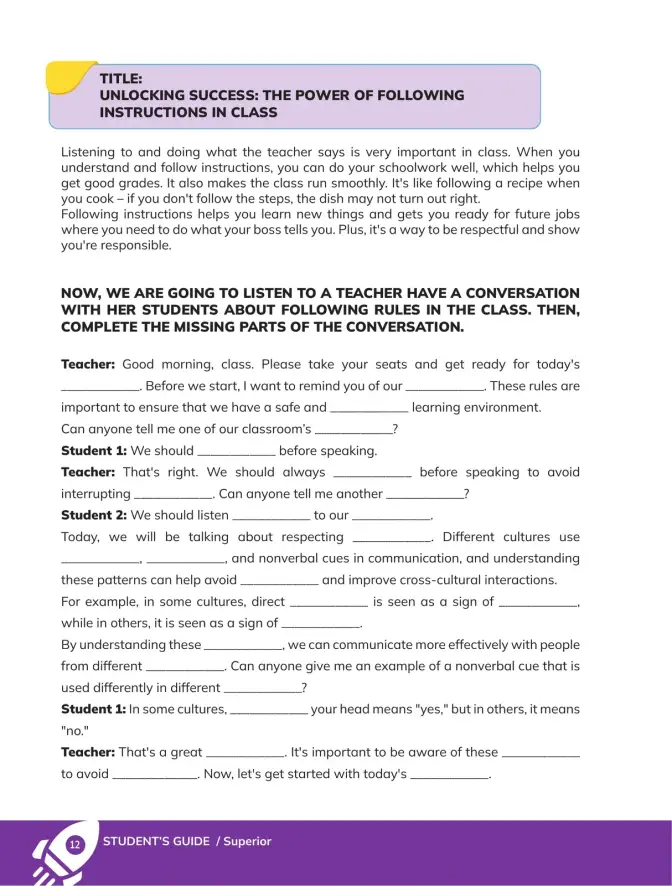
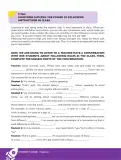
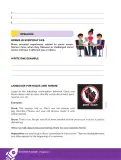
TITLE: UNLOCKING SUCCESS: THE POWER OF FOLLOWING INSTRUCTIONS IN CLASS
Listening to and doing what the teacher says is very important in class. When you understand and follow instructions, you can do your schoolwork well, which helps you get good grades. It also makes the class run smoothly. It's like following a recipe when you cook – if you don't follow the steps, the dish may not turn out right.
Following instructions helps you learn new things and gets you ready for future jobs where you need to do what your boss tells you. Plus, it's a way to be respectful and show you're responsible.
NOW, WE ARE GOING TO LISTEN TO A TEACHER HAVE A CONVERSATION WITH HER STUDENTS ABOUT FOLLOWING RULES IN THE CLASS. THEN, COMPLETE THE MISSING PARTS OF THE CONVERSATION.
Teacher: Good morning, class. Please take your seats and get ready for today's ___. Before we start, I want to remind you of our ___. These rules are important to ensure that we have a safe and ___ learning environment.
Can anyone tell me one of our classroom's ___?
Student 1: We should ___ before speaking.
Teacher: That's right. We should always ___ before speaking to avoid interrupting ___. Can anyone tell me another ___?
Student 2: We should listen ___ to our ___.
Today, we will be talking about respecting ___. Different cultures use ___, ___, and nonverbal cues in communication, and understanding these patterns can help avoid ___ and improve cross-cultural interactions.
For example, in some cultures, direct ___ is seen as a sign of ___, while in others, it is seen as a sign of ___.
By understanding these ___, we can communicate more effectively with people from different ___. Can anyone give me an example of a nonverbal cue that is used differently in different ___?
Student 1: In some cultures, ___ your head means "yes," but in others, it means "no."
Teacher: That's a great ___. It's important to be aware of these ___ to avoid ___. Now, let's get started with today's ___.
STUDENT'S GUIDE / Superior — Página 12
Ejemplos resueltos
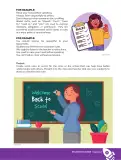
Complete: "We should always ______ before speaking to avoid interrupting ______."
- La frase "before speaking" indica una acción previa al habla: raise our hands.
- Evitamos interrumpir a others (a los demás).
Respuesta: We should always raise our hands before speaking to avoid interrupting others.
Tabla
| # | Blanking | Palabra sugerida |
|---|---|---|
| 1 | today's ___ | lesson |
| 2 | our ___ | rules |
| 3 | safe and ___ | positive |
| 4 | classroom's ___ | rules |
| 5 | should ___ before speaking | raise our hands |
| 6 | always ___ before speaking | raise our hands |
| 7 | interrupting ___ | others |
| 8 | another ___ | rule |
| 9 | listen ___ | carefully |
| 10 | to our ___ | teacher |
| 11 | respecting ___ | differences |
| 12 | cultures use ___ | words |
| 13 | use ___, ___ | gestures |
| 14 | help avoid ___ | misunderstandings |
| 15 | direct ___ | eye contact |
| 16 | sign of ___ | honesty |
| 17 | sign of ___ | disrespect |
| 18 | these ___ | differences |
| 19 | different ___ | cultures |
| 20 | different ___ | cultures |
| 21 | ___ your head | nodding |
| 22 | a great ___ | example |
| 23 | these ___ | differences |
| 24 | to avoid ___ | misunderstandings |
| 25 | today's ___ | lesson |
Glosario (8)
- to follow instructions
- Seguir las instrucciones dadas.
- classroom rules
- Reglas del aula que mantienen un ambiente seguro.
- learning environment
- Ambiente de aprendizaje.
- to interrupt
- Interrumpir, cortar a alguien que está hablando.
- nonverbal cue
- Señal no verbal (gesto, expresión) usada en la comunicación.
- cross-cultural interaction
- Interacción entre personas de distintas culturas.
- misunderstanding
- Malentendido.
- direct eye contact
- Contacto visual directo.
Preguntas para practicar
Why is it important to follow instructions in class? (¿Por qué es importante seguir las instrucciones en clase?)
Following instructions helps you do your schoolwork well and get good grades, makes the class run smoothly, helps you learn new things, and prepares you for future jobs. It also shows that you are respectful and responsible.
Give an example of a nonverbal cue that is different in other cultures. (Da un ejemplo de una señal no verbal usada distinto en otras culturas.)
In some cultures nodding your head means 'yes' while in others it means 'no'. Also, direct eye contact may be seen as honesty in one culture but as disrespect in another.
Temas y conceptos clave
Preguntas que la gente también hace
¿Por qué es importante seguir las instrucciones del profesor en clase?
¿Qué es una nonverbal cue y cómo varía entre culturas?
¿Cómo completar un diálogo con espacios en blanco en inglés (cloze test)?
- • Vocabulario básico de aula (classroom, teacher, student, rules)
- • Comprensión de lectura en inglés a nivel intermedio
- • Conocer expresiones como 'raise your hand', 'listen carefully'
📝 Transcripción de la página (texto seleccionable) 2030 caracteres
TITLE: UNLOCKING SUCCESS: THE POWER OF FOLLOWING INSTRUCTIONS IN CLASS
Listening to and doing what the teacher says is very important in class. When you understand and follow instructions, you can do your schoolwork well, which helps you get good grades. It also makes the class run smoothly. It's like following a recipe when you cook — if you don't follow the steps, the dish may not turn out right.
Following instructions helps you learn new things and gets you ready for future jobs where you need to do what your boss tells you. Plus, it's a way to be respectful and show you're responsible.
NOW, WE ARE GOING TO LISTEN TO A TEACHER HAVE A CONVERSATION WITH HER STUDENTS ABOUT FOLLOWING RULES IN THE CLASS. THEN, COMPLETE THE MISSING PARTS OF THE CONVERSATION.
Teacher: Good morning, class. Please take your seats and get ready for today's
. Before we start, | want to remind you of our __ . These rules are
important to ensure that we have a safe and _ learning environment.
Can anyone tell me one of our classroom’s _ ?
Student 1: We should __________ before speaking.
Teacher: That's right. We should always __ -—_ before speaking to avoid interrupting____________, Can anyone tell me another ______ ?
Student 2: We should listen ___ toour ,
Today, we will be talking about respecting ___________. Different cultures use
, , and nonverbal cues in communication, and understanding
these patterns can help avoid _ and improve cross-cultural interactions.
For example, in some cultures, direct __ is seen as a sign of
while in others, it is seen as a sign of __ .
By understanding these __ , we can communicate more effectively with people from different ___ ___. Can anyone give me an example of a nonverbal cue that is used differently in different __ ?
Student 1: In some cultures,
your head means "yes," but in others, it means
no."
Teacher: That's a great . It's important to be aware ofthese__________
to avoid . . Now, let's get started with today's__
(12) STUDENTS GUIDE / Superior
Otros libros recomendados
Inglés – Sexto Básico | Student’s Book MINEDUC – Descargar PDF · 2024
MINEDUC
240 págs.
Inglés – Sexto Básico | Student’s Book MINEDUC – Descargar PDF · 2024
MINEDUC
240 págs.
Inglés – Sexto Básico | Student’s Book MINEDUC – Descargar PDF · 2023
MINEDUC
132 págs.

Inglés – Octavo Básico | Student’s Book MINEDUC – Descargar PDF · 2024
MINEDUC
124 págs.

Inglés – Octavo Básico | Student’s Book MINEDUC – Descargar PDF · 2024
MINEDUC
82 págs.

Inglés – Octavo Básico | Student’s Book MINEDUC – Descargar PDF · 2024
MINEDUC
162 págs.

Inglés – Octavo Básico | Student’s Book MINEDUC – Descargar PDF · 2024
MINEDUC
162 págs.

Inglés – Octavo Básico | Student’s Book MINEDUC – Descargar PDF · 2024
MINEDUC
4 págs.