Ejercicio 1
Contenido de la página (Nonverbal Communication)
Esta página es teoría/vocabulario: describe tres pistas de la comunicación no verbal y define tres términos clave. A continuación se explica cada sección.
 MisLibrosTexto
Prueba nacional
TransformarPor universidad (27)
 ESPE — Universidad de las Fuerzas Armadas ESPE
 ESPOCH — Escuela Superior Politécnica de Chimborazo
 ESPOL — Escuela Superior Politécnica del Litoral IKIAM — Universidad Regional Amazónica Ikiam
 UCE — Universidad Central del Ecuador
 UCUENCA — Universidad de Cuenca UEA — Universidad Estatal Amazónica
 UEB — Universidad Estatal de Bolívar
 UG — Universidad de Guayaquil
 ULEAM — Universidad Laica Eloy Alfaro de Manabí
 UNACH — Universidad Nacional de Chimborazo
 UNAE — Universidad Nacional de Educación
 UNEMI — Universidad Estatal de Milagro
 UNESUM — Universidad Estatal del Sur de Manabí UNL — Universidad Nacional de Loja
 UPEC — Universidad Politécnica Estatal del Carchi
 UPSE — Universidad Estatal Península de Santa Elena UTA — Universidad Técnica de Ambato UTB — Universidad Técnica de Babahoyo UTC — Universidad Técnica de Cotopaxi
 UTELVT — Universidad Técnica Luis Vargas Torres de Esmeraldas
 UTEQ — Universidad Técnica Estatal de Quevedo
 UTM — Universidad Técnica de Manabí UTMACH — Universidad Técnica de Machala UTN — Universidad Técnica del Norte MisLibrosTexto
Eye contact, smiling y hand gestures son pistas no verbales clave. Inclusivity = todos valorados; Empathy = comprender sentimientos ajenos; Cultural Understanding = conocer costumbres de otras culturas para interactuar con respeto.
Ingles 9° · 2024
Esta página es teoría/vocabulario: describe tres pistas de la comunicación no verbal y define tres términos clave. A continuación se explica cada sección.
The way you look at someone can communicate many things: interest, affection, hostility, or attraction. It is also important to maintain the flow of conversation and to assess the other person's interest and response.
Traducción orientativa: la forma en que miras a alguien comunica interés, afecto, hostilidad o atracción; además mantiene el flujo de la conversación y te permite evaluar el interés y la respuesta del otro.
Smiling is an important nonverbal cue. There are different types of smiles, including genuine smiles (sonrisas genuinas) and fake smiles (sonrisas falsas). A simple smile can be a powerful gesture.
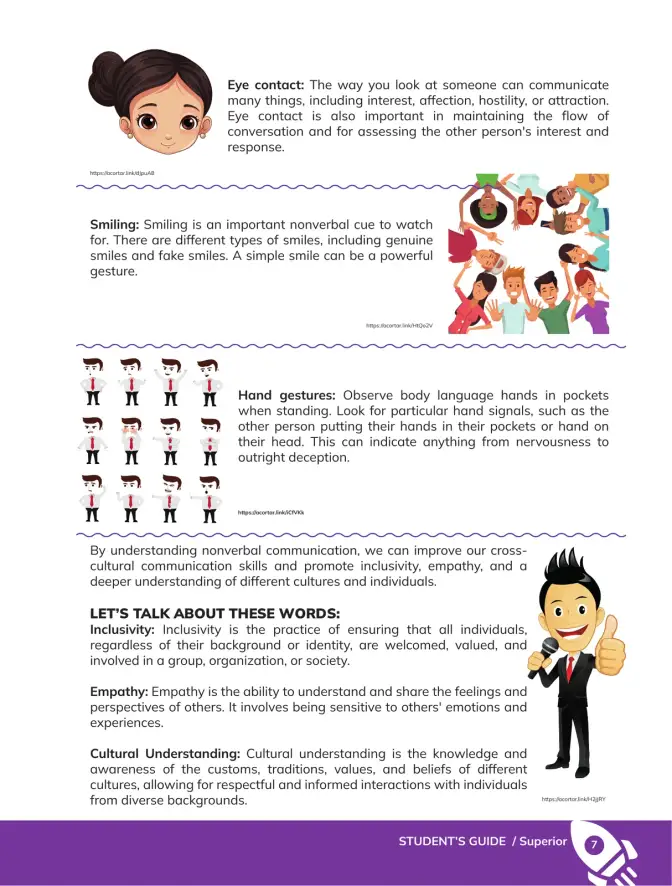
Observe body language, for example hands in pockets when standing. Look for particular hand signals, such as putting hands in pockets or a hand on the head. This can indicate anything from nervousness to outright deception (desde nerviosismo hasta engaño descarado).
By understanding nonverbal communication, we can improve our cross-cultural communication skills and promote inclusivity, empathy, and a deeper understanding of different cultures and individuals.
| Term | Definition (resumen) |
|---|---|
| Inclusivity | Práctica de asegurar que todas las personas, sin importar su origen o identidad, sean bienvenidas, valoradas e involucradas en un grupo u organización. |
| Empathy | Capacidad de entender y compartir los sentimientos y perspectivas de otros; implica sensibilidad hacia sus emociones. |
| Cultural Understanding | Conocimiento y conciencia de costumbres, tradiciones, valores y creencias de distintas culturas, que permite interacciones respetuosas e informadas. |
Comprender la comunicación no verbal mejora nuestras habilidades de comunicación intercultural y promueve la inclusión, la empatía y el respeto por personas de diferentes culturas, evitando malentendidos en la interacción cotidiana.
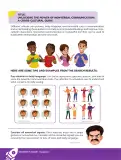
Eye contact: The way you look at someone can communicate many things, including interest, affection, hostility, or attraction. Eye contact is also important in maintaining the flow of conversation and for assessing the other person's interest and response.
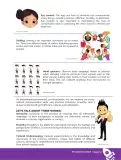
Smiling: Smiling is an important nonverbal cue to watch for. There are different types of smiles, including genuine smiles and fake smiles. A simple smile can be a powerful gesture.
Hand gestures: Observe body language, hands in pockets when standing. Look for particular hand signals, such as the other person putting their hands in their pockets or hand on their head. This can indicate anything from nervousness to outright deception.
By understanding nonverbal communication, we can improve our cross-cultural communication skills and promote inclusivity, empathy, and a deeper understanding of different cultures and individuals.
Inclusivity: the practice of ensuring that all individuals, regardless of their background or identity, are welcomed, valued, and involved in a group, organization, or society.
Empathy: the ability to understand and share the feelings and perspectives of others. It involves being sensitive to others' emotions and experiences.
Cultural Understanding: the knowledge and awareness of the customs, traditions, values, and beliefs of different cultures, allowing for respectful and informed interactions with individuals from diverse backgrounds.
Identify the nonverbal cues mentioned on the page.
The three nonverbal cues are: (1) eye contact, (2) smiling (genuine and fake smiles), and (3) hand gestures (e.g., hands in pockets, hand on the head).
| Term | Definition |
|---|---|
| Inclusivity | Ensuring all individuals are welcomed, valued and involved regardless of background or identity. |
| Empathy | Ability to understand and share the feelings and perspectives of others. |
| Cultural Understanding | Knowledge of customs, traditions, values and beliefs of different cultures for respectful interaction. |
Why is eye contact important in a conversation? (¿Por qué es importante el contacto visual en una conversación?)
Eye contact is important because it communicates interest, affection or hostility, helps maintain the flow of conversation, and allows you to assess the other person's interest and response.
How can understanding nonverbal communication improve cross-cultural communication?
Understanding nonverbal communication helps us interpret gestures, expressions and eye contact correctly, avoiding misunderstandings; it also promotes inclusivity, empathy and a deeper understanding of different cultures.
Give an example of how you can show empathy with someone from a different culture.
Example: I listen carefully without judging, I try to understand their feelings and point of view, and I respect their customs, which allows for a respectful and informed interaction.



Eye contact: The way you look at someone can communicate many things, including interest, affection, hostility, or attraction. Eye contact is also important in maintaining the flow of conversation and for assessing the other person's interest and response.
https:/facortarlink/d]puA8
Smiling: Smiling is an important nonverbal cue to watch for. There are different types of smiles, including genuine smiles and fake smiles. A simple smile can be a powerful
gesture. https://acortar.link/HtQo2V_ Y r nN nt Hand gestures: Observe body language hands in pockets when standing. Look for particular hand signals, such as the
Loto ft 4
It Yí Tí Tí https://acortar.link/iCAVKk
By understanding nonverbal communication, we can improve our cross- cultural communication skills and promote inclusivity, empathy, and a deeper understanding of different cultures and individuals.
LET’S TALK ABOUT THESE WORDS:
Inclusivity: Inclusivity is the practice of ensuring that all individuals, regardless of their background or identity, are welcomed, valued, and involved in a group, organization, or society.
Empathy: Empathy is the ability to understand and share the feelings and perspectives of others. It involves being sensitive to others' emotions and experiences.
Cultural Understanding: Cultural understanding is the knowledge and awareness of the customs, traditions, values, and beliefs of different cultures, allowing for respectful and informed interactions with individuals from diverse backgrounds. heepsiecortarinlH2)RY
STUDENT’S GUIDE / Superior

Inglés – Sexto Básico | Student’s Book MINEDUC – Descargar PDF · 2024
MINEDUC
240 págs.
Inglés – Sexto Básico | Student’s Book MINEDUC – Descargar PDF · 2023
MINEDUC
132 págs.

Inglés – Octavo Básico | Student’s Book MINEDUC – Descargar PDF · 2024
MINEDUC
124 págs.

Inglés – Octavo Básico | Student’s Book MINEDUC – Descargar PDF · 2024
MINEDUC
82 págs.

Inglés – Octavo Básico | Student’s Book MINEDUC – Descargar PDF · 2024
MINEDUC
162 págs.

Inglés – Octavo Básico | Student’s Book MINEDUC – Descargar PDF · 2024
MINEDUC
162 págs.
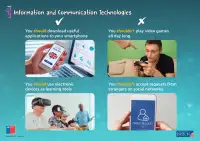
Inglés – Octavo Básico | Student’s Book MINEDUC – Descargar PDF · 2024
MINEDUC
4 págs.

Ingles 1° · 2024
Ministerio de Educación del Ecuador
34 págs.
Usamos cookies propias y de terceros para personalizar contenido, mostrar publicidad y analizar el tráfico. Las cookies necesarias siempre están activas.