
Página — Ingles 8 (pág. 106)
Solución no disponible aún
Esta página está en proceso de revisión.
Pídela y la resolveremos antes. Sin registro.
📝 Transcripción de la página (texto seleccionable) 3229 caracteres
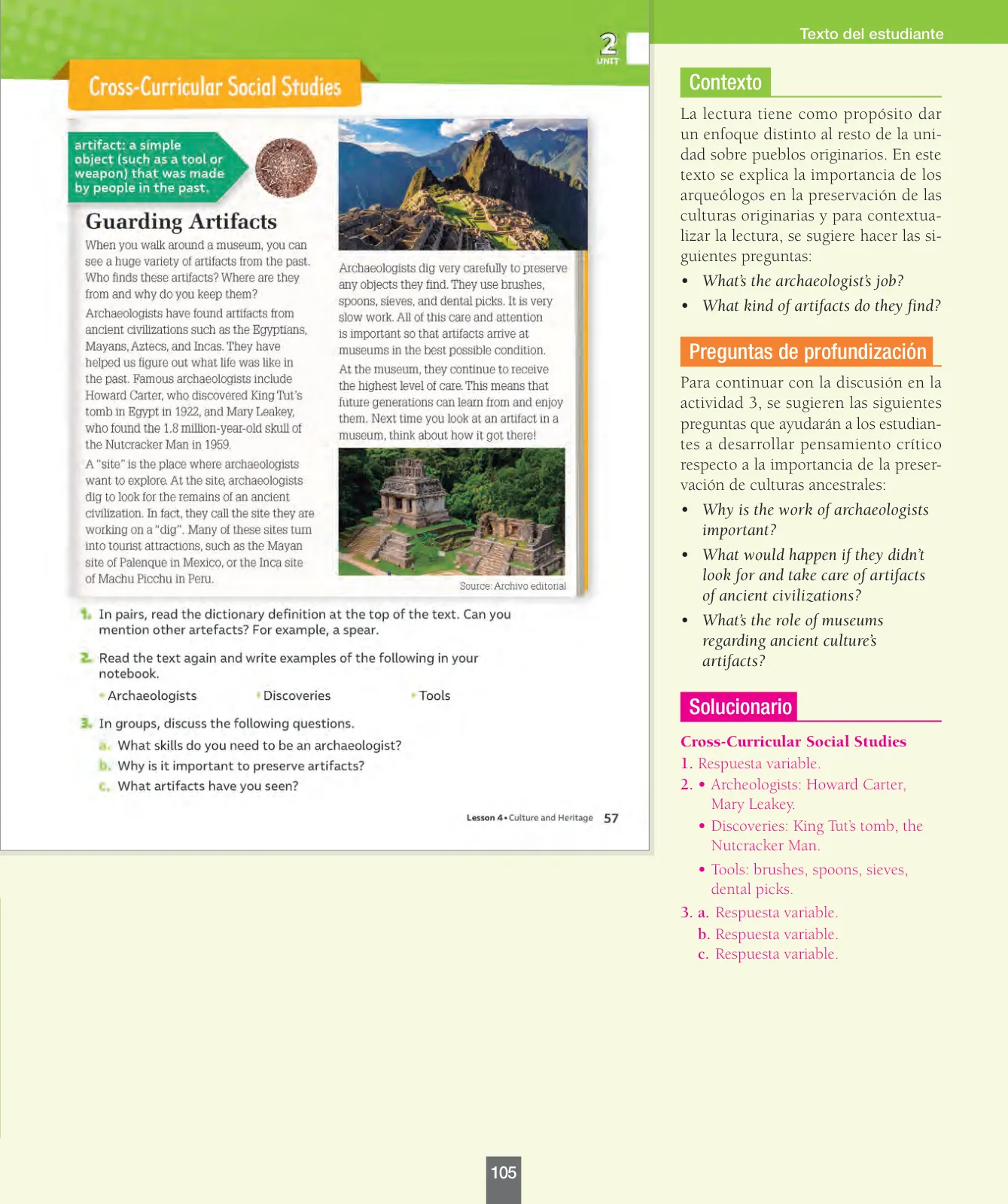
artifact:a simple object (such as a tool or weapon) that was made by people in the past.
Guarding Artifacts
When you walk around a museum, you can see a huge variety of artifacts from the past.Who finds these artifacts? Where are they from and why do you keep them?
Archaeologists have found artifacts from ancient civilizations such as the Egyptians,Mayans, Aztecs, and Incas. They have helped us figure out what life was like in the past. Famous archaeologists include Howard Carter,who discovered King Tut's tomb in Egypt in 1922, and Mary Leakey,who found the 1.8 million-year-old skull of the Nutcracker Manin1959.
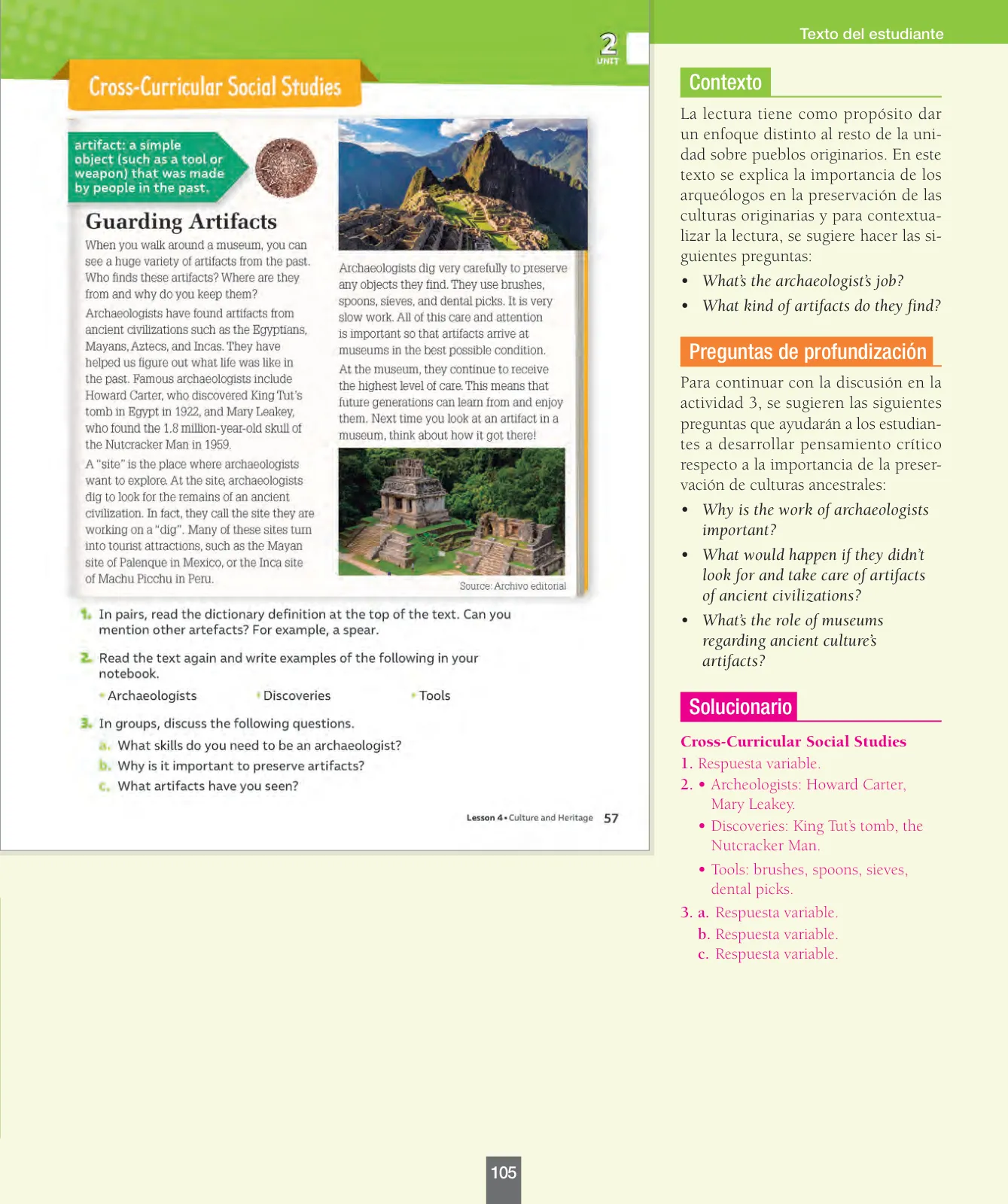
A"site"is the place where archaeologists want to explore. At the site, archaeoloqists dig to look for the remains of an ancient civilization. In fact, they call the site they are working on a"dig".Many of these sites tum into tourist attractions, such as the Mayan site of Palenque in Mexico, or the Inca site of Machu Picchu in Peru.
Archaeologists dig very carefully to preserve any objects they find. They use brushes,spoons, sieves, and dental picks.It is very slow work. All of this care and attention is important so that artifacts arrive at museums in the best possible condition.At the museum, they continue to receive the highest level of care. This means that future generations can learn from and enjoy them. Next time you look at an artifact in a museum, think about how it got there!
In pairs, read the dictionary definition at the top of the text. Can you mention other artefacts? For example, a spear.
Z Read the text again and write examples of the following in your notebook.
Archaeologists Discoveries
Tools
- In groups, discuss the following questions.
a. What skills do you need to be an archaeologist?
b.Why is it important to preserve artifacts?
C. What artifacts have you seen?
Lesson 4-Culture and Heritage 57
Contexto
La lectura tiene como propósito dar un enfoque distinto al resto de la unidad sobre pueblos originarios. En este texto se explica la importancia de los arqueólogos en la preservación de las culturas originarias y para contextualizar la lectura, se sugiere hacer las siguientes preguntas:
• What's the archaeologist's job?
• What kind of artifacts do they find?
Preguntas de profundización
Para continuar con la discusión en la actividad 3, se sugieren las siguientes preguntas que ayudarán a los estudiantes a desarrollar pensamiento crítico respecto a la importancia de la preservación de culturas ancestrales:
• Why is the work of archaeologists important?
• What would happen if they didn't look for and take care of artifacts of ancient civilizations?
What's the role of museums regarding ancient culture's artifacts?
Solucionario
Cross-Curricular Social Studies
- Respuesta variable.
2.· Archeologists: Howard Carter,Mary Leakey.
• Discoveries: King Tut's tomb, the Nutcracker Man.
• Tools: brushes, spoons, sieves,dental picks.
- a. Respuesta variable.
b. Respuesta variable.
c. Respuesta variable.
2UNIT
Texto del estudiante
Cross-Curricular Social Studies


Source:Archivo editorial
105
Otros libros recomendados
Lengua y Literatura – Octavo Básico | Texto del Estudiante MINEDUC – Descargar PDF · 2024
MINEDUC
243 págs.
Lengua y Literatura – Octavo Básico | Texto del Estudiante MINEDUC – Descargar PDF · 2024
MINEDUC
249 págs.

Matemática – Octavo Básico | Texto del Estudiante MINEDUC – Descargar PDF · 2024
MINEDUC
155 págs.
Matemática – Octavo Básico | Texto del Estudiante MINEDUC – Descargar PDF · 2024
MINEDUC
235 págs.
Matemática – Octavo Básico | Texto del Estudiante MINEDUC – Descargar PDF · 2024
MINEDUC
211 págs.
Inglés – Octavo Básico | Student’s Book MINEDUC – Descargar PDF · 2024
MINEDUC
124 págs.

Inglés – Octavo Básico | Student’s Book MINEDUC – Descargar PDF · 2024
MINEDUC
82 págs.
Inglés – Octavo Básico | Student’s Book MINEDUC – Descargar PDF · 2024
MINEDUC
162 págs.