

















Present Perfect: for, since y how long
Respuesta rápida
Present perfect = have/has + participio. Since + inicio (the 16th century); for + duración (500 years); how long pregunta la duración.
Solución — Página 30
Uérakua anapu uantakua. Projects and Readings. Libro de Educación Telesecundaria Grado 3° Ciclo Escolar 2025 - 2026
Contenido: Present Perfect con for, since y how long
El present perfect (have/has + participio pasado) se usa para hablar de situaciones o actividades que comenzaron en un momento específico del pasado y continúan en el presente, o de acciones pasadas con consecuencia importante en el presente.
Estructura
| Forma | Estructura | Ejemplo |
|---|---|---|
| Afirmativa | sujeto + have/has + participio pasado + complemento | The danza del venado has been practiced in Sonora since the pre-Hispanic era. |
| Negativa | sujeto + haven't/hasn't + participio pasado + complemento | Foreign folk dances haven't been common in Mexico. |
| Interrogativa | have/has + sujeto + participio pasado + complemento + ? | Have you met someone who practices Mexican folk dances? |
How long, since y for
- How long pregunta por el origen en el tiempo de una actividad que continúa: How long have piñatas existed in Mexico?
- Since indica cuándo empezó la situación: Piñatas have existed in Mexico since the 16th century.
- For indica cuánto tiempo ha existido la situación: Piñatas have existed in Mexico for about 500 years.
Ejemplos resueltos
- How long have piñatas existed in Mexico? → They have existed since the 16th century. (since + punto de inicio)
- How long have piñatas existed in Mexico? → They have existed for about 500 years. (for + duración)
Respuesta orientativa: El present perfect con for y since permite describir tradiciones mexicanas que siguen vigentes; since marca el inicio y for la duración.
Contenido de la página
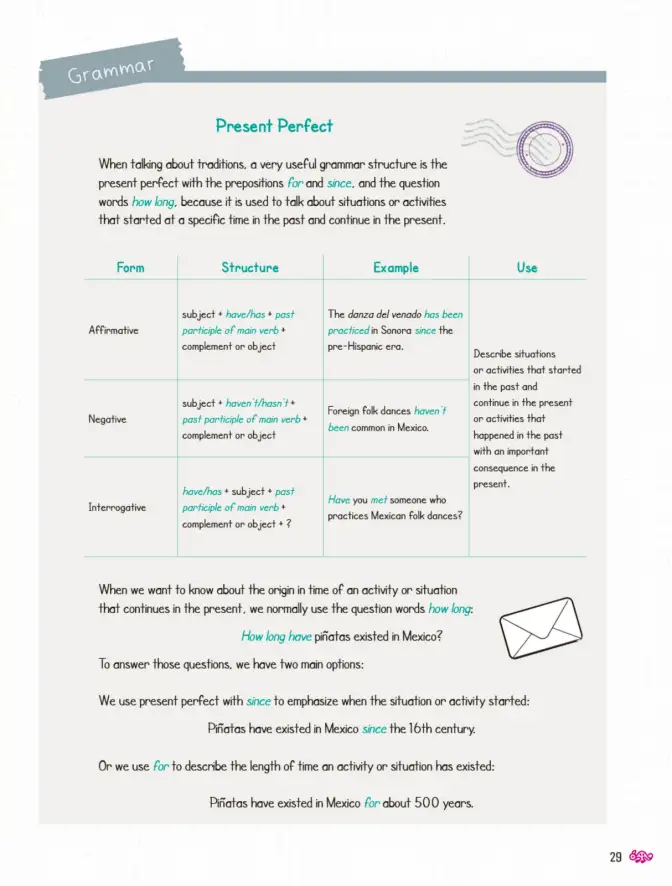
Present Perfect
When talking about traditions, a very useful grammar structure is the present perfect with the prepositions for and since, and the question words how long, because it is used to talk about situations or activities that started at a specific time in the past and continue in the present.
| Form | Structure | Example | Use |
|---|---|---|---|
| Affirmative | subject + have/has + past participle of main verb + complement or object | The danza del venado has been practiced in Sonora since the pre-Hispanic era. | Describe situations or activities that started in the past and continue in the present or activities that happened in the past with an important consequence in the present. |
| Negative | subject + haven't/hasn't + past participle of main verb + complement or object | Foreign folk dances haven't been common in Mexico. | (misma función) |
| Interrogative | have/has + subject + past participle of main verb + complement or object + ? | Have you met someone who practices Mexican folk dances? | (misma función) |
When we want to know about the origin in time of an activity or situation that continues in the present, we normally use the question words how long:
How long have piñatas existed in Mexico?
To answer those questions, we have two main options:
We use present perfect with since to emphasize when the situation or activity started:
Piñatas have existed in Mexico since the 16th century.
Or we use for to describe the length of time an activity or situation has existed:
Piñatas have existed in Mexico for about 500 years.
Ejemplos resueltos
How long have piñatas existed in Mexico? (responder con since)
Se usa since + el momento de inicio: Piñatas have existed in Mexico since the 16th century.
How long have piñatas existed in Mexico? (responder con for)
Se usa for + la duración: Piñatas have existed in Mexico for about 500 years.
Tabla
| Form | Structure | Example | Use |
|---|---|---|---|
| Affirmative | subject + have/has + past participle + complement | The danza del venado has been practiced in Sonora since the pre-Hispanic era. | Situaciones que empezaron en el pasado y continúan en el presente. |
| Negative | subject + haven't/hasn't + past participle + complement | Foreign folk dances haven't been common in Mexico. | Igual que la afirmativa, en forma negativa. |
| Interrogative | have/has + subject + past participle + complement + ? | Have you met someone who practices Mexican folk dances? | Preguntar por experiencias o situaciones vigentes. |
Diagrama
flowchart TD
  A[Present Perfect] --> B[Afirmativa: have/has + participio]
  A --> C[Negativa: haven't/hasn't + participio]
  A --> D[Interrogativa: have/has + sujeto + participio?]
  A --> E[How long?]
  E --> F[Since + inicio]
  E --> G[For + duración]
Fórmulas y ecuaciones
subject + have/has + past participle + complement
subject + haven't/hasn't + past participle + complement
have/has + subject + past participle + complement + ?
Glosario (6)
- present perfect
- Tiempo verbal que conecta el pasado con el presente: have/has + participio pasado.
- since
- Preposición que indica el momento exacto en que comenzó una acción.
- for
- Preposición que indica la duración de una acción.
- how long
- Expresión interrogativa que pregunta la duración de una situación.
- past participle
- Forma verbal usada con have/has (p. ej. been, practiced, met).
- folk dance
- Danza tradicional o folclórica de una región.
Preguntas para practicar
¿Cuál es la diferencia entre *for* y *since* en el present perfect?
*Since* señala el punto exacto en que comenzó la acción (since 1990, since the 16th century), mientras que *for* indica cuánto tiempo ha durado (for ten years, for about 500 years). Ambos acompañan al present perfect cuando la situación inició en el pasado y continúa en el presente.
¿Por qué se usa *how long* con el present perfect?
Porque *how long* pregunta por la duración u origen temporal de una actividad que sigue vigente. Al responder, se elige *since* si se menciona el inicio o *for* si se menciona el periodo transcurrido.
Temas y conceptos clave
Figuras de la página (2)


Preguntas que la gente también hace
¿Cuál es la diferencia entre for y since en present perfect?
¿Cómo se forma el present perfect en afirmativa, negativa e interrogativa?
¿Cuándo se usa how long con present perfect?
- • Verbo have/has como auxiliar
- • Participios pasados de verbos irregulares
- • Uso básico del presente simple
📝 Transcripción de la página (texto seleccionable) 1780 caracteres
Present Perfect
When talking about traditions, a very useful grammar structure is the present perfect with the prepositions for and since, and the question words how long, because it is used to talk about situations or activities that started at a specific time in the past and continue in the present.
When we want to know about the origin in time of an activity or situation that continues in the present, we normally use the question words how long:
How long have pinatas existed in Mexico?
To answer those questions, we have two main options:
We use present perfect with since to emphasize when the situation or activity started:
Pinatas have existed in Mexico since the 16th century.
Or we use for to describe the length of time an activity or situation has existed:
Piñatas have existed in Mexico for about 500 years.
Grammar

| Form | Structure | Example | Use |
| Affirmative | subject + have/has+ past panficiple of main verb + complement or object | The danza del venado has been practicedin Sonona since the pre-Hispanic ena. | Describe situations or activities that stanted in the past and continue in the present or activities that happened in the past with an impontant consequence in the present. |
| Negative | subject + haven't/hasn't + past participle of main verb+ complement or object | Foreign folk dances haven't been common in Mexico. | |
| Interrogative | have/has + subject + past parficiple of main venb + complement or object +? | Have you met someone who practices Mexican folk dances? |

29
乐

Otros libros recomendados
Colección Nanahuatzin. Lenguajes. Libro de Educación Telesecundaria Grado 3° Ciclo Escolar 2025 - 2026
SEP/CONALITEG
323 págs.
Colección Nanahuatzin. Ética, naturaleza y sociedades. Libro de Educación Telesecundaria Grado 3° Ciclo Escolar 2025 - 2026
SEP/CONALITEG
355 págs.
Colección Nanahuatzin. De lo humano y lo comunitario. Libro de Educación Telesecundaria Grado 3° Ciclo Escolar 2025 - 2026
SEP/CONALITEG
259 págs.
Colección Nanahuatzin. Nuestro libro de Proyectos. Tomo II. Libro de Educación Telesecundaria Grado 3° Ciclo Escolar 2025 - 2026
SEP/CONALITEG
275 págs.
Colección Nanahuatzin. Saberes y pensamiento científico. Libro de Educación Telesecundaria Grado 3° Ciclo Escolar 2025 - 2026
SEP/CONALITEG
339 págs.
Colección Nanahuatzin. Nuestro libro de Proyectos. Tomo I. Libro de Educación Telesecundaria Grado 3° Ciclo Escolar 2025 - 2026
SEP/CONALITEG
299 págs.
Colección Nanahuatzin. Nuestro libro de Proyectos. Tomo III. Libro de Educación Telesecundaria Grado 3° Ciclo Escolar 2025 - 2026
SEP/CONALITEG
291 págs.
Colección Nanahuatzin. Múltiples lenguajes. Libro de Educación Telesecundaria Grado 3° Ciclo Escolar 2025 - 2026
SEP/CONALITEG
163 págs.