

















Verb Patterns, Present Continuous y Past Simple
Respuesta rápida
Página teórica de gramática: patrones verbales, presente continuo y pasado simple. No hay ejercicios que resolver.
Solución — Página 70
Inglés – Séptimo Básico | Student’s Book MINEDUC – Descargar PDF · 2024
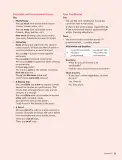
Página de teoría gramatical
Esta página es un apéndice de gramática. No contiene ejercicios para resolver, sino explicaciones y tablas de referencia. A continuación se explica y ejemplifica cada sección.
Verb Patterns (Patrones verbales)
Verbo + -ing o to + base:
- like / love / hate / prefer + -ing: I like hanging out with friends.
- like / love / hate / prefer + to + base: I like to hang out with friends.
Nota: al expresar gustos y disgustos se usa normalmente la forma -ing.
Verbo + -ing:
- enjoy / can't stand + -ing: I enjoy watching TV for hours. / I can't stand watching TV for hours.
Verbo + base (sin to):
- would rather + base: I would rather be rollerblading in the park.
Verbo + to + base:
- would like / would prefer + to + base: I would like to go to the movies.
Present Continuous (Presente continuo)
Uso: describe una acción que ocurre en este momento o alrededor de este momento.
- This year, they are playing basketball for the school team.
Forma: presente simple del verbo to be + participio presente (-ing).
Afirmativo y negativo:
| Sujeto | Verbo to be | Ejemplo |
|---|---|---|
| I | am (I'm) / am not (I'm not) | I am wearing a cap. |
| He / She / It | is (He's/She's/It's) / is not (isn't) | She is wearing a cap. |
| We / You / They | are (We're/You're/They're) / are not (aren't) | They are wearing a cap. |
Preguntas:
| Wh- | to be | Sujeto | Complemento |
|---|---|---|---|
| What | is | he / she / it | learning in other school subjects? |
| What | are | we / you / they | learning in other school subjects? |
| What | am | I | learning in other school subjects? |
Respuestas cortas:
- Are you going swimming this weekend? → Yes, I am. / No, I am (I'm) not.
- Is she going swimming this weekend? → Yes, she is. / No, she is not (isn't).
Past Simple (Pasado simple)
Uso:
- Acción terminada en el pasado: It rained a lot.
- Secuencia de eventos pasados: I came home and collapsed on the sofa.
Forma: la misma para todas las personas.
Reglas de formación:
- Regla normal: agregar -ed a la base: rain → rained.
- Verbos terminados en -e: agregar -d: observe → observed.
- Verbos terminados en consonante + y: eliminar la y y agregar -ied: try → tried.
- Verbos terminados en vocal + consonante (una sílaba): duplicar la consonante y agregar -ed: stop → stopped.
- Existen muchos verbos irregulares comunes.
Contenido de la página
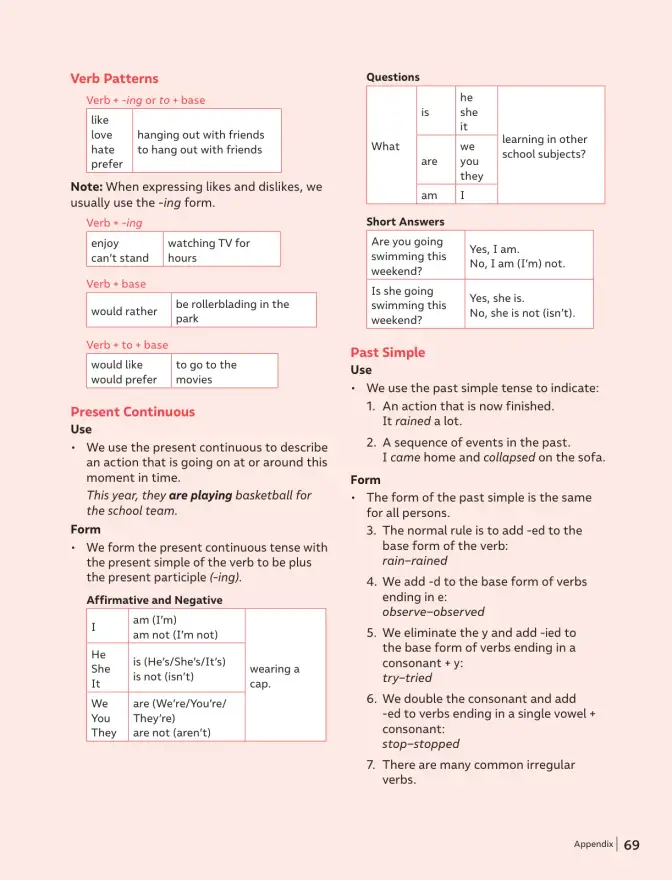
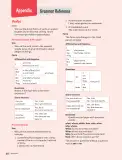
Verb Patterns
Note: When expressing likes and dislikes, we usually use the -ing form.
| Verb + -ing or to + base | |
|---|---|
| like / love / hate / prefer | hanging out with friends / to hang out with friends |
| Verb + -ing | |
|---|---|
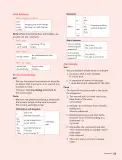
| enjoy / can't stand | watching TV for hours |
| Verb + base | |
|---|---|
| would rather | be rollerblading in the park |
| Verb + to + base | |
|---|---|
| would like / would prefer | to go to the movies |
Present Continuous
Use
We use the present continuous to describe an action that is going on at or around this moment in time.
This year, they are playing basketball for the school team.
Form
We form the present continuous tense with the present simple of the verb to be plus the present participle (-ing).
Affirmative and Negative
| Subject | Verb to be | |
|---|---|---|
| I | am (I'm) / am not (I'm not) | wearing a cap. |
| He / She / It | is (He's/She's/It's) / is not (isn't) | wearing a cap. |
| We / You / They | are (We're/You're/They're) / are not (aren't) | wearing a cap. |
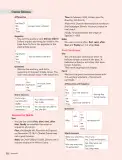
Questions
| Wh- | to be | Subject | |
|---|---|---|---|
| What | is | he / she / it | learning in other school subjects? |
| What | are | we / you / they | learning in other school subjects? |
| What | am | I | learning in other school subjects? |
Short Answers
| Question | Short answer |
|---|---|
| Are you going swimming this weekend? | Yes, I am. / No, I am (I'm) not. |
| Is she going swimming this weekend? | Yes, she is. / No, she is not (isn't). |
Past Simple
Use
- We use the past simple tense to indicate:
- An action that is now finished. It rained a lot.
- A sequence of events in the past. I came home and collapsed on the sofa.
Form
- The form of the past simple is the same for all persons.
- The normal rule is to add -ed to the base form of the verb: rain → rained.
- We add -d to the base form of verbs ending in e: observe → observed.
- We eliminate the y and add -ied to the base form of verbs ending in a consonant + y: try → tried.
- We double the consonant and add -ed to verbs ending in a single vowel + consonant: stop → stopped.
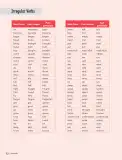
- There are many common irregular verbs.
Ejemplos resueltos
Completa: I like ___ (hang out) with friends.
El verbo like puede ir seguido de -ing o de to + base. Ambas son correctas: I like hanging out with friends. / I like to hang out with friends.
Forma el presente continuo de They / play basketball.
Se usa el presente de to be (are) + participio presente (-ing): They are playing basketball.
Escribe el pasado simple de stop.
Stop termina en vocal + consonante, por lo que se duplica la consonante y se agrega -ed: stopped.
Tablas (7)
| Verb + -ing or to + base | |
|---|---|
| like / love / hate / prefer | hanging out with friends / to hang out with friends |
| Verb + -ing | |
|---|---|
| enjoy / can't stand | watching TV for hours |
| Verb + base | |
|---|---|
| would rather | be rollerblading in the park |
| Verb + to + base | |
|---|---|
| would like / would prefer | to go to the movies |
| Subject | Verb to be | |
|---|---|---|
| I | am (I'm) / am not (I'm not) | wearing a cap. |
| He / She / It | is (He's/She's/It's) / is not (isn't) | wearing a cap. |
| We / You / They | are (We're/You're/They're) / are not (aren't) | wearing a cap. |
| Wh- | to be | Subject | |
|---|---|---|---|
| What | is | he / she / it | learning in other school subjects? |
| What | are | we / you / they | learning in other school subjects? |
| What | am | I | learning in other school subjects? |
| Question | Short answer |
|---|---|
| Are you going swimming this weekend? | Yes, I am. / No, I am (I'm) not. |
| Is she going swimming this weekend? | Yes, she is. / No, she is not (isn't). |
Glosario (5)
- verb pattern
- patrón que indica qué forma verbal sigue a un verbo (gerundio, infinitivo o base)
- present continuous
- tiempo verbal que expresa acciones en curso en el momento actual
- past simple
- tiempo verbal que expresa acciones terminadas en el pasado
- base form
- forma base del verbo, sin conjugación ni terminaciones
- irregular verb
- verbo que no forma el pasado agregando -ed
Preguntas para practicar
¿Cuándo se usa el presente continuo?
Se usa para describir una acción que está ocurriendo en este momento o alrededor de este momento. Por ejemplo: *This year, they are playing basketball for the school team.*
¿Cómo se forma el pasado simple de los verbos regulares?
Se agrega -ed a la forma base; si el verbo termina en -e se agrega solo -d; si termina en consonante + y, se cambia la y por -ied; y si termina en vocal + consonante, se duplica la consonante y se agrega -ed.
Temas y conceptos clave
Preguntas que la gente también hace
¿Cuándo se usa el presente continuo en inglés?
¿Cómo se forma el pasado simple de los verbos regulares?
¿Cuál es la diferencia entre like + -ing y like + to + base?
- • Verbo to be en presente
- • Formación del gerundio (-ing)
- • Vocabulario básico de actividades y rutinas
📝 Transcripción de la página (texto seleccionable) 2448 caracteres
Verb Patterns
Note: When expressing likes and dislikes, we usually use the -ing form.
Present Continuous
Use
We use the present continuous to describe an action that is going on at or around this moment in time.
This year, they are playing basketball for the school team.
Form
We form the present continuous tense with the present simple of the verb to be plus the present participle (-ing).
Past Simple
Use
• We use the past simple tense to indicate:
- An action that is now finished.
It rained a lot.
- A sequence of events in the past.I came home and collapsed on the sofa.
Form
· The form of the past simple is the same for all persons.
- The normal rule is to add -ed to the base form of the verb:
rain-rained
- We add -d to the base form of verbs ending in e:
observe-observed
We eliminate the y and add -ied to the base form of verbs ending in a consonant + y:try-tried
We double the consonant and add -ed to verbs ending in a single vowel +consonant:
stop-stopped
- There are many common irregular verbs.
Verb + -ing or to + base
| like love hate prefer | hanging out with friends to hang out with friends |
Verb + -ing
| enjoy can't stand | watching TV for hours |
Verb + base
| would rather | be rollerblading in the park |
Verb + to + base
| would like would prefer | to go to the movies |
Affirmative and Negative
| I | am (I'm) am not (I'm not) | wearing a cap. |
| He She It | is (He's/She's/It's) is not (isn't) | |
| We You They | are (We're/You're/ They're) are not (aren't) |
Questions
| What | is | he she it | learning in other school subjects? |
| are | we you they | ||
| am | I |
Short Answers
| Are you going swimming this weekend? | Yes, I am. No, I am (I'm) not. |
| Is she going swimming this weekend? | Yes, she is. No, she is not (isn't). |
Appendix|
69
Otros libros recomendados

Matemática – Séptimo Básico | Texto del Estudiante MINEDUC – Descargar PDF · 2024
MINEDUC
146 págs.
Inglés – Séptimo Básico | Student’s Book MINEDUC – Descargar PDF · 2024
MINEDUC
162 págs.
Inglés – Séptimo Básico | Student’s Book MINEDUC – Descargar PDF · 2024
MINEDUC
162 págs.

Inglés – Séptimo Básico | Student’s Book MINEDUC – Descargar PDF · 2024
MINEDUC
136 págs.
Ciencias Naturales – Séptimo Básico | Texto del Estudiante MINEDUC – Descargar PDF · 2024
MINEDUC
178 págs.

Ciencias Naturales – Séptimo Básico | Texto del Estudiante MINEDUC – Descargar PDF · 2024
MINEDUC
162 págs.
Ciencias Naturales – Séptimo Básico | Texto del Estudiante MINEDUC – Descargar PDF · 2024
MINEDUC
178 págs.
Historia, Geografía y Ciencias Sociales – Séptimo Básico | Texto del Estudiante MINEDUC – Descargar PDF · 2024
MINEDUC
146 págs.