Saltar al contenido
MisLibrosTexto
Ad
Inglés – Octavo Básico | Student’s Book MINEDUC – Descargar PDF · 2024
Libro de Inglés 8

MINEDUC

23/82

Reading and Vocabulary – Opposites, do/make (Lesson 3)

📄 ejercicios ingles 🎓 otro · 8° BASICA Chile 🇨🇱 CL 🗣 Español
Página 23
23 de 82
Página 23 de Inglés – Octavo Básico | Student’s Book MINEDUC – Descargar PDF · 2024
Anterior Página 23 / 82 Siguiente

Respuesta rápida

  1. a) first b) ugly c) low d) boring e) terrible f) empty. 2. a) ✘ b) ✔ c) ✔ d) ✘ e) ✔. 3. Do = actividades/tareas; make = crear/producir y resultados.
📚 exercise ingles ⭐⭐ Dificultad 2/5 ⏱ 6 min lectura

Solución — Página 23

Inglés – Octavo Básico | Student’s Book MINEDUC – Descargar PDF · 2024

1
Ejercicio 1

(Reading and Vocabulary)

Look at the words below and write the opposite of each on the lines provided. Use a dictionary to help you.

a
Parte 1.a
  1. "Last" significa último; su antónimo es primero.
  2. Opposite: first.
Respuesta

first

b
Parte 1.b
  1. "Beautiful" significa hermoso/bello.
  2. Su antónimo es feo.
Respuesta

ugly

c
Parte 1.c
  1. "High" significa alto.
  2. Su antónimo es bajo.
Respuesta

low

d
Parte 1.d
  1. "Interesting" significa interesante.
  2. Su antónimo es aburrido.
Respuesta

boring

e
Parte 1.e
  1. "Amazing" significa asombroso.
  2. Su antónimo es terrible/horrible.
Respuesta

terrible

f
Parte 1.f
  1. "Crowded" significa lleno de gente/atestado.
  2. Su antónimo es vacío/solitario.
Respuesta

empty
1
Ejercicio 1

(Language Focus)

Read the following sentences and put a ✔ for correct ✘ for incorrect next to each sentence.

a
Parte 1.a
  1. "Sorry I did a mistake." → En inglés la colocación correcta es make a mistake.
  2. Por lo tanto la oración es incorrecta.
Respuesta

✘ (incorrect) — lo correcto es Sorry, I made a mistake.

b
Parte 1.b
  1. "You make me happy." → make se usa para producir un sentimiento o resultado.
  2. La colocación make somebody happy es correcta.
Respuesta

✔ (correct)

c
Parte 1.c
  1. "Shhh! You are making too much noise." → make noise es la colocación correcta.
  2. La oración es gramaticalmente correcta.
Respuesta

✔ (correct)

d
Parte 1.d
  1. "I have things to make." → Para tareas o actividades se usa do, no make.
  2. Lo correcto es I have things to do.
Respuesta

✘ (incorrect) — lo correcto es I have things to do.

e
Parte 1.e
  1. "I am doing my homework." → do homework es la colocación correcta.
  2. La oración es correcta.
Respuesta

✔ (correct)

2
Ejercicio 2

(Speaking)

Share with the class the difference between the verbs "do" and "make".

  1. Do se usa para actividades, tareas y trabajos generales: do homework, do the dishes, do exercise.
  2. Make se usa para crear, producir o fabricar algo, y para resultados o sentimientos: make a cake, make a mistake, make noise, make somebody happy.
  3. Regla práctica: si la acción crea algo nuevo o produce un resultado → make; si es una actividad o tarea → do.

Respuesta orientativa: Do se usa con actividades y tareas (do homework, do the dishes), mientras que make se usa para crear o producir algo y para resultados o sentimientos (make a cake, make noise, make me happy).

Contenido de la página

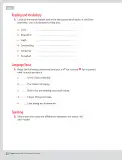
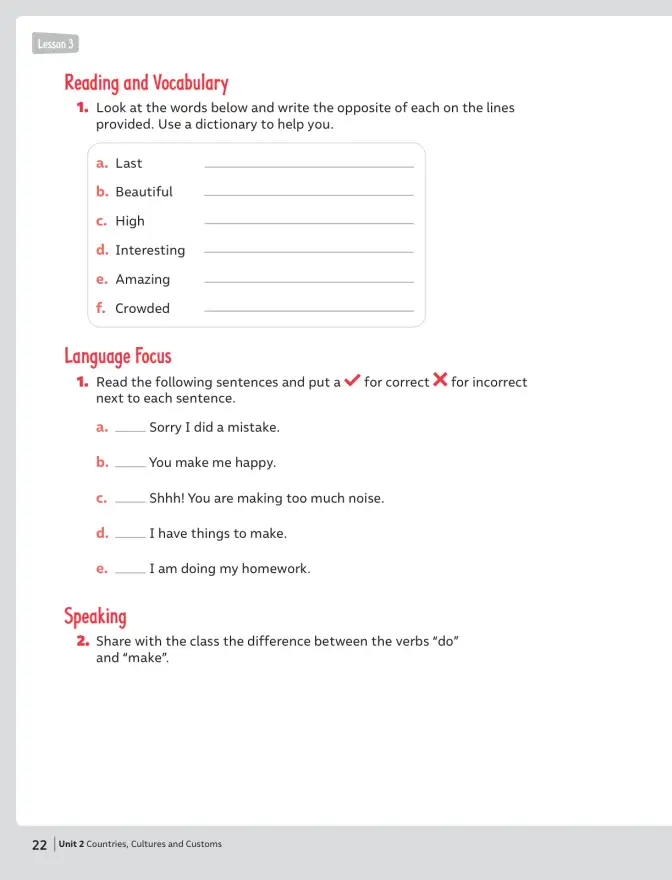
Lesson 3

Reading and Vocabulary

1. Look at the words below and write the opposite of each on the lines provided. Use a dictionary to help you.

a. Last ______ b. Beautiful ______ c. High ______ d. Interesting ______ e. Amazing ______ f. Crowded ______

Language Focus

1. Read the following sentences and put a ✔ for correct ✘ for incorrect next to each sentence.

a. ____ Sorry I did a mistake. b. ____ You make me happy. c. ____ Shhh! You are making too much noise. d. ____ I have things to make. e. ____ I am doing my homework.

Speaking

2. Share with the class the difference between the verbs "do" and "make".


Unit 2 Countries, Cultures and Customs — Page 22

Ejemplos resueltos

Write the opposite of crowded.

Crowded = lleno de gente. Su opuesto es empty (vacío).

Is the sentence "I have things to make" correct?

No. Con tareas o actividades se usa do: I have things to do.

Tabla

Verbo Uso Ejemplos
do actividades, tareas y quehaceres do homework, do the dishes, do exercise
make crear, producir, resultados y sentimientos make a cake, make a mistake, make noise, make me happy

Diagrama

graph TD
  A[Do vs Make] --> B[DO]
  A --> C[MAKE]
  B --> B1[Actividades: do exercise]
  B --> B2[Tareas: do homework]
  B --> B3[Quehaceres: do the dishes]
  C --> C1[Crear/producir: make a cake]
  C --> C2[Resultados: make noise]
  C --> C3[Sentimientos: make me happy]

Glosario (14)

last
último
first
primero
beautiful
hermoso, bello
ugly
feo
high
alto
low
bajo
interesting
interesante
boring
aburrido
amazing
asombroso
terrible
terrible, horrible
crowded
lleno de gente, atestado
empty
vacío
do
verbo para actividades y tareas generales
make
verbo para crear, producir o generar un resultado

Preguntas para practicar

Share with the class the difference between the verbs "do" and "make".

Do se usa para actividades y tareas generales, como do homework o do the dishes. Make se usa para crear o producir algo y para resultados o sentimientos, como make a cake, make noise o make me happy.

Temas y conceptos clave

OppositesDo vs MakeSpeaking about grammarantónimoscollocationsdomakepresente continuo
¿Te fue útil esta página?

Preguntas que la gente también hace

¿Cuál es la diferencia entre do y make en inglés?
Consulta la solución completa arriba o explora el libro entero para temas relacionados.
¿Cómo se dice el antónimo de crowded en inglés?
Consulta la solución completa arriba o explora el libro entero para temas relacionados.
¿Se dice make a mistake o do a mistake?
Consulta la solución completa arriba o explora el libro entero para temas relacionados.
📌 Antes de leer esto
  • • Vocabulario básico de adjetivos en inglés
  • • Uso del presente simple y presente continuo
  • • Manejo básico del diccionario bilingüe
Siguiente tema sugerido
Countries, cultures and customs: reading comprehension and comparatives
📝 Transcripción de la página (texto seleccionable) 598 caracteres

Reading and Vocabulary

1.Look at the words below and write the opposite of each on the lines provided. Use a dictionary to help you.

a.Last

b.Beautiful

C.High

d. Interesting

e.Amazing

f. Crowded

Language Focus

1.Read the following sentences and put a for correctXfor incorrect next to each sentence.

a.Sorry I did a mistake.

b.You make me happy.

Shhh! You are making too much noise.

d.I have things to make.

e.I am doing my homework.

Speaking

  1. Share with the class the difference between the verbs "do"and"make".

Lesson 3

22

Unit 2 Countries, Cultures and Customs

Ad

Otros libros recomendados

Ver todos →
Ad

Usamos cookies propias y de terceros para personalizar contenido, mostrar publicidad y analizar el tráfico. Las cookies necesarias siempre están activas.