


















Grammar Reference: Asking for Information, Phrasal Verbs and Collocations
Respuesta rápida
Question words: how long (tiempo), how many (cantidad), whose (posesión), how (manera), where (lugar). Phrasal verbs: get on = subir, get off = bajar. Collocations: catch a bus/train, go on holidays/on tour.
Solución — Página 72
Inglés – Octavo Básico | Student’s Book MINEDUC – Descargar PDF · 2024
Página de referencia gramatical
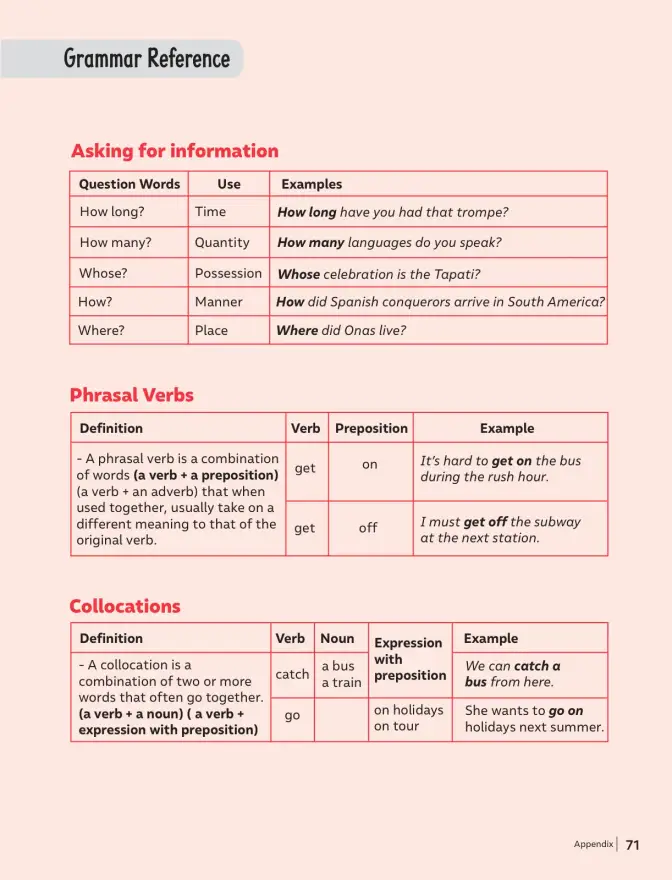
Esta página no contiene ejercicios para resolver; es una sección de consulta (Grammar Reference) con tres cuadros: Asking for information, Phrasal Verbs y Collocations. A continuación se explica y traduce cada apartado.
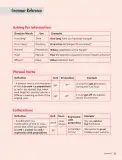
Asking for information (Pedir información)
| Question Word | Uso | Ejemplo (traducción) |
|---|---|---|
| How long? | Tiempo (duración) | How long have you had that trompe? — ¿Cuánto tiempo has tenido ese trompe? |
| How many? | Cantidad (contables) | How many languages do you speak? — ¿Cuántos idiomas hablas? |
| Whose? | Posesión | Whose celebration is the Tapati? — ¿De quién es la celebración Tapati? |
| How? | Modo / manera | How did Spanish conquerors arrive in South America? — ¿Cómo llegaron los conquistadores españoles a Sudamérica? |
| Where? | Lugar | Where did Onas live? — ¿Dónde vivían los onas? |
Respuesta: cada question word se usa para preguntar un tipo distinto de información: duración, cantidad, posesión, manera y lugar.
Phrasal Verbs (Verbos compuestos)
Definición: un phrasal verb es la combinación de un verbo + preposición o verbo + adverbio que, al usarse juntos, adquiere un significado distinto al del verbo original.
| Verbo | Preposición | Ejemplo |
|---|---|---|
| get | on | It's hard to get on the bus during the rush hour. — Es difícil subirse al bus en hora punta. |
| get | off | I must get off the subway at the next station. — Debo bajarme del metro en la próxima estación. |
Respuesta: get on = subir(se) a un transporte; get off = bajar(se) de un transporte.
Collocations (Colocaciones)
Definición: una collocation es la combinación de dos o más palabras que suelen ir juntas (verbo + sustantivo, o verbo + expresión con preposición).
| Verbo | Sustantivo | Expresión con preposición | Ejemplo |
|---|---|---|---|
| catch | a bus / a train | — | We can catch a bus from here. — Podemos tomar un bus desde aquí. |
| go | — | on holidays / on tour | She wants to go on holidays next summer. — Ella quiere irse de vacaciones el próximo verano. |
Respuesta: catch a bus/train = tomar un bus/tren; go on holidays/on tour = irse de vacaciones / irse de gira.
Contenido de la página
Grammar Reference
Asking for information
| Question Words | Use | Examples |
|---|---|---|
| How long? | Time | How long have you had that trompe? |
| How many? | Quantity | How many languages do you speak? |
| Whose? | Possession | Whose celebration is the Tapati? |
| How? | Manner | How did Spanish conquerors arrive in South America? |
| Where? | Place | Where did Onas live? |
Phrasal Verbs
Definition: A phrasal verb is a combination of words (a verb + a preposition) (a verb + an adverb) that when used together, usually take on a different meaning to that of the original verb.
| Verb | Preposition | Example |
|---|---|---|
| get | on | It's hard to get on the bus during the rush hour. |
| get | off | I must get off the subway at the next station. |
Collocations
Definition: A collocation is a combination of two or more words that often go together. (a verb + a noun) (a verb + expression with preposition)
| Verb | Noun | Expression with preposition | Example |
|---|---|---|---|
| catch | a bus / a train | We can catch a bus from here. | |
| go | on holidays / on tour | She wants to go on holidays next summer. |
Appendix | 71
Ejemplos resueltos
Completa: How ______ have you had that trompe?
Se pregunta por la duración de una acción que continúa en el presente, por lo que se usa how long con presente perfecto: How long have you had that trompe?
Elige el phrasal verb correcto: I must ______ the subway at the next station.
El contexto indica bajar del metro, por lo que corresponde get off: I must get off the subway at the next station.
Completa la collocation: We can ______ a bus from here.
La colocación natural con bus es catch: We can catch a bus from here.
Tablas (3)
| Question Words | Use | Examples |
|---|---|---|
| How long? | Time | How long have you had that trompe? |
| How many? | Quantity | How many languages do you speak? |
| Whose? | Possession | Whose celebration is the Tapati? |
| How? | Manner | How did Spanish conquerors arrive in South America? |
| Where? | Place | Where did Onas live? |
| Verb | Preposition | Example |
|---|---|---|
| get | on | It's hard to get on the bus during the rush hour. |
| get | off | I must get off the subway at the next station. |
| Verb | Noun | Expression with preposition | Example |
|---|---|---|---|
| catch | a bus / a train | We can catch a bus from here. | |
| go | on holidays / on tour | She wants to go on holidays next summer. |
Diagrama
graph TD
  A[Grammar Reference] --> B[Asking for information]
  A --> C[Phrasal Verbs]
  A --> D[Collocations]
  B --> B1[How long? - Time]
  B --> B2[How many? - Quantity]
  B --> B3[Whose? - Possession]
  B --> B4[How? - Manner]
  B --> B5[Where? - Place]
  C --> C1[get on - subir]
  C --> C2[get off - bajar]
  D --> D1[catch a bus / a train]
  D --> D2[go on holidays / on tour]
Glosario (7)
- Question word
- Palabra interrogativa que introduce una pregunta (how, where, whose, etc.).
- Phrasal verb
- Verbo combinado con preposición o adverbio cuyo significado conjunto difiere del verbo original.
- Collocation
- Combinación de dos o más palabras que suelen aparecer juntas de forma natural.
- Rush hour
- Hora punta, momento de mayor congestión en el transporte.
- Trompe
- Instrumento musical de viento, similar a un cuerno o trompa.
- Tapati
- Festival cultural de la Isla de Pascua (Rapa Nui).
- Onas
- Pueblo indígena de Tierra del Fuego, también llamado selk'nam.
Preguntas para practicar
¿Por qué los phrasal verbs tienen un significado distinto al del verbo original?
Porque la preposición o adverbio que acompaña al verbo modifica su sentido literal y crea una unidad de significado nueva. Por ejemplo, *get* significa 'obtener', pero *get on* significa 'subirse a un transporte'. Este carácter idiomático hace necesario aprenderlos como bloques completos.
¿Cómo ayudan las collocations a sonar más natural en inglés?
Las collocations son combinaciones que los hablantes nativos usan con frecuencia, como *catch a bus* en lugar de *take a bus* en ciertos contextos. Aprenderlas mejora la fluidez y evita traducciones literales del español. Además, facilitan la comprensión auditiva porque el oyente reconoce bloques completos.
Temas y conceptos clave
Preguntas que la gente también hace
¿Cuál es la diferencia entre how long y how many en inglés?
¿Qué significa el phrasal verb get off y cómo se usa?
¿Qué son las collocations y para qué sirven en inglés?
- • Vocabulario básico de transporte y viajes
- • Uso elemental del presente simple y pasado simple
- • Reconocimiento de pronombres interrogativos en inglés
📝 Transcripción de la página (texto seleccionable) 1606 caracteres
Grammar Reference
Asking for information
| Question Words | Use | Examples |
| How long? | Time | How long have you had that trompe? |
| How many? | Quantity | How many languages do you speak? |
| Whose? | Possession | Whose celebration is the Tapati? |
| How? | Manner | How did Spanish conquerors arrive in South America? |
| Where? | Place | Where did Onas live? |
Phrasal Verbs
| Definition | Verb | Preposition | Example |
| - A phrasal verb is a combination of words (a verb + a preposition) (a verb + an adverb) that when used together, usually take on a different meaning to that of the original verb. | get | on | It's hard to get on the bus during the rush hour. |
| get | off | I must get off the subway at the next station. |
Collocations
| Definition | Verb | Noun | Expression with preposition | Example |
| - A collocation is a combination of two or more words that often go together. (a verb + a noun)(a verb + expression with preposition) | catch | a bus a train | We can catch a bus from here. | |
| go | on holidays on tour | She wants to go on holidays next summer. |
Appendix
71
Otros libros recomendados

Lengua y Literatura – Octavo Básico | Texto del Estudiante MINEDUC – Descargar PDF · 2024
MINEDUC
243 págs.

Lengua y Literatura – Octavo Básico | Texto del Estudiante MINEDUC – Descargar PDF · 2024
MINEDUC
249 págs.

Matemática – Octavo Básico | Texto del Estudiante MINEDUC – Descargar PDF · 2024
MINEDUC
155 págs.

Matemática – Octavo Básico | Texto del Estudiante MINEDUC – Descargar PDF · 2024
MINEDUC
235 págs.

Matemática – Octavo Básico | Texto del Estudiante MINEDUC – Descargar PDF · 2024
MINEDUC
211 págs.

Inglés – Octavo Básico | Student’s Book MINEDUC – Descargar PDF · 2024
MINEDUC
124 págs.

Inglés – Octavo Básico | Student’s Book MINEDUC – Descargar PDF · 2024
MINEDUC
162 págs.

Inglés – Octavo Básico | Student’s Book MINEDUC – Descargar PDF · 2024
MINEDUC
162 págs.