Anexo2: Methodology
Below, you will find an example of one of the active methodologies and strategies for the
active teaching process, collaborative learning techniques, use of educational technology,
demonstrations, debates, projects, among others, with a CITAM+H approach for the Preschool
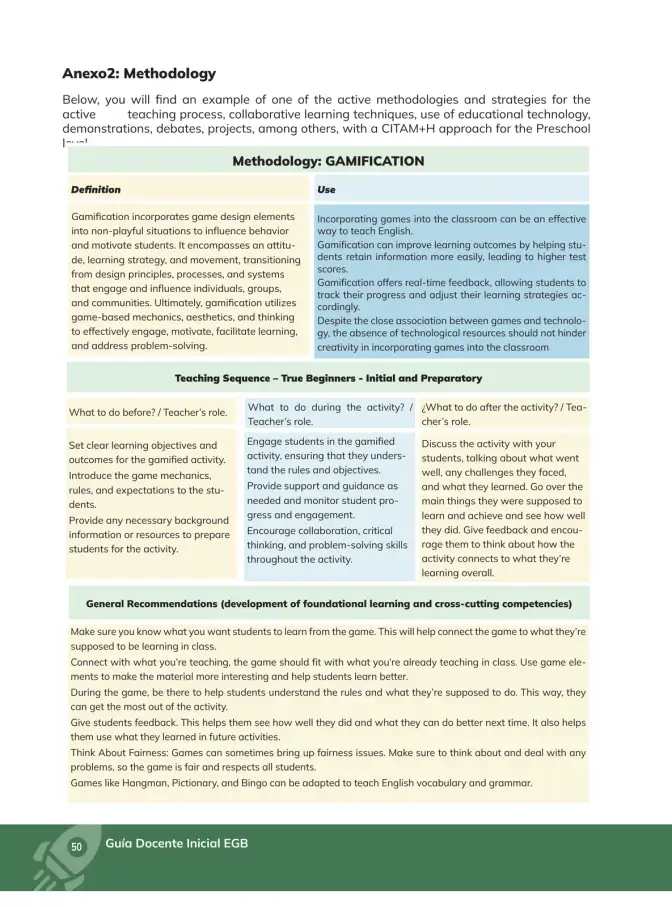
Methodology: GAMIFICATION
Definition
Gamification incorporates game design elements
into non-playful situations to influence behavior
and motivate students. It encompasses an attitu-
de, learning strategy, and movement, transitioning
from design principles, processes, and systems
that engage and influence individuals, groups,
and communities. Ultimately, gamification utilizes
game-based mechanics, aesthetics, and thinking
to effectively engage, motivate, facilitate learning,
and address problem-solving.
Use
Incorporating games into the classroom can be an effective
way to teach English.
Gamification can improve learning outcomes by helping stu-
dents retain information more easily, leading to higher test
scores.
Gamification offers real-time feedback, allowing students to
track their progress and adjust their learning strategies ac-
cordingly.
Despite the close association between games and technolo-
gy, the absence of technological resources should not hinder
creativity in incorporating games into the classroom
Teaching Sequence - True Beginners - Initial and Preparatory
What to do before? / Teacher's role.
Teacher's role.
Set clear learning objectives and
outcomes for the gamified activity.
Introduce the game mechanics,
rules, and expectations to the stu-
dents.
Provide any necessary background
information or resources to prepare
students for the activity.
Engage students in the gamified
activity, ensuring that they unders-
tand the rules and objectives.
Provide support and guidance as
needed and monitor student pro-
gress and engagement.
Encourage collaboration, critical
thinking, and problem-solving skills
throughout the activity.
What to do during the activity? / ¿What to do after the activity? / Tea-
cher's role.
Discuss the activity with your
students, talking about what went
well, any challenges they faced,
and what they learned. Go over the
main things they were supposed to
learn and achieve and see how well
they did. Give feedback and encou-
rage them to think about how the
activity connects to what they're
learning overall.
General Recommendations (development of foundational learning and cross-cutting competencies)
Make sure you know what you want students to learn from the game. This will help connect the game to what they're
supposed to be learning in class.
Connect with what you're teaching, the game should fit with what you're already teaching in class. Use game ele-
ments to make the material more interesting and help students learn better.
During the game, be there to help students understand the rules and what they're supposed to do. This way, they
can get the most out of the activity.
Give students feedback. This helps them see how well they did and what they can do better next time. It also helps
them use what they learned in future activities.
Think About Fairness: Games can sometimes bring up fairness issues. Make sure to think about and deal with any
problems, so the game is fair and respects all students.
Games like Hangman, Pictionary, and Bingo can be adapted to teach English vocabulary and grammar.
Guía Docente Inicial EGB
50