
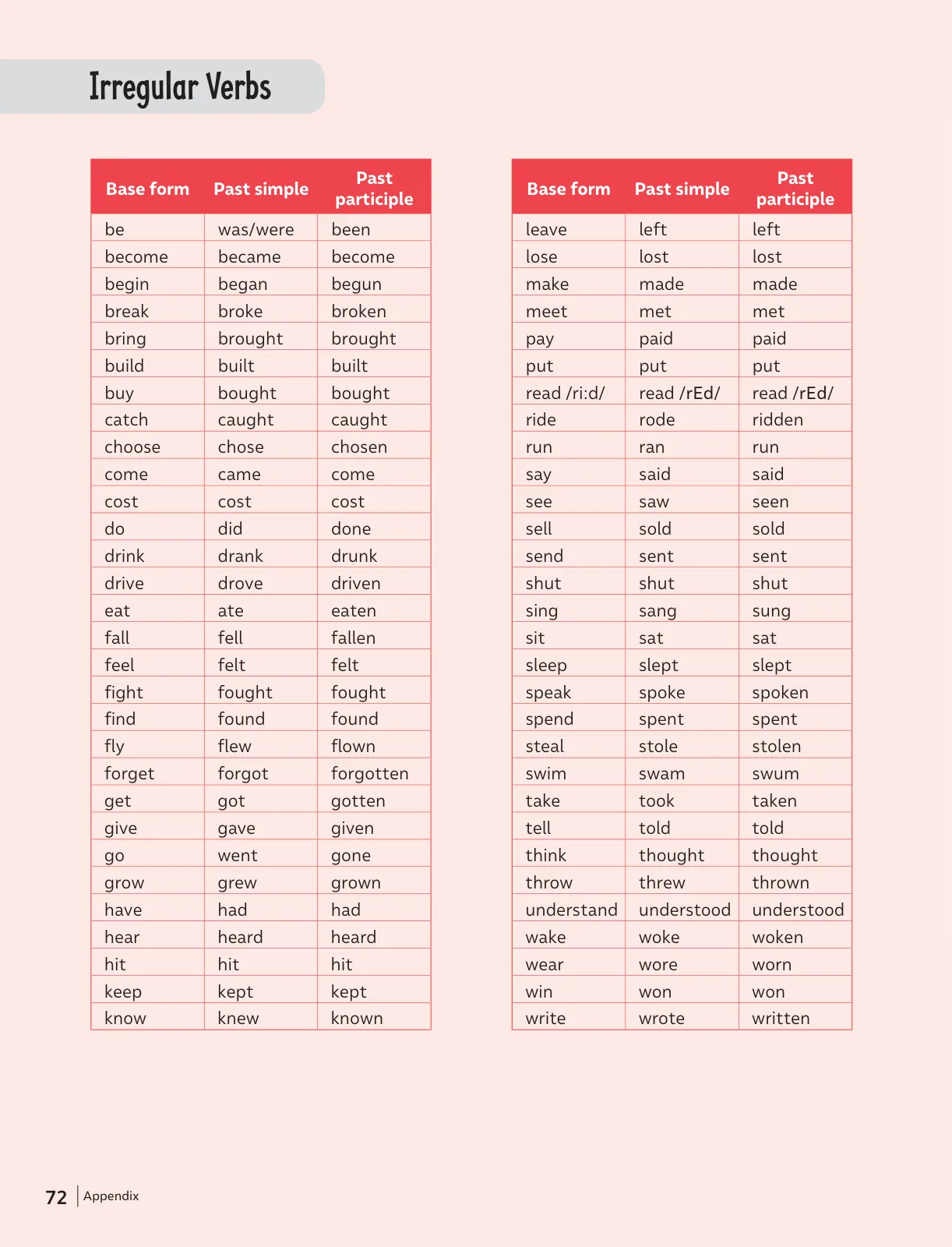
Página — Ingles 7 (pág. 72)
Solución no disponible aún
Esta página está en proceso de revisión.
Pídela y la resolveremos antes. Sin registro.
📝 Transcripción de la página (texto seleccionable) 1910 caracteres
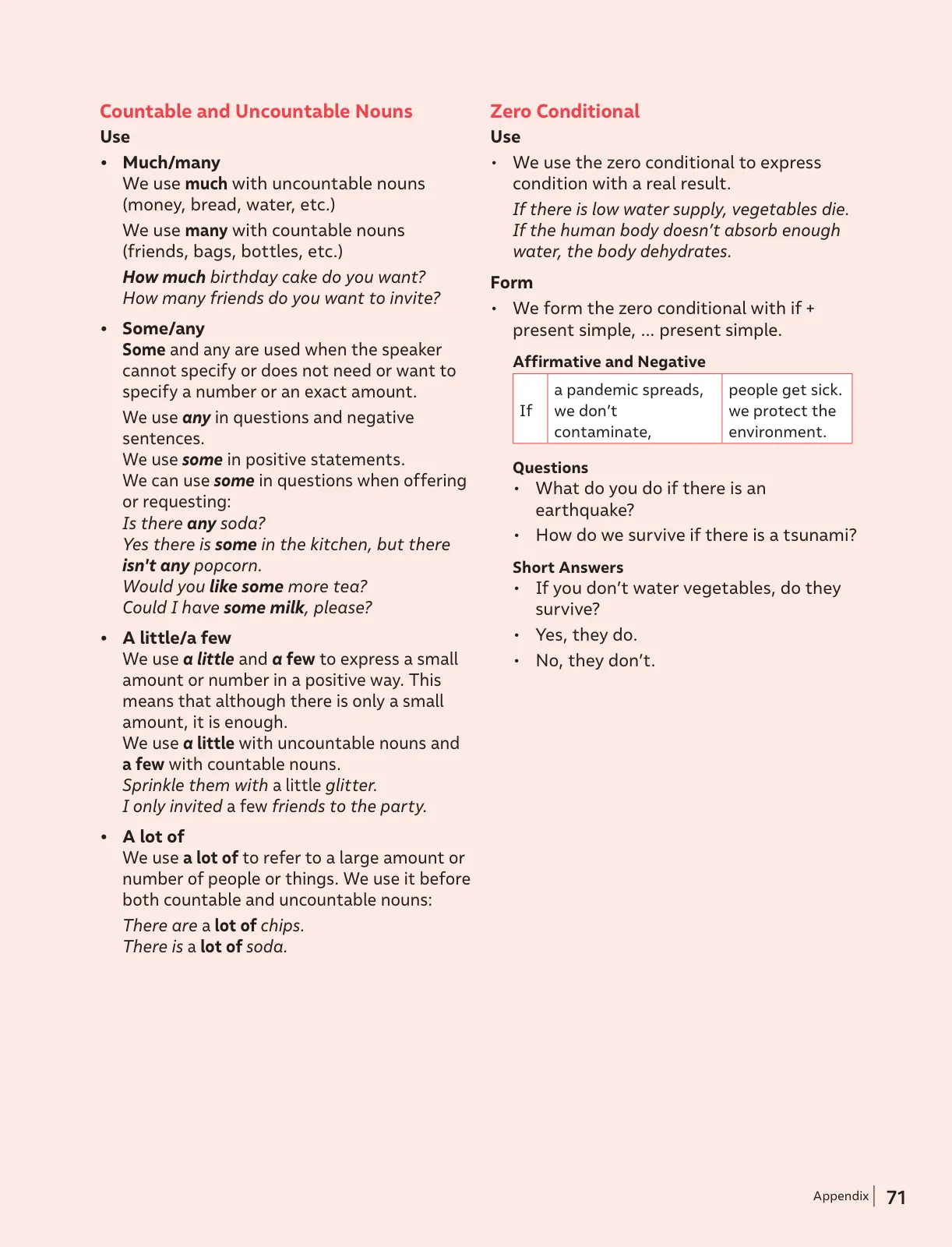
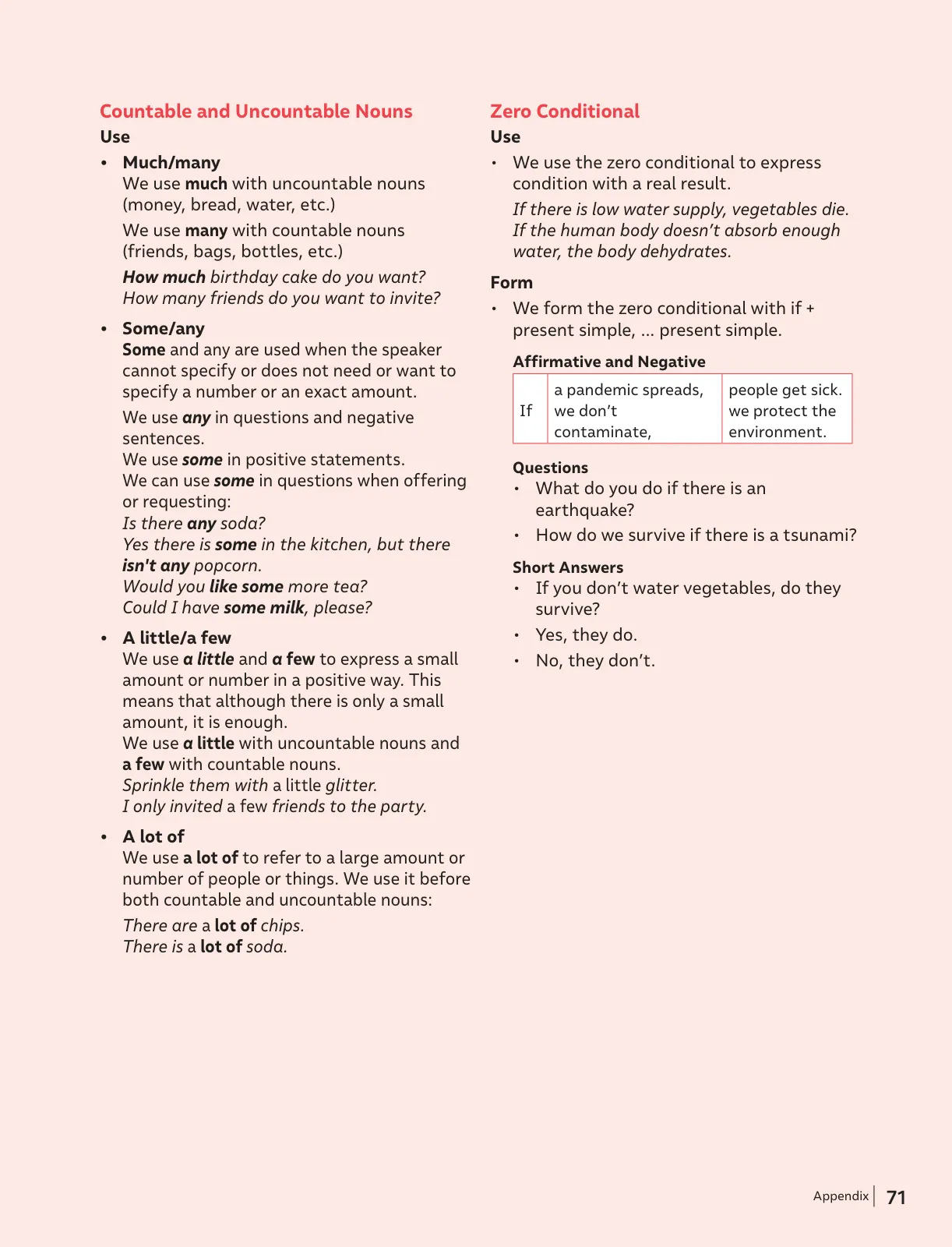
Countable and Uncountable Nouns Use
Much/many
We use much with uncountable nouns (money, bread, water, etc.)
We use many with countable nouns (friends, bags, bottles, etc.)
How much birthday cake do you want?How many friends do you want to invite?
Some/any
Some and any are used when the speaker cannot specify or does not need or want to specify a number or an exact amount.
We use any in questions and negative sentences.
We use some in positive statements.
We can use some in questions when offering or requesting:
Is there any soda?
Yes there is some in the kitchen, but there isn't any popcorn.
Would you like some more tea?
Could I have some milk, please?
A little/a few
We use a little and a few to express a small amount or number in a positive way. This means that although there is only a small amount, it is enough.
We use a little with uncountable nouns and a few with countable nouns.
Sprinkle them with a little glitter.
I only invited a few friends to the party.
A lot of
We use a lot of to refer to a large amount or number of people or things. We use it before both countable and uncountable nouns:
There are a lot of chips.
There is a lot of soda.
Zero Conditional
Use
We use the zero conditional to express condition with a real result.
If there is low water supply, vegetables die.If the human body doesn't absorb enough water, the body dehydrates.
Form
We form the zero conditional with if +present simple, ... present simple.
Questions
What do you do if there is an earthquake?
•How do we survive if there is a tsunami?
Short Answers
• If you don't water vegetables, do they survive?
• Yes, they do.
• No, they don't.
Affirmative and Negative
| If | a pandemic spreads, we don't contaminate, | people get sick. we protect the environment. |
Appendix
71
Otros libros recomendados
Matemática – Séptimo Básico | Texto del Estudiante MINEDUC – Descargar PDF · 2024
MINEDUC
146 págs.
Inglés – Séptimo Básico | Student’s Book MINEDUC – Descargar PDF · 2024
MINEDUC
162 págs.
Inglés – Séptimo Básico | Student’s Book MINEDUC – Descargar PDF · 2024
MINEDUC
162 págs.
Inglés – Séptimo Básico | Student’s Book MINEDUC – Descargar PDF · 2024
MINEDUC
136 págs.
Ciencias Naturales – Séptimo Básico | Texto del Estudiante MINEDUC – Descargar PDF · 2024
MINEDUC
178 págs.
Ciencias Naturales – Séptimo Básico | Texto del Estudiante MINEDUC – Descargar PDF · 2024
MINEDUC
162 págs.
Ciencias Naturales – Séptimo Básico | Texto del Estudiante MINEDUC – Descargar PDF · 2024
MINEDUC
178 págs.
Historia, Geografía y Ciencias Sociales – Séptimo Básico | Texto del Estudiante MINEDUC – Descargar PDF · 2024
MINEDUC
146 págs.