
Página — Uerakua Anapu Uantakua Projects And Readings 2° Secundaria (pág. 163)
Solución no disponible aún
Esta página está en proceso de revisión.
Pídela y la resolveremos antes. Sin registro.
📝 Transcripción de la página (texto seleccionable) 2004 caracteres
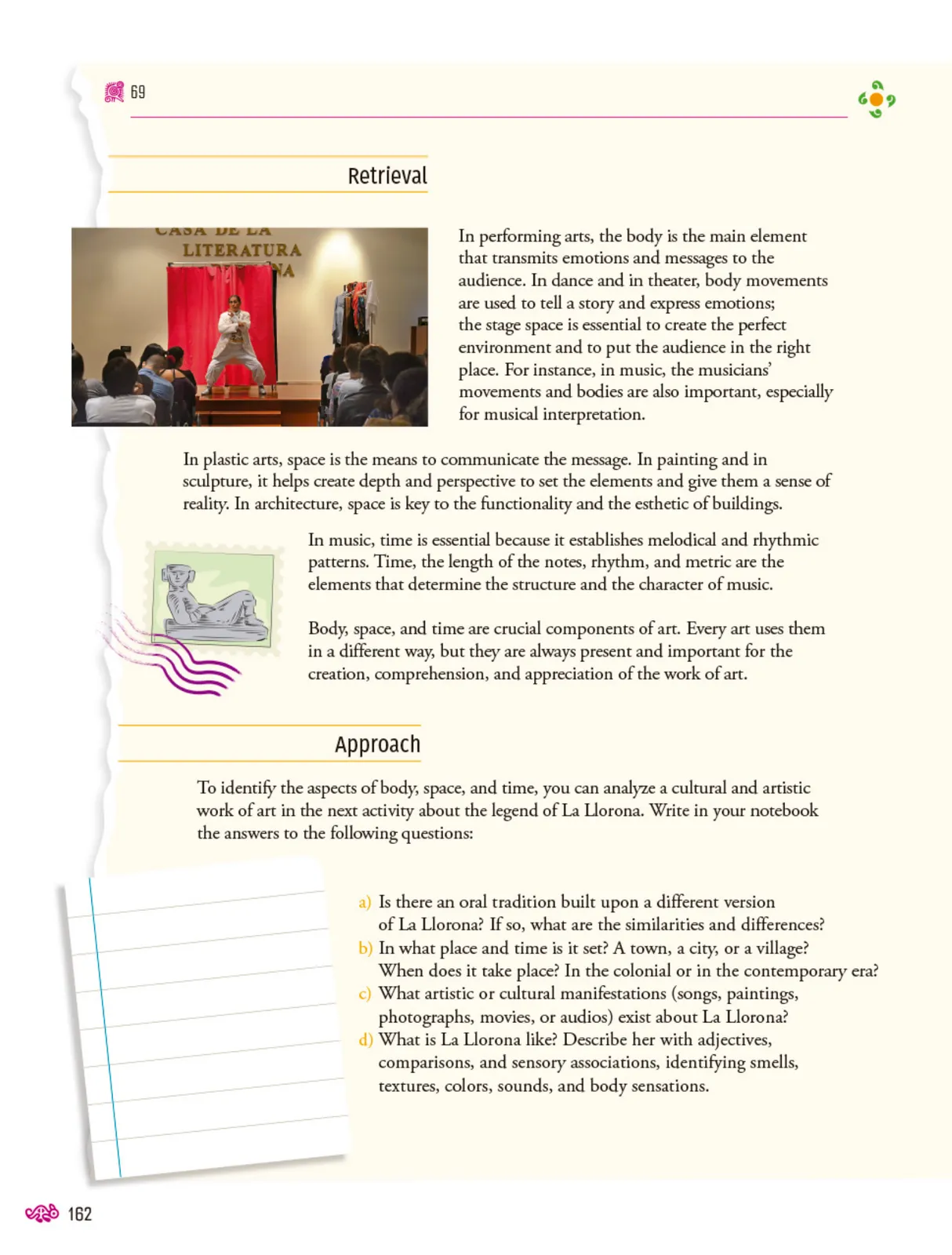
Retrieval
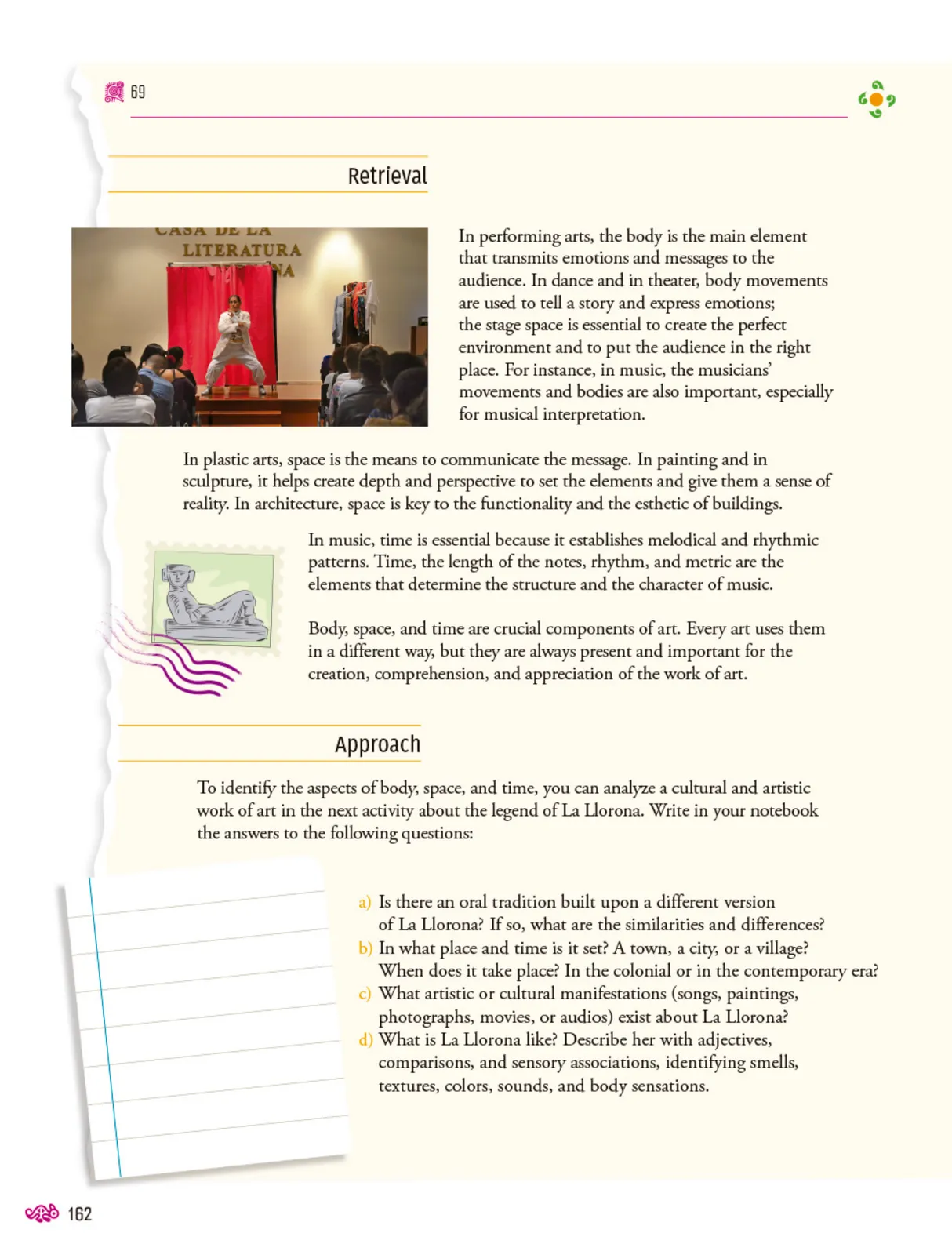
In performing arts, the body is the main element that transmits emotions and messages to the audience. In dance and in theater, body movements are used to tell a story and express emotions;the stage space is essential to create the perfect environment and to put the audience in the right place. For instance, in music, the musicians'movements and bodies are also important, especially for musical interpretation.
In plastic arts, space is the means to communicate the message. In painting and in sculpture, it helps create depth and perspective to set the elements and give them a sense of reality. In architecture, space is key to the functionality and the esthetic of buildings.
In music, time is essential because it establishes melodical and rhythmic patterns. Time, the length of the notes, rhythm, and metric are the elements that determine the structure and the character of music.
Body, space, and time are crucial components of art. Every art uses them in a different way, but they are always present and important for the creation, comprehension, and appreciation of the work of art.
Approach
To identify the aspects of body, space, and time, you can analyze a cultural and artistic work of art in the next activity about the legend of La Llorona. Write in your notebook the answers to the following questions:
a) Is there an oral tradition built upon a different version of La Llorona? If so, what are the similarities and differences?b) In what place and time is it set? A town, a city, or a village?When does it take place? In the colonial or in the contemporary era?What artistic or cultural manifestations (songs, paintings,photographs, movies, or audios) exist about La Llorona?d) What is La Llorona like? Describe her with adjectives,comparisons, and sensory associations, identifying smells,textures, colors, sounds, and body sensations.
6


162
Otros libros recomendados
Uérakua anapu uantakua. Projects and Readings. Libro de Educación Secundaria Grado 3° Ciclo Escolar 2025 - 2026
SEP/CONALITEG
187 págs.
Colección Sk´asolil. De lo humano y lo comunitario. Libro de Educación Secundaria Grado 2° Ciclo Escolar 2025 - 2026
SEP/CONALITEG
259 págs.
Colección Sk´asolil. Nuestro libro de proyectos. Libro de Educación Secundaria Grado 2° Ciclo Escolar 2025 - 2026
SEP/CONALITEG
259 págs.
Colección Sk´asolil. Múltiples lenguajes. Libro de Educación Secundaria Grado 2° Ciclo Escolar 2025 - 2026
SEP/CONALITEG
163 págs.
Uérakua anapu uantakua. Projects and Readings Libro de Educación Secundaria Grado 1° Ciclo Escolar 2025 - 2026
SEP/CONALITEG
187 págs.
Colección Ximhai. Múltiples lenguajes. Libro de Educación Secundaria Grado 1° Ciclo Escolar 2025 - 2026
SEP/CONALITEG
163 págs.
Matematica 9° · Secundaria Activa
MinEducación
218 págs.
Ciencias Naturales 9° · Secundaria Activa
MinEducación
318 págs.