Saltar al contenido
MisLibrosTexto
Ad

Marc Chagall: vida y obra de un pintor judío ruso

📄 teoria ingles 🎓 otro · 2° TELESECUNDARIA México 🇲🇽 MX 🗣 Español
Página 53
53 de 171
Página 53 de Uérakua anapu uantakua. Projects and Readings.  Libro de Educación Telesecundaria Grado 2°  Ciclo Escolar 2025 - 2026
Anterior Página 53 / 171 Siguiente

Respuesta rápida

  1. Because the family was poor and expected him to work. 2. To propose to Bella and join the revolutionary movement. 3. Due to the fascist movement led by Hitler. 4. To the United States. 5. A rural scene with a cart, animals, and people in bright colors.
📚 theory ingles ⭐⭐ Dificultad 2/5 ⏱ 5 min lectura

Solución — Página 53

Uérakua anapu uantakua. Projects and Readings. Libro de Educación Telesecundaria Grado 2° Ciclo Escolar 2025 - 2026

1
Ejercicio 1

Read the text and answer: Why were Marc's parents surprised when he told them he wanted to be a painter?

  1. El texto indica que la familia era pobre: "Money was tight and they had to work hard to keep the family well fed".
  2. Los padres esperaban que Marc consiguiera un trabajo pronto para ayudar a la familia a sobrevivir.
  3. Por eso, cuando les dijo que quería ser pintor, se sorprendieron.
Respuesta

Because the family was poor and his parents expected him to get a job soon to help the family survive.

2
Ejercicio 2

Read the text and answer: Why did Marc return to Russia in 1914?

  1. El texto dice que regresó "with the intention of proposing to Bella, his wife".
  2. También quería participar a través del arte y la cultura en el movimiento revolucionario que vivía su país.
Respuesta

He returned to propose to Bella and to participate through art and culture in the revolutionary movement of his country.

3
Ejercicio 3

Read the text and answer: Why did Marc leave Germany very soon?

  1. El texto menciona que tuvo que abandonar Alemania "due to the growing fascist movement led by Adolf Hitler".
Respuesta

Because of the growing fascist movement led by Adolf Hitler.

Ad
4
Ejercicio 4

Read the text and answer: Where did Marc go when the Jewish persecution increased and the Second World War broke out?

  1. El texto indica que "he went to the United States".
  2. Después de la guerra regresó a Francia, donde desarrolló gran parte de su carrera.
Respuesta

He went to the United States. After the war, he returned to France.

5
Ejercicio 5

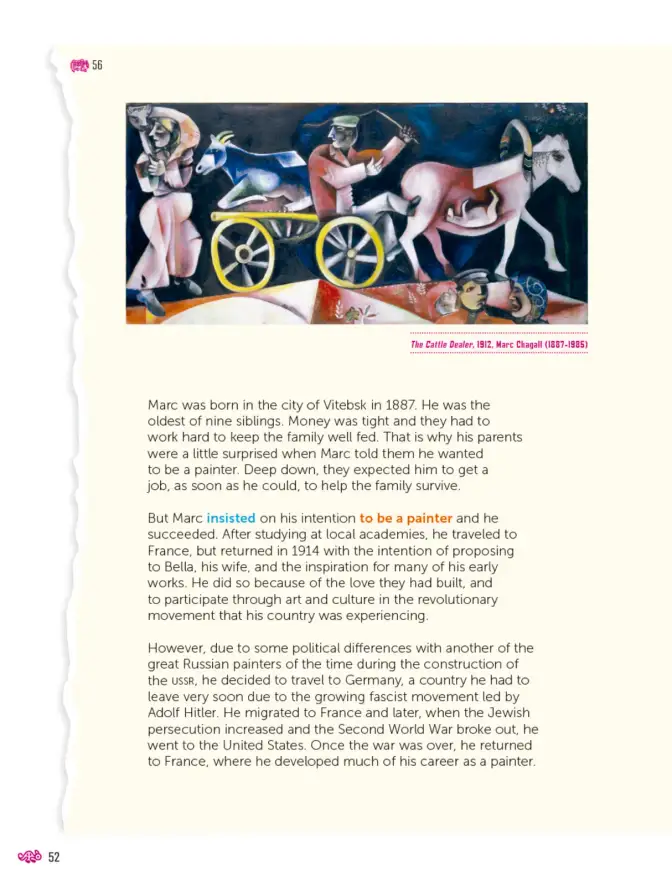
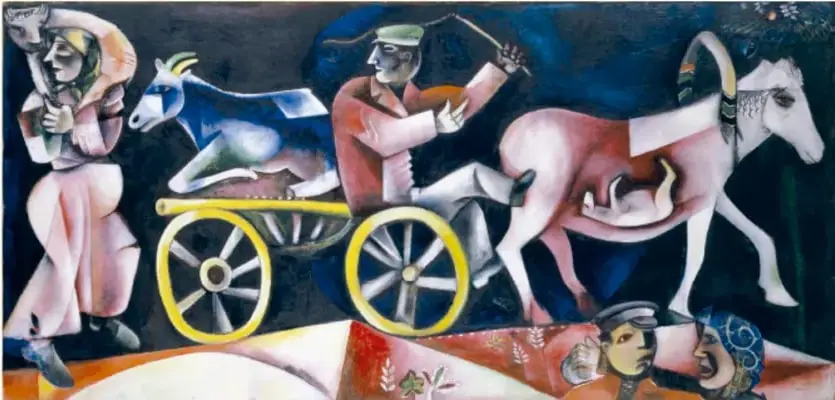
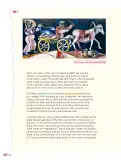
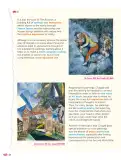
Look at the painting 'The Cattle Dealer' (1912). Describe what you see.

  1. La obra muestra una escena rural con figuras humanas y animales.
  2. Se observa un carro con ruedas amarillas tirado por un caballo blanco; sobre el carro hay una vaca azul y un hombre con un látigo.
  3. A la izquierda, una figura femenina; abajo, cabezas de personas y animales.
  4. Los colores son vivos y las formas están distorsionadas, típicas del estilo de Chagall.
Respuesta

A rural scene with a horse-drawn cart, a blue cow, a man with a whip, a woman, and heads at the bottom, painted with bright colors and distorted shapes.

Contenido de la página

Marc was born in the city of Vitebsk in 1887. He was the oldest of nine siblings. Money was tight and they had to work hard to keep the family well fed. That is why his parents were a little surprised when Marc told them he wanted to be a painter. Deep down, they expected him to get a job, as soon as he could, to help the family survive.

But Marc insisted on his intention to be a painter and he succeeded. After studying at local academies, he traveled to France, but returned in 1914 with the intention of proposing to Bella, his wife, and the inspiration for many of his early works. He did so because of the love they had built, and to participate through art and culture in the revolutionary movement that his country was experiencing.

However, due to some political differences with another of the great Russian painters of the time during the construction of the USSR, he decided to travel to Germany, a country he had to leave very soon due to the growing fascist movement led by Adolf Hitler. He migrated to France and later, when the Jewish persecution increased and the Second World War broke out, he went to the United States. Once the war was over, he returned to France, where he developed much of his career as a painter.


Image caption: The Cattle Dealer, 1912, Marc Chagall (1887-1985)

Glosario (6)

siblings
hermanos
tight
escaso, ajustado (en este contexto, dinero)
insisted
insistió
proposing
proponer matrimonio
fascist
fascista
persecution
persecución

Preguntas para practicar

What does the painting 'The Cattle Dealer' suggest about Chagall's style?

The painting shows Chagall's characteristic use of bright colors, distorted figures, and dreamlike composition, blending reality with fantasy.

Temas y conceptos clave

Biografía de Marc ChagallArte y revoluciónExilio y persecución judíaMarc ChagallVitebskBella RosenfeldRevolución RusaSegunda Guerra MundialArte moderno
¿Te fue útil esta página?

Figuras de la página (1)

Reproducción de la pintura 'The Cattle Dealer' (1912) de Marc Chagall. Muestra una escena rural con un carro de ruedas amarillas tirado por un caballo blanco, una vaca azul sobre el carro, un hombre con un látigo, una mujer a la izquierda y cabezas de personas y animales en la parte inferior. Colores vivos y formas distorsionadas.
Figura 1 image

Preguntas que la gente también hace

¿Quién fue Marc Chagall y por qué es famoso?
Consulta la solución completa arriba o explora el libro entero para temas relacionados.
¿Qué técnica utilizó Marc Chagall en sus pinturas?
Consulta la solución completa arriba o explora el libro entero para temas relacionados.
¿Cómo influyó la Revolución Rusa en la obra de Chagall?
Consulta la solución completa arriba o explora el libro entero para temas relacionados.
📌 Antes de leer esto
  • • Vocabulario básico en inglés (familia, trabajo, arte)
  • • Conocimiento de la Segunda Guerra Mundial
  • • Identificación de ideas principales en un texto
Siguiente tema sugerido
Análisis de la obra 'The Cattle Dealer' y el estilo de Chagall
📝 Transcripción de la página (texto seleccionable) 1342 caracteres

Marc Was born in the city of Vitebsk in 1887. He was the oldest of nine siblings. Money was tight and they had to work hard to keep the family well fed. That is why his parents were a little surprised when Marc told them he wanted to be a painter. Deep down, they expected him to get a job, as soon as he could, to help the family survive.

But Marc insisted on his intention to be a painter and he succeeded. After studying at local academies, he traveled to France, but returned in 1914 with the intention of proposing to Bella, his wife, and the inspiration for many of his early works. He did so because of the love they had built, and to participate through art and culture in the revolutionary movement that his country was experiencing.

However, due to some political differences with another of the great Russian painters of the time during the construction of the ussR, he decided to travel to Germany, a country he had to leave very soon due to the growing fascist movement led by Adolf Hitler. He migrated to France and later, when the Jewish persecution increased and the Second World War broke out, he went to the United States. Once the war was Over, he returned to France, where he developed much of his career as a painter.

56

![](page=0,bbox=[225, 184, 1060, 584])

The Cattle Dealer, 1912, Marc Chagall (1887-1985)

o

52

Ad

Otros libros recomendados

Ver todos →
Ad

Usamos cookies propias y de terceros para personalizar contenido, mostrar publicidad y analizar el tráfico. Las cookies necesarias siempre están activas.