Ejercicio 1
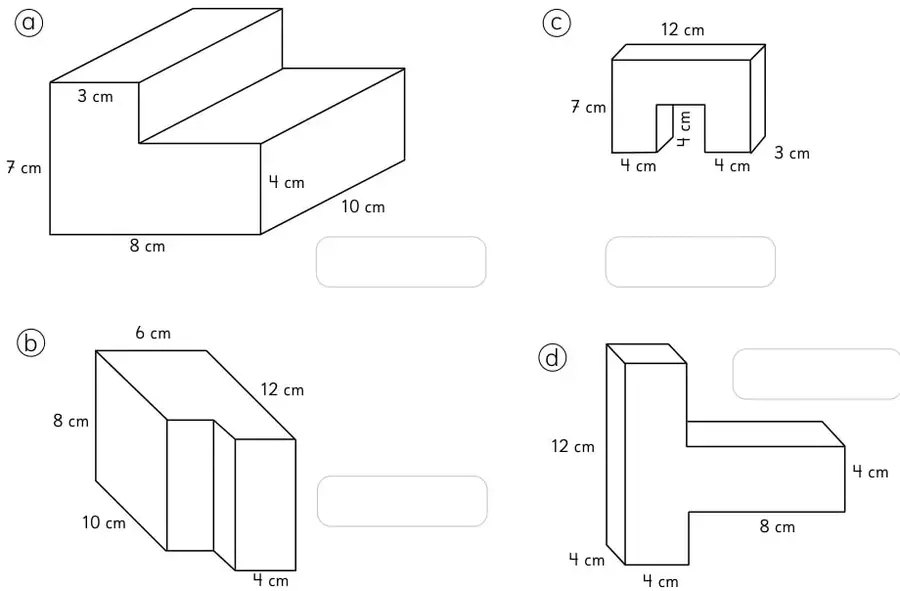
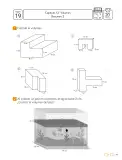
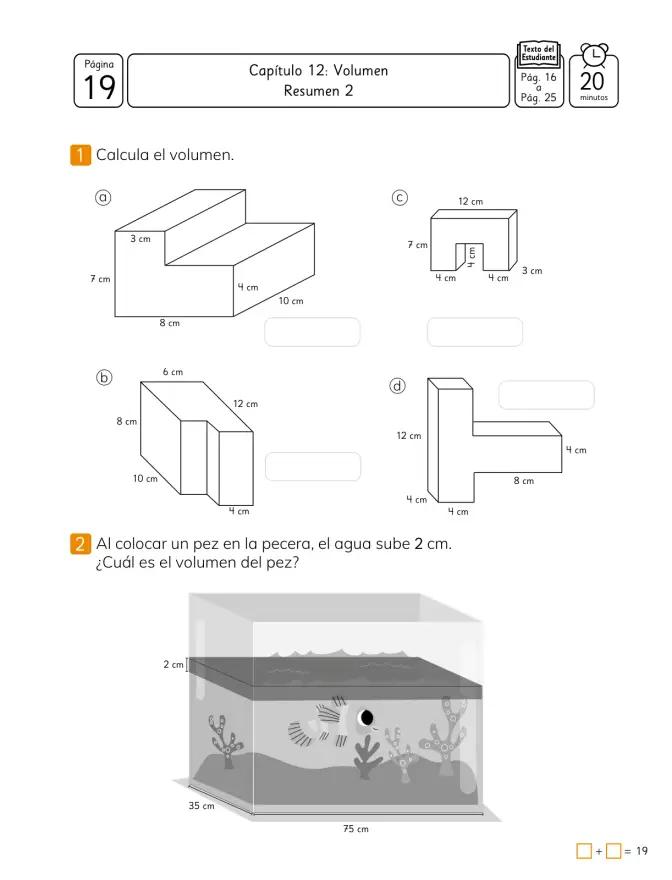
Calcula el volumen de cada cuerpo compuesto.
Parte 1.a
El cuerpo se descompone en dos prismas rectangulares.
- Prisma inferior: 8 \, \text{cm} \times 10 \, \text{cm} \times 4 \, \text{cm}. V_1 = 8 \cdot 10 \cdot 4 = 320 \, \text{cm}^{3}
- Prisma superior: ancho 8 \, \text{cm}, largo 10 \, \text{cm}, alto 3 \, \text{cm}. V_2 = 8 \cdot 10 \cdot 3 = 240 \, \text{cm}^{3}
- Volumen total: V = 320 + 240 = 560 \, \text{cm}^{3}
Respuesta
560 \, \text{cm}^{3}
Parte 1.b
Se descompone en dos prismas rectangulares.
- Prisma mayor: 10 \, \text{cm} \times 12 \, \text{cm} \times 8 \, \text{cm}. V_1 = 10 \cdot 12 \cdot 8 = 960 \, \text{cm}^{3}
- Prisma menor (saliente): 4 \, \text{cm} \times 6 \, \text{cm} \times 8 \, \text{cm}. V_2 = 4 \cdot 6 \cdot 8 = 192 \, \text{cm}^{3}
- Volumen total: V = 960 + 192 = 1152 \, \text{cm}^{3}
Respuesta
1152 \, \text{cm}^{3}
Parte 1.c
Se descompone en dos prismas rectangulares.
- Prisma mayor: 12 \, \text{cm} \times 7 \, \text{cm} \times 3 \, \text{cm}. V_1 = 12 \cdot 7 \cdot 3 = 252 \, \text{cm}^{3}
- Prisma menor (rebaje): 4 \, \text{cm} \times 4 \, \text{cm} \times 3 \, \text{cm}. V_2 = 4 \cdot 4 \cdot 3 = 48 \, \text{cm}^{3}
- Volumen total: V = 252 - 48 = 204 \, \text{cm}^{3}
Respuesta
204 \, \text{cm}^{3}
Parte 1.d
Se descompone en dos prismas rectangulares.
- Prisma vertical: 4 \, \text{cm} \times 4 \, \text{cm} \times 12 \, \text{cm}. V_1 = 4 \cdot 4 \cdot 12 = 192 \, \text{cm}^{3}
- Prisma horizontal: 8 \, \text{cm} \times 4 \, \text{cm} \times 4 \, \text{cm}. V_2 = 8 \cdot 4 \cdot 4 = 128 \, \text{cm}^{3}
- Volumen total: V = 192 + 128 = 320 \, \text{cm}^{3}
Respuesta
320 \, \text{cm}^{3}