
















Ejercicio 1
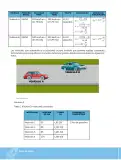
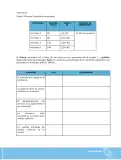
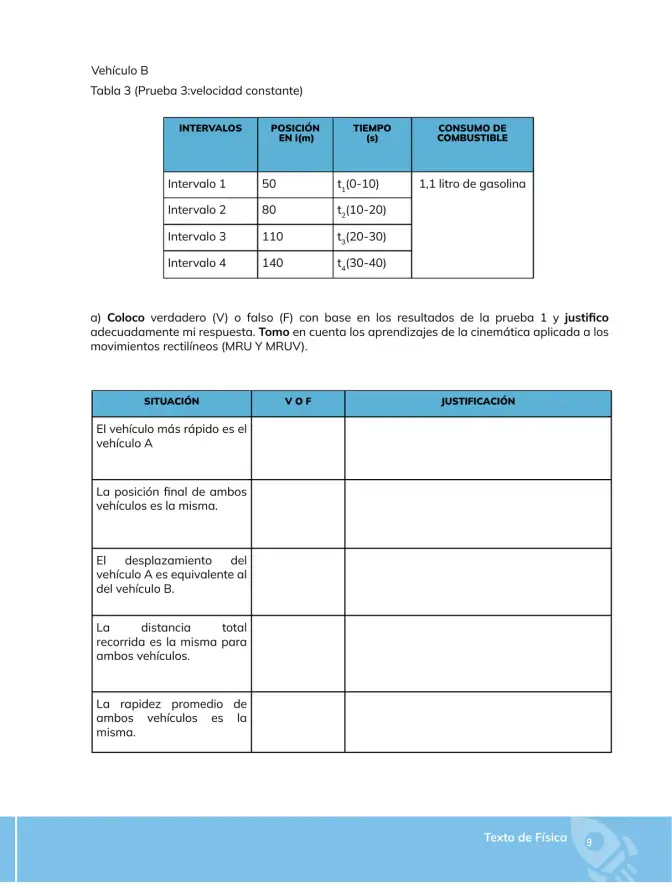
Ejercicio: Análisis de la Tabla 3 — Vehículo B (Prueba 3: velocidad constante)
El enunciado da la tabla del vehículo B (MRU):
| Intervalo | Posición x (m) | Tiempo t (s) |
|---|---|---|
| 1 | 50 | t_1 (0–10) |
| 2 | 80 | t_2 (10–20) |
| 3 | 110 | t_3 (20–30) |
| 4 | 140 | t_4 (30–40) |
Consumo total: 1{,}1 L de gasolina.
- Desplazamiento en cada intervalo: Δx_i = x_{i+1} - x_i.
- Intervalo 1: Δx_1 = 80-50 = 30\ \text{m} en \Delta t = 10\ \text{s}.
- Intervalo 2: Δx_2 = 110-80 = 30\ \text{m} en 10\ \text{s}.
- Intervalo 3: Δx_3 = 140-110 = 30\ \text{m} en 10\ \text{s}.
- Rapidez en cada intervalo: v = \dfrac{\Delta x}{\Delta t} = \dfrac{30\ \text{m}}{10\ \text{s}} = 3\ \text{m/s} (constante) → el movimiento es un MRU.
- Observación sobre el instante inicial: si el vehículo parte de x(0)=0, el intervalo 1 daría v_1 = \dfrac{50\ \text{m}}{10\ \text{s}} = 5\ \text{m/s}, lo que contradice el título “velocidad constante”. La lectura coherente es x(0)=20\ \text{m} (o x_1=30\ \text{m}), de modo que todos los intervalos dan 3\ \text{m/s}.
- Con x(0)=20\ \text{m}: desplazamiento total Δx = 140-20 = 120\ \text{m} en \Delta t = 40\ \text{s}; rapidez promedio v_{p}=\dfrac{120\ \text{m}}{40\ \text{s}} = 3\ \text{m/s}, igual a la velocidad instantánea constante (caso característico del MRU).
- Con x(0)=0: desplazamiento total =140\ \text{m} y v_{p}=\dfrac{140}{40}=3{,}5\ \text{m/s}.
- Consumo específico: \dfrac{1{,}1\ \text{L}}{120\ \text{m}} = 9{,}2\times10^{-3}\ \text{L/m}, es decir \approx 9{,}2 L por cada 1000 m (o \approx 7{,}9 L/km si se usa 140 m).