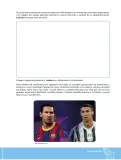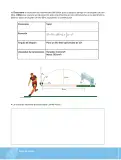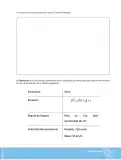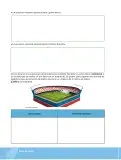

















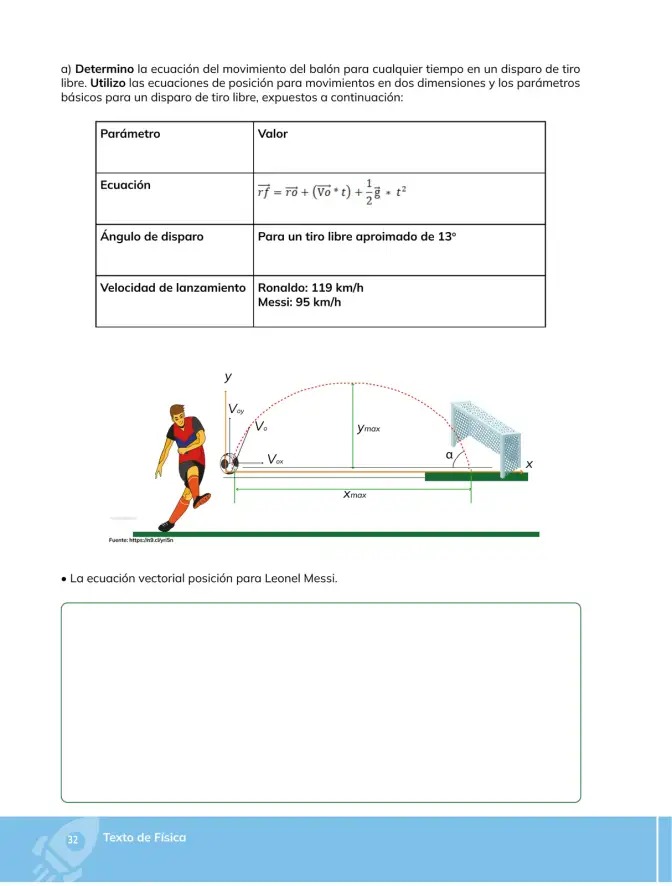
Determinar la ecuación vectorial posición para el tiro libre de Leonel Messi (95 km/h, ángulo de 13°) usando \overrightarrow{r_f}=\overrightarrow{r_0}+(\overrightarrow{v_0}\,t)+\tfrac{1}{2}\overrightarrow{g}\,t^{2}.
Paso 1: Unidades y datos
- Velocidad: v_0 = 95\,\text{km/h} = \dfrac{95}{3.6} = 26.39\,\text{m/s}.
- Ángulo: \alpha = 13^\circ.
- Gravedad: \overrightarrow{g} = -9.8\,\hat{j}\,\text{m/s}^{2} (eje y positivo hacia arriba).
- Origen en el punto de lanzamiento: \overrightarrow{r_0} = 0.
Paso 2: Componentes de la velocidad inicial
v_{0x} = v_0 \cos\alpha = 26.39 \times \cos 13^\circ = 26.39 \times 0.9744 = 25.71\,\text{m/s}
v_{0y} = v_0 \sin\alpha = 26.39 \times \sin 13^\circ = 26.39 \times 0.2250 = 5.94\,\text{m/s}
Por tanto: \overrightarrow{v_0} = 25.71\,\hat{i} + 5.94\,\hat{j}\;\text{m/s}.
Paso 3: Sustitución en la ecuación vectorial
\overrightarrow{r_f}(t) = \underbrace{0}_{\overrightarrow{r_0}} + \left(25.71\,\hat{i} + 5.94\,\hat{j}\right)t + \tfrac{1}{2}\left(-9.8\,\hat{j}\right)t^{2}
\overrightarrow{r_f}(t) = 25.71\,t\,\hat{i} + \left(5.94\,t - 4.9\,t^{2}\right)\hat{j}
Paso 4: Escritas las coordenadas por separado
x(t) = 25.71\,t , con v_{0y} arriba; y
y(t) = 5.94\,t - 4.9\,t^{2} , con g = 9.8\,\text{m/s}^{2} hacia abajo.
Comprobación (valores característicos)
- Tiempo de vuelo (vuelve a y=0): t = \dfrac{2v_{0y}}{g} = \dfrac{2(5.94)}{9.8} = 1.21\,\text{s} .
- Alcance: x_{max} = 25.71 \times 1.21 = 31.1\,\text{m} .
- Altura máxima: y_{max} = \dfrac{v_{0y}^{2}}{2g} = \dfrac{(5.94)^{2}}{19.6} = 1.80\,\text{m} (altura típica para pasar la barrera).
\overrightarrow{r_f}(t) = (25.71\,t)\,\hat{i} + \left(5.94\,t - 4.9\,t^{2}\right)\hat{j}\;\text{metros}.