















Saltar al contenido
MisLibrosTexto
Ad
Ingles 9° · 2024
Libro de Inglés 9 EGB

Ministerio de Educación del Ecuador

13/50

Unlocking Success: The Power of Following Instructions in Class

📄 ejercicios ingles 🎓 secundaria · 9° EGB Ecuador 🇪🇨 EC 🗣 Español
Página 13
13 de 50
Página 13 de Ingles 9° · 2024
Anterior Página 13 / 50 Siguiente

Respuesta rápida

1.a) lesson; classroom rules; positive. 1.b) rules. 1.c) raise our hands. 1.d) wait; others; rule. 1.e) carefully; teachers. 1.f) differences; verbal cues; gestures; misunderstandings. 1.g) eye contact; confidence; rudeness. 1.h) patterns; cultures; cultures. 1.i) nodding. 1.j) example; differences; misunderstandings; lesson.
📚 exercise ingles ⭐⭐ Dificultad 2/5 ⏱ 8 min lectura

Solución — Página 13

Ingles 9° · 2024

1
Ejercicio 1

Completar los espacios en blanco de la conversación entre la profesora y los estudiantes sobre reglas del aula y comunicación intercultural.

a
Parte 1.a

Primer bloque (Teacher)

"Good morning, class. Please take your seats and get ready for today's ___. Before we start, I want to remind you of our ___. These rules are important to ensure that we have a safe and ___ learning environment."

  1. "get ready for today's ___" → pide una actividad escolar: lesson.
  2. "remind you of our ___" → se habla de reglas después: classroom rules.
  3. "safe and ___ learning environment" → adjetivo paralelo a "safe" y positivo: positive.
Respuesta

lesson; classroom rules; positive.

b
Parte 1.b

"Can anyone tell me one of our classroom's ___?"

  1. La profesora pregunta por normas concretas del aula: sustantivo plural: rules (o norms).
Respuesta

rules.

c
Parte 1.c

Turno de Student 1

"We should ___ before speaking."

  1. En clase, antes de hablar se debe esperar el turno: verbo: raise our hands.
Respuesta

raise our hands.

d
Parte 1.d

Respuesta de la Teacher

"We should always ___ before speaking to avoid interrupting ___. Can anyone tell me another ___?"

  1. Confirma la acción de esperar: wait (wait for our turn).
  2. A quién se interrumpe: others.
  3. Pide otra norma: rule.
Respuesta

wait; others; rule.

e
Parte 1.e

Turno de Student 2

"We should listen ___ to our ___."

  1. Adverbio de atención: carefully (o attentively).
  2. A quién se escucha en clase: teachers.
Respuesta

carefully; teachers.

f
Parte 1.f

Bloque sobre comunicación intercultural

"Today, we will be talking about respecting ___. Different cultures use ___, ___, and nonverbbal cues in communication, and understanding these patterns can help avoid ___ and improve cross-cultural interactions."

  1. Tema de respeto entre culturas: differences (cultural differences).
  2. Medios de comunicación (paralelo a "nonverbal cues"): verbal cues y gestures.
  3. Lo que se evita en interacciones interculturales: misunderstandings.
Respuesta

differences; verbal cues; gestures; misunderstandings.

g
Parte 1.g

Ejemplo de la profesora

"For example, in some cultures, direct ___ is seen as a sign of ___, while in others, it is seen as a sign of ___."

  1. Comportamiento comunicativo directo: eye contact (o communication).
  2. En algunas culturas se ve como algo positivo: confidence (o respect).
  3. En otras, como algo negativo: rudeness (o disrespect).
Respuesta

eye contact; confidence; rudeness.

h
Parte 1.h

Continuación

"By understanding these ___, we can communicate more effectively with people from different ___. Can anyone give me an example of a nonverbal cue that is used differently in different ___?"

  1. Lo que se acaba de describir (patrones): patterns.
  2. Origen de las personas: cultures (o countries).
  3. Dónde varía el gesto: cultures.
Respuesta

patterns; cultures; cultures.

i
Parte 1.i

Ejemplo de Student 1

"In some cultures, ___ your head means 'yes,' but in others, it means 'no.'"

  1. Gesto cefálico clásico: nodding (asentir con la cabeza) / shaking (negar). Se acepta "nodding".
Respuesta

nodding (o shaking).

j
Parte 1.j

Cierre de la Teacher

"That's a great ___. It's important to be aware of these ___ to avoid ___. Now, let's get started with today's ___."

  1. Elogio al ejemplo: example.
  2. Aspectos a tener en cuenta: differences (o cues).
  3. Lo que se busca evitar: misunderstandings.
  4. Actividad que inicia: lesson (o activity).
Respuesta

example; differences; misunderstandings; lesson.
Contenido de la página

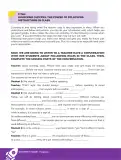
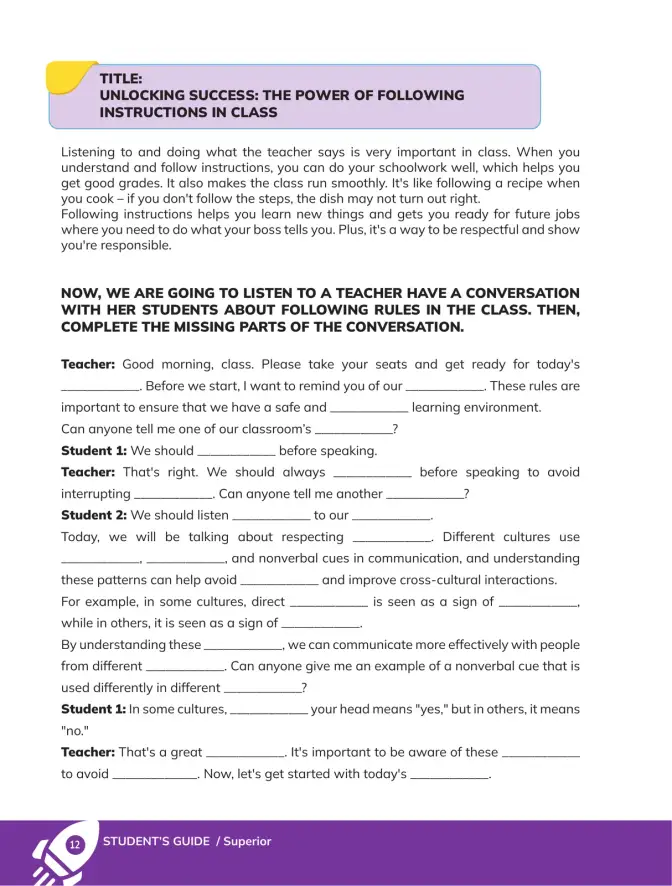
TITLE: UNLOCKING SUCCESS: THE POWER OF FOLLOWING INSTRUCTIONS IN CLASS

Listening to and doing what the teacher says is very important in class. When you understand and follow instructions, you can do your schoolwork well, which helps you get good grades. It also makes the class run smoothly. It's like following a recipe when you cook – if you don't follow the steps, the dish may not turn out right.

Following instructions helps you learn new things and gets you ready for future jobs where you need to do what your boss tells you. Plus, it's a way to be respectful and show you're responsible.

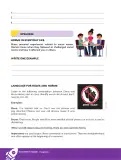
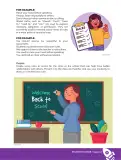
NOW, WE ARE GOING TO LISTEN TO A TEACHER HAVE A CONVERSATION WITH HER STUDENTS ABOUT FOLLOWING RULES IN THE CLASS. THEN, COMPLETE THE MISSING PARTS OF THE CONVERSATION.

Teacher: Good morning, class. Please take your seats and get ready for today's __________. Before we start, I want to remind you of our __________. These rules are important to ensure that we have a safe and __________ learning environment.

Can anyone tell me one of our classroom's __________?

Student 1: We should __________ before speaking.

Teacher: That's right. We should always __________ before speaking to avoid interrupting __________. Can anyone tell me another __________?

Student 2: We should listen __________ to our __________.

Today, we will be talking about respecting __________. Different cultures use __________, __________, and nonverbal cues in communication, and understanding these patterns can help avoid __________ and improve cross-cultural interactions.

For example, in some cultures, direct __________ is seen as a sign of __________, while in others, it is seen as a sign of __________.

By understanding these __________, we can communicate more effectively with people from different __________. Can anyone give me an example of a nonverbal cue that is used differently in different __________?

Student 1: In some cultures, __________ your head means "yes," but in others, it means "no."

Teacher: That's a great __________. It's important to be aware of these __________ to avoid __________. Now, let's get started with today's __________.


STUDENT'S GUIDE / Superior

Ejemplos resueltos

Modelo de analogía del texto: "It's like following a recipe when you cook – if you don't follow the steps, the dish may not turn out right."

La comparación (simile con "like") muestra que seguir instrucciones es como seguir una receta: sin los pasos, el resultado falla. Igualmente, sin seguir al profesor, el trabajo escolar falla.

Tabla

Blank Palabra sugerida Contexto
1 lesson get ready for today's ___
2 classroom rules remind you of our ___
3 positive safe and ___ learning environment
4 rules classroom's ___
5 raise our hands we should ___ before speaking
6 wait always ___ before speaking
7 others interrupting ___
8 rule another ___?
9 carefully listen ___
10 teachers to our ___
11 differences respecting ___
12-13 verbal cues, gestures cultures use ___, ___ and nonverbal cues
14 misunderstandings avoid ___
15 eye contact direct ___
16 confidence sign of ___
17 rudeness sign of ___
18 patterns understanding these ___
19-20 cultures different ___
21 nodding ___ your head
22 example a great ___
23 differences aware of these ___
24 misunderstandings avoid ___
25 lesson today's ___

Glosario (8)

Following instructions
Hacer lo que se pide siguiendo los pasos indicados por alguien (profesor, jefe).
Classroom rules
Normas que la clase acuerda para mantener un ambiente seguro y productivo.
Learning environment
Ambiente o entorno donde se produce el aprendizaje.
Nonverbal cues
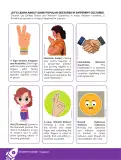
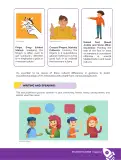
Señales de comunicación sin palabras: gestos, expresiones faciales, contacto visual.
Cross-cultural interactions
Interacciones entre personas de culturas diferentes.
Misunderstanding
Malentendido; interpretación errónea de lo que otro dice o hace.
Eye contact
Contacto visual; mirarse a los ojos al hablar.
Responsible
Persona que cumple con sus obligaciones y responde por sus actos.

Preguntas para practicar

Why is it important to follow instructions in class?

Because it helps students do their schoolwork well, get good grades, keep the class running smoothly, learn new things, prepare for future jobs, and show respect and responsibility.

Give an example of a nonverbal cue that is used differently in different cultures.

In some cultures nodding your head means 'yes', but in others it means 'no'; also, direct eye contact can be a sign of confidence in some cultures and of rudeness in others.

Temas y conceptos clave

Importancia de seguir instrucciones en claseNormas del aula (classroom rules)Comunicación intercultural y gestos no verbalesfollowing instructionsclassroom ruleslearning environmentnonverbal cuescross-cultural interactionsmisunderstandingseye contactcultural differences
¿Te fue útil esta página?

Preguntas que la gente también hace

¿Por qué es importante seguir las instrucciones del profesor en clase?
Consulta la solución completa arriba o explora el libro entero para temas relacionados.
¿Qué son los nonverbal cues y por qué varían entre culturas?
Consulta la solución completa arriba o explora el libro entero para temas relacionados.
¿Cómo completar una actividad de cloze (espacios en blanco) en inglés?
Consulta la solución completa arriba o explora el libro entero para temas relacionados.
📌 Antes de leer esto
  • • Vocabulario básico de normas escolares en inglés
  • • Comprensión lectora de textos expositivos simples
  • • Conocimiento de marcadores de cortesía en inglés
Siguiente tema sugerido
Actividad de listening con la conversación completa y verificación de respuestas
📝 Transcripción de la página (texto seleccionable) 2030 caracteres

TITLE: UNLOCKING SUCCESS: THE POWER OF FOLLOWING INSTRUCTIONS IN CLASS

Listening to and doing what the teacher says is very important in class. When you understand and follow instructions, you can do your schoolwork well, which helps you get good grades. It also makes the class run smoothly. It's like following a recipe when you cook — if you don't follow the steps, the dish may not turn out right.

Following instructions helps you learn new things and gets you ready for future jobs where you need to do what your boss tells you. Plus, it's a way to be respectful and show you're responsible.

NOW, WE ARE GOING TO LISTEN TO A TEACHER HAVE A CONVERSATION WITH HER STUDENTS ABOUT FOLLOWING RULES IN THE CLASS. THEN, COMPLETE THE MISSING PARTS OF THE CONVERSATION.

Teacher: Good morning, class. Please take your seats and get ready for today's

. Before we start, | want to remind you of our __ . These rules are

important to ensure that we have a safe and _ learning environment.

Can anyone tell me one of our classroom’s _ ?

Student 1: We should __________ before speaking.

Teacher: That's right. We should always __ -—_ before speaking to avoid interrupting____________, Can anyone tell me another ______ ?

Student 2: We should listen ___ toour ,

Today, we will be talking about respecting ___________. Different cultures use

, , and nonverbal cues in communication, and understanding

these patterns can help avoid _ and improve cross-cultural interactions.

For example, in some cultures, direct __ is seen as a sign of

while in others, it is seen as a sign of __ .

By understanding these __ , we can communicate more effectively with people from different ___ ___. Can anyone give me an example of a nonverbal cue that is used differently in different __ ?

Student 1: In some cultures,

your head means "yes," but in others, it means

no."

Teacher: That's a great . It's important to be aware ofthese__________

to avoid . . Now, let's get started with today's__

(12) STUDENTS GUIDE / Superior

Ad

Otros libros recomendados

Ver todos →
Ad

Usamos cookies propias y de terceros para personalizar contenido, mostrar publicidad y analizar el tráfico. Las cookies necesarias siempre están activas.