
Página — Ingles 8 (pág. 100)
Solución no disponible aún
Esta página está en proceso de revisión.
Pídela y la resolveremos antes. Sin registro.
📝 Transcripción de la página (texto seleccionable) 3790 caracteres
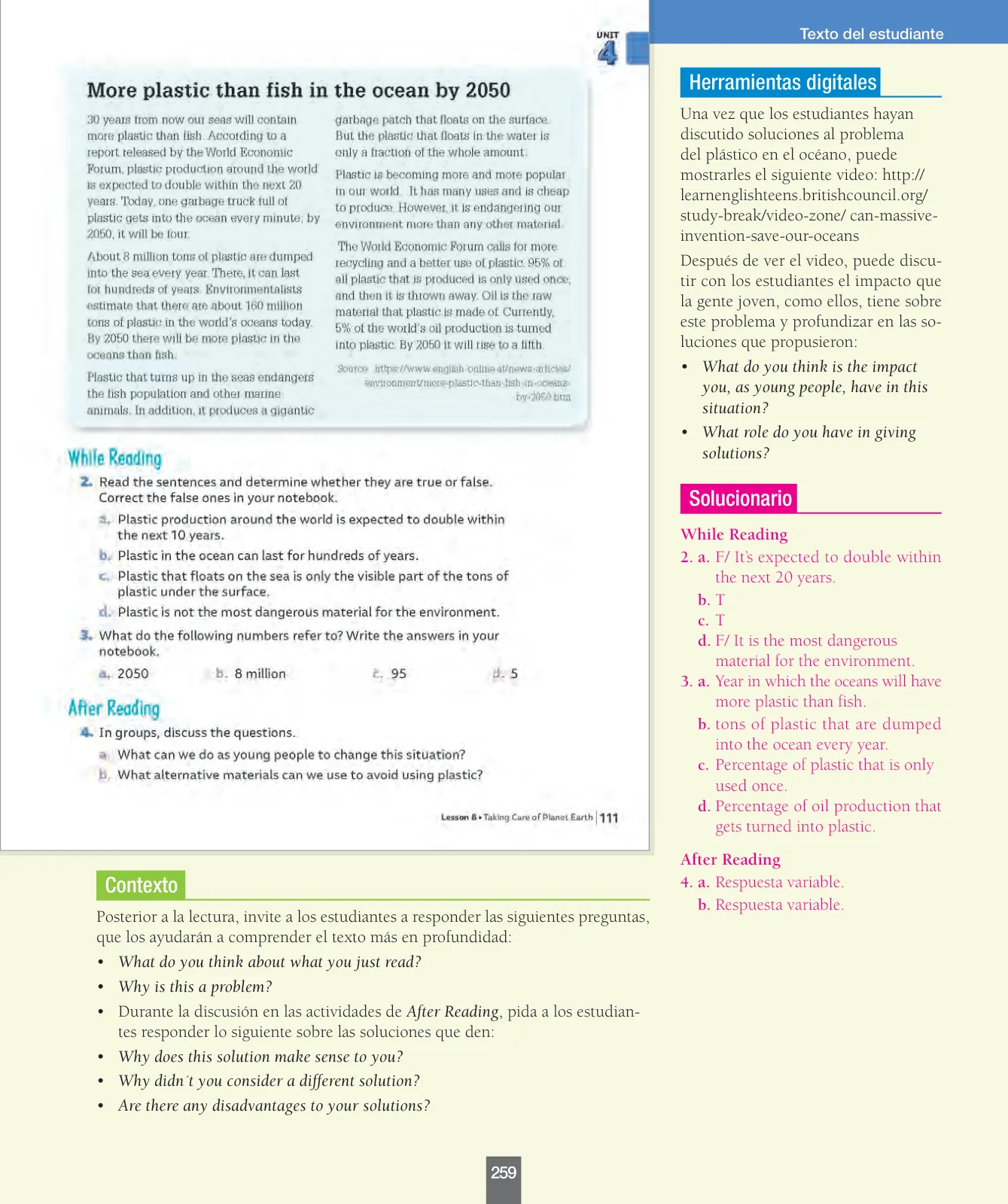
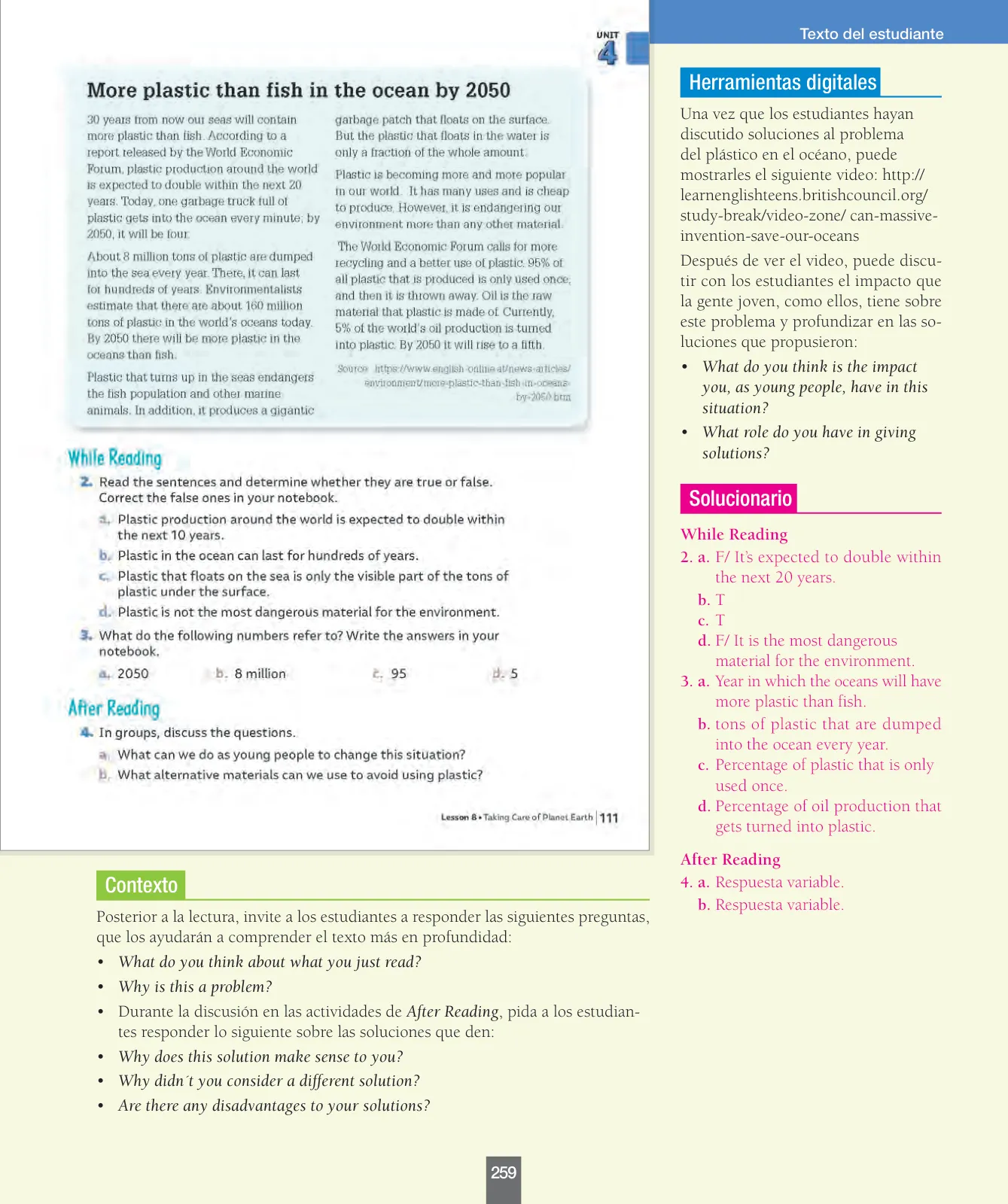
More plastic than fish in the ocean by 2050
30 years from now ou seas will contain more plastic than fish. Aecording to a report released by the World Econonic Forum. plastic production around the world is expected to double within the next 20years. Today.one garbage truck full of plastic gets into the ocean every minute; by 2050, it will be four
About 8 million tons ol plastic are dumped into the sea every year There,it can last for hundreds ofyears Environmentalists estimate that there are about 160 milion tons of plastic in the world's oceans today.By 2050 there will be more plastic in the oceans than hsh.
Plastic that turms up in the seas endangers the tish population and other marine animals. In addition, it produces a gigantic
garbage patch that floats on the surface.But the plastio that floats in the water is only a fraction of the whole amount
Plastic is becoming more and more popular in our world. It has many uses and is cheap to produce, However, it is endangering our environment more than any other material
The Wotld Economic Forum calls for more recycling and a better use o[ plastic. 95% of all plastic that is produced is only used once,and then it is thrown away Oil is the raw material that plastic is made of Currently,5% of the world's oil production is turned into plastic. By 2050 it will rise to a fifth
Souros htps-/www.englishonlliaanews antichas anvionmenvmere-plastic-than fish in-oceana by-2050bmm
Whlle Reading
Z Read the sentences and determine whether they are true or false.Correct the false ones in your notebook.
Plastic production around the world is expected to double within the next 10 years.
b, Plastic in the ocean can last for hundreds of years.
C Plastic that floats on the sea is only the visible part of the tons of plastic under the surface.
d. Plastic is not the most dangerous material for the environment.
- what do the following numbers refer to? Write the answers in your notebook.
a2050b.8million 95d.5
Aer Reading
4 In groups, discuss the questions.
What can we do as young people to change this situation?
B, What alternative materials can we use to avoid using plastic?
Lesson 8-Taking Care of Planet Earth111
Contexto
Posterior a la lectura, invite a los estudiantes a responder las siguientes preguntas,que los ayudarán a comprender el texto más en profundidad:
• What do you think about what you just read?
• Why is this a problem?
Durante la discusión en las actividades de After Reading, pida a los estudiantes responder lo siguiente sobre las soluciones que den:
Why does this solution make sense to you?
Why didn't you consider a different solution?
• Are there any disadvantages to your solutions?
Herramientas digitales
Una vez que los estudiantes hayan discutido soluciones al problema del plástico en el océano, puede mostrarles el siguiente video: http://learnenglishteens.britishcouncil.org/study-break/video-zone/ can-massiveinvention-save-our-oceans
Después de ver el video, puede discutir con los estudiantes el impacto que la gente joven, como ellos, tiene sobre este problema y profundizar en las soluciones que propusieron:
• What do you think is the impact you, as young people, have in this situation?
• What role do you have in giving solutions?
Solucionario
While Reading
- a. F/ It's expected to double within the next 20 years.
b.T
c.T
d. F/ It is the most dangerous material for the environment.
- a. Year in which the oceans will have more plastic than fish.
b. tons of plastic that are dumped into the ocean every year.
c. Percentage of plastic that is only used once.
d. Percentage of oil production that gets turned into plastic.
After Reading
- a. Respuesta variable.
b. Respuesta variable.
Texto del estudiante
259
Otros libros recomendados
Lengua y Literatura – Octavo Básico | Texto del Estudiante MINEDUC – Descargar PDF · 2024
MINEDUC
243 págs.
Lengua y Literatura – Octavo Básico | Texto del Estudiante MINEDUC – Descargar PDF · 2024
MINEDUC
249 págs.
Matemática – Octavo Básico | Texto del Estudiante MINEDUC – Descargar PDF · 2024
MINEDUC
155 págs.
Matemática – Octavo Básico | Texto del Estudiante MINEDUC – Descargar PDF · 2024
MINEDUC
235 págs.
Matemática – Octavo Básico | Texto del Estudiante MINEDUC – Descargar PDF · 2024
MINEDUC
211 págs.
Inglés – Octavo Básico | Student’s Book MINEDUC – Descargar PDF · 2024
MINEDUC
124 págs.
Inglés – Octavo Básico | Student’s Book MINEDUC – Descargar PDF · 2024
MINEDUC
82 págs.
Inglés – Octavo Básico | Student’s Book MINEDUC – Descargar PDF · 2024
MINEDUC
162 págs.