
Página — Ingles 8 (pág. 101)
Solución no disponible aún
Esta página está en proceso de revisión.
Pídela y la resolveremos antes. Sin registro.
📝 Transcripción de la página (texto seleccionable) 4440 caracteres
Unidad 4 • Lección 8
Contexto
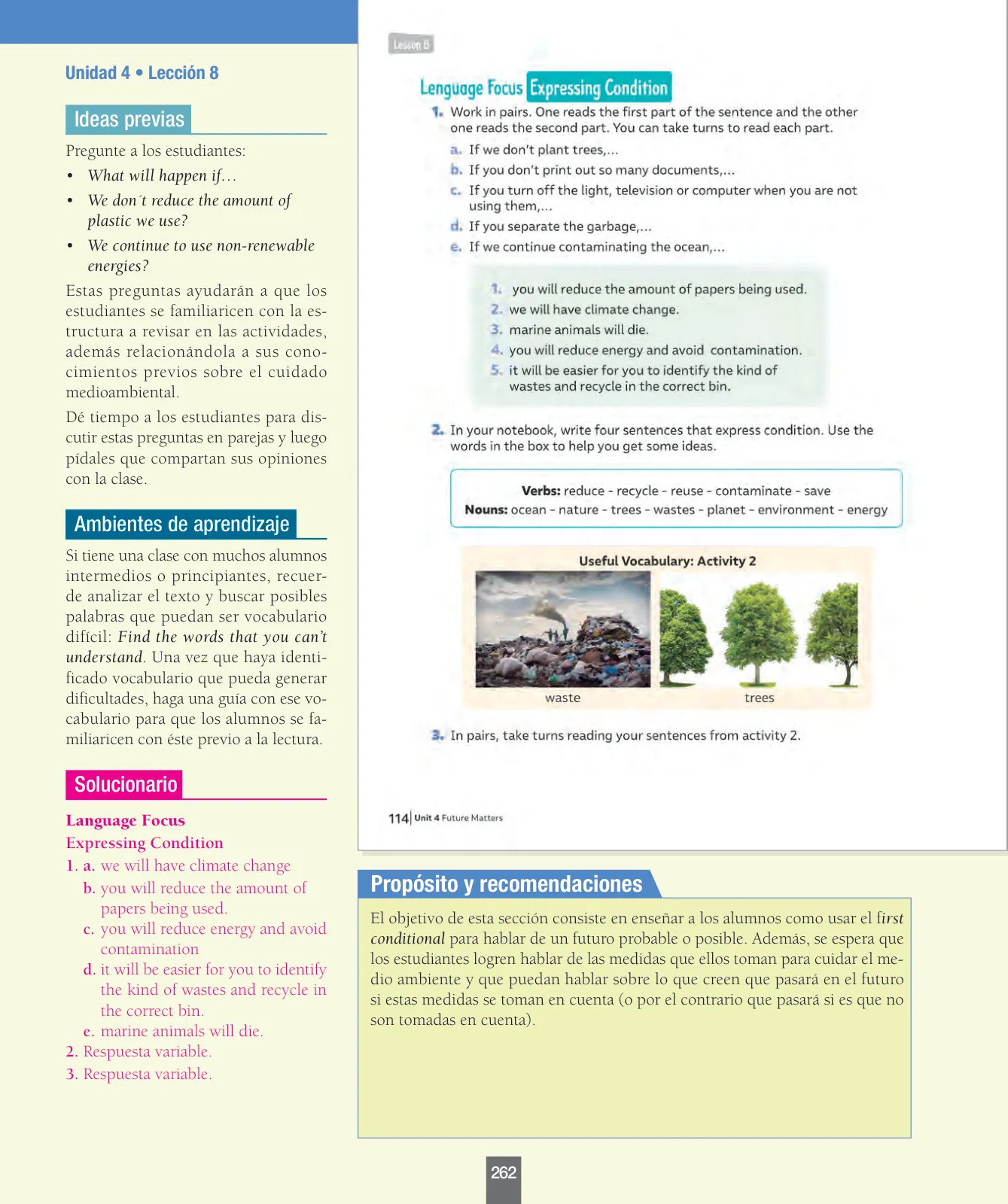
Como contexto a la lectura, puede comentar con los estudiantes lo siguiente: Currently, approximately a 10% of the energy we consume comes from renewable sources. In 2018, Chile led a worldwide ranking (Climatescope) about investment in renewable energies.
La fuente de este dato es: http://www.ren21.net/wp-content/uploads/2018/06/GSR_2018_Highlights_final.pdf http://global-climatescope.org/assets/ data/reports/climatescope-2018-report-en.pdf
Errores frecuentes
Un error frecuente al momento de hacer actividades orales o de escritura, es usar frases demasiado largas y complicadas, ya que el español lo permite de esa forma, sin embargo el inglés no.Los estudiantes pueden crear muchas oraciones y unirlas en una a través del uso de palabras como“and", "or","but","because", etc. Recuerde a sus estudiantes que a menos que la situación lo amerite es mejor usar oraciones cortas y separadas antes que una oración muy compleja usando estos conectores: In English, sentences tend to be shorter than in Spanish. Use short sentences and try to connect them using the following connectors: "and", "or",“but”,“because".
Solucionario
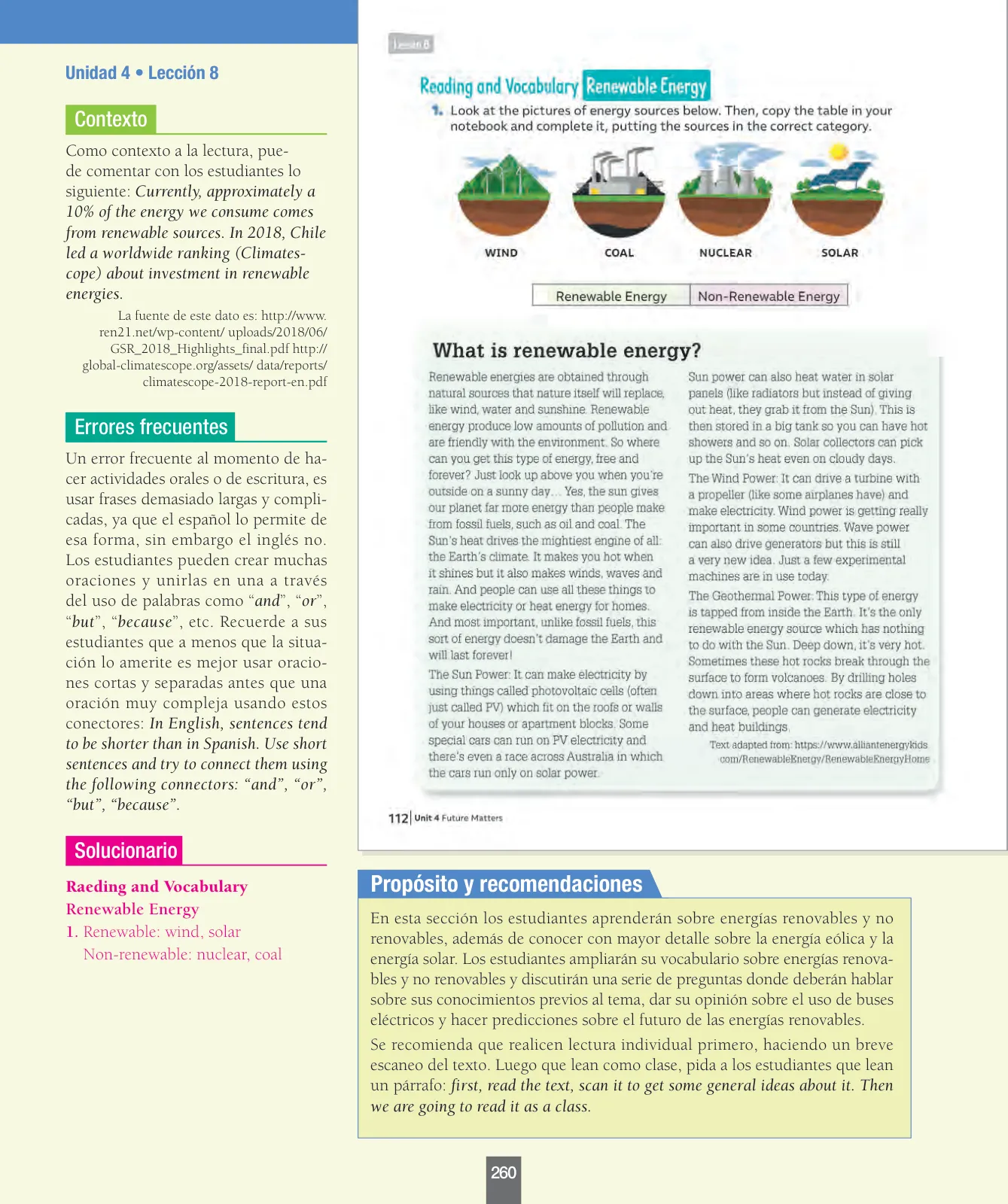
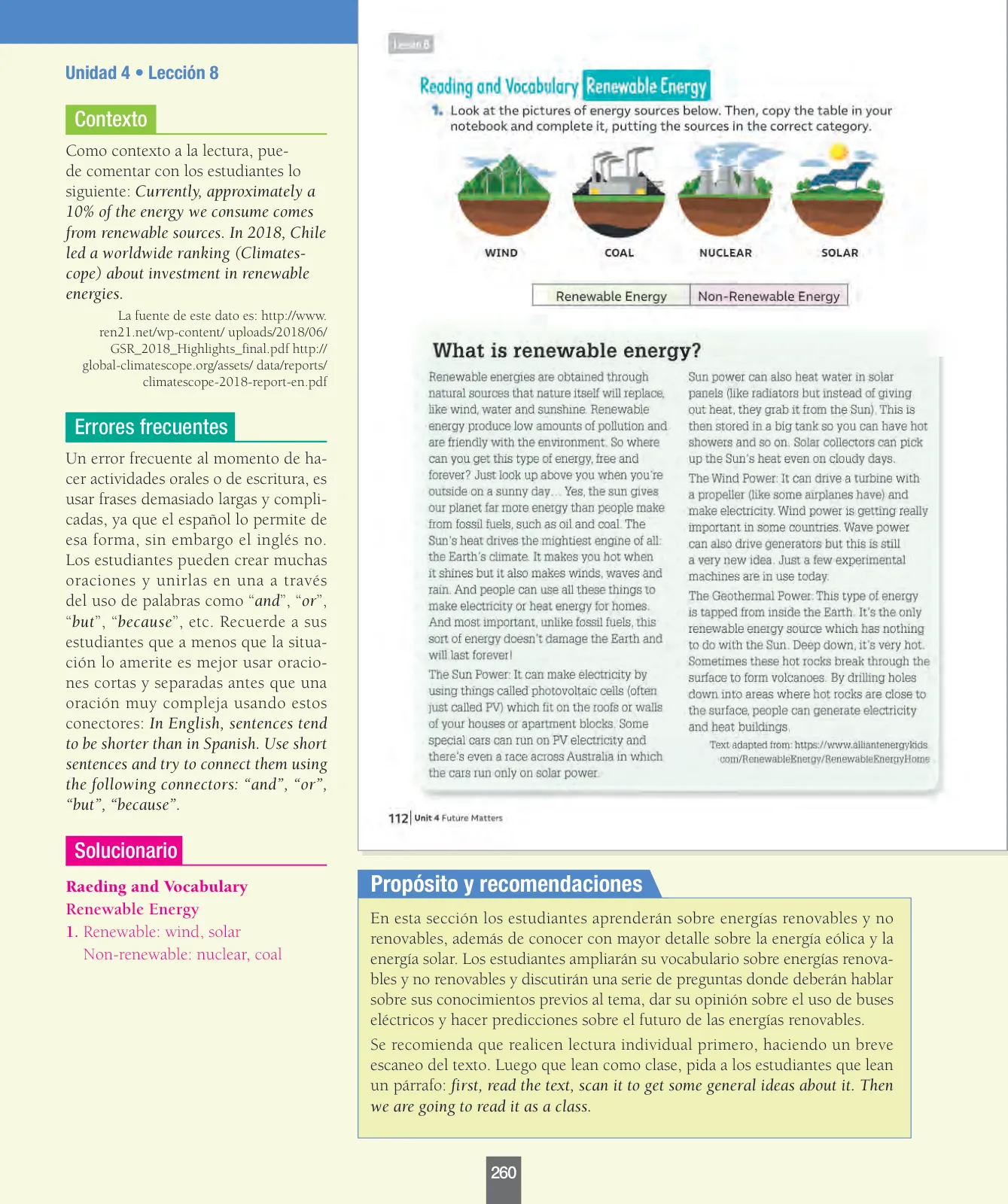
Raeding and Vocabulary Renewable Energy 1. Renewable: wind, solar Non-renewable: nuclear, coal
1n8
Reading and Vocabulary Renewable Energy
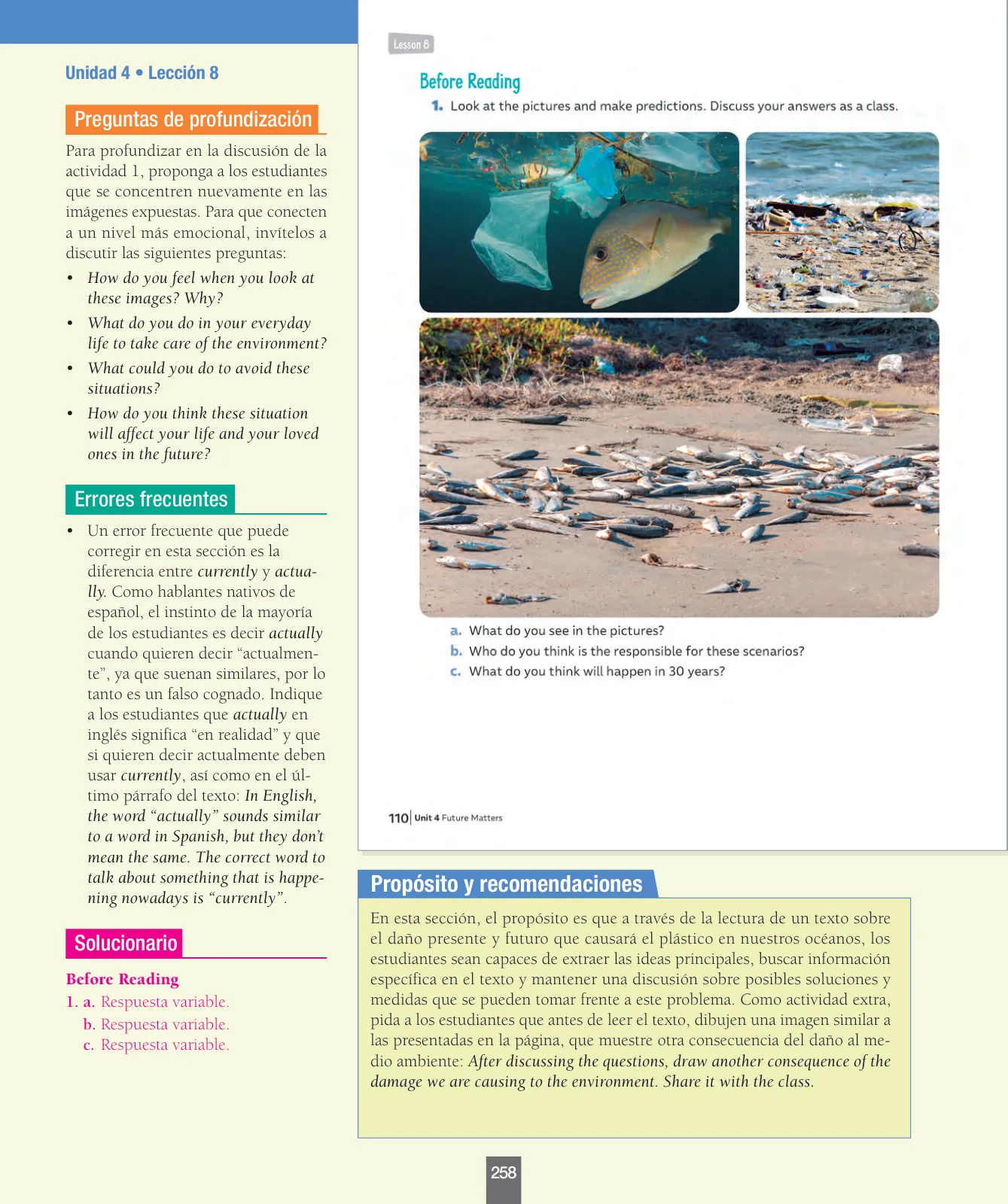
Look at the pictures of energy sources below. Then, copy the table in your notebook and complete it, putting the sources in the correct category.
What is renewable energy?
Renewable energies are obtained through natural sources that nature itself will replace,like wind, water and sunshine. Renewabie energy produce low amounts of pollution and are friendly with the environment. So where can you get this type of energy.free and forever? Just look up above you when you're outside on a sunny day. Yes, the sun gives our planet far more energy than people make from fossil fuels, such as oil and coal The Sun's heat drives the mightiest enqine of all the Earth's climate It makes you hot when it shines but it also makes winds, waves and rain. And people can use all these things to make electricity or heat energy for homes.And most important, unlike fossil fuels, this sort of energy doesn't damage the Earth and will last foreverl
The Sun Power It can make electricity by using things called photovoltaic cells (often just called PV) which fit on the roofs or walls ofyour houses or apartment blocks. Some special cars can run on Pv electricity and there's even a race across Australia in which the cars run only on solar power
112Unit 4Future Matters
Sun power can also heat water in solar panels (like radiators but instead of giving out heat, they grab it from the Sun) This is then stored in a big tank so you can have hot showers and so on Solar collectors can pick up the Sun's heat even on cloudy days.The Wind Power: It can dnive a turbine with a propeller (like some airplanes have) and make electricity. Wind power is getting really important in some countries. Wave power can also drive generators but this is still a very new idea. Just a few experimental machines are in use today.
The Geothenmal Power This type of energy is tapped from inside the Earth It's the only renewable energy source which has nothing to do with the Sun. Deep down, it's very hot.Sometimes these hot rocks break through the surface to form volcanoes. By drilling holes down into areas where hot rocks are close to the surface, people can generate electricity and heat buildings
Text adapted from:https://www.alliantenergykids Com/RenewableEnergy/RenewableEnergyHome
Propósito y recomendaciones
En esta sección los estudiantes aprenderán sobre energías renovables y no renovables, además de conocer con mayor detalle sobre la energía eólica y la energía solar. Los estudiantes ampliarán su vocabulario sobre energías renovables y no renovables y discutirán una serie de preguntas donde deberán hablar sobre sus conocimientos previos al tema, dar su opinión sobre el uso de buses eléctricos y hacer predicciones sobre el futuro de las energías renovables.
Se recomienda que realicen lectura individual primero, haciendo un breve escaneo del texto. Luego que lean como clase, pida a los estudiantes que lean un párrafo: first, read the text, scan it to get some general ideas about it. Then we are going to read it as a class.

Non-Renewable Energy
Renewable Energy
260
Otros libros recomendados
Lengua y Literatura – Octavo Básico | Texto del Estudiante MINEDUC – Descargar PDF · 2024
MINEDUC
243 págs.
Lengua y Literatura – Octavo Básico | Texto del Estudiante MINEDUC – Descargar PDF · 2024
MINEDUC
249 págs.
Matemática – Octavo Básico | Texto del Estudiante MINEDUC – Descargar PDF · 2024
MINEDUC
155 págs.
Matemática – Octavo Básico | Texto del Estudiante MINEDUC – Descargar PDF · 2024
MINEDUC
235 págs.
Matemática – Octavo Básico | Texto del Estudiante MINEDUC – Descargar PDF · 2024
MINEDUC
211 págs.
Inglés – Octavo Básico | Student’s Book MINEDUC – Descargar PDF · 2024
MINEDUC
124 págs.
Inglés – Octavo Básico | Student’s Book MINEDUC – Descargar PDF · 2024
MINEDUC
82 págs.
Inglés – Octavo Básico | Student’s Book MINEDUC – Descargar PDF · 2024
MINEDUC
162 págs.