

















Past Simple vs. Past Continuous: formas y usos
Respuesta rápida
Past simple: acción terminada (did + base). Past continuous: acción en progreso (was/were + -ing). Se combinan con when/while.
Solución — Página 60
Uérakua anapu uantakua. Projects and Readings. Libro de Educación Secundaria Grado 2° Ciclo Escolar 2025 - 2026
Contenido de la página
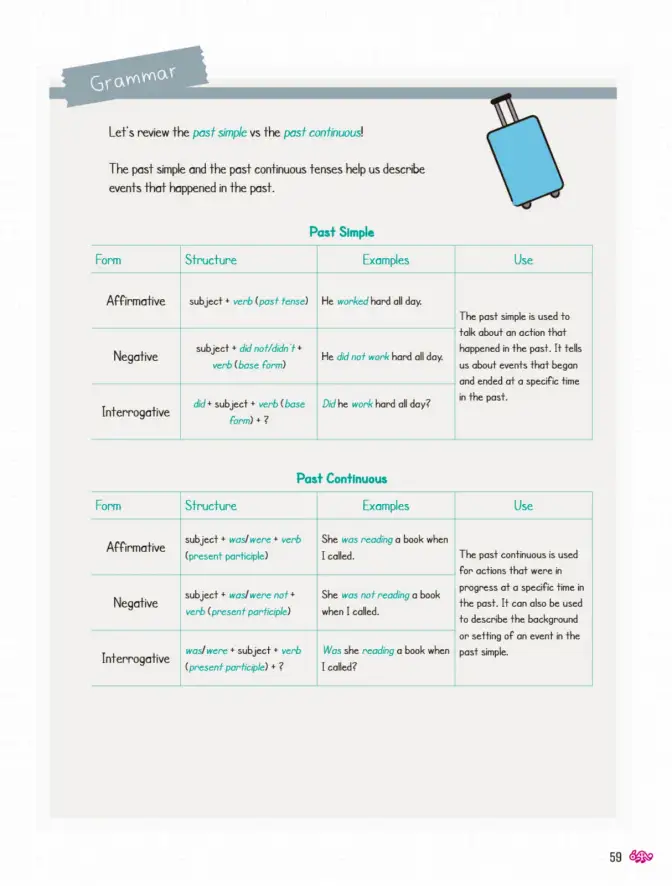
Esta página es una revisión gramatical (no contiene ejercicios). Compara dos tiempos verbales del pasado en inglés: past simple y past continuous.
Past Simple
Se usa para acciones terminadas que comenzaron y acabaron en un momento específico del pasado.
| Forma | Estructura | Ejemplo |
|---|---|---|
| Afirmativa | sujeto + verbo en pasado | He worked hard all day. |
| Negativa | sujeto + did not/didn't + verbo en forma base | He did not work hard all day. |
| Interrogativa | did + sujeto + verbo en forma base + ? | Did he work hard all day? |
Past Continuous
Se usa para acciones en progreso en un momento específico del pasado; también describe el contexto o escenario de un evento en past simple.
| Forma | Estructura | Ejemplo |
|---|---|---|
| Afirmativa | sujeto + was/were + verbo en gerundio | She was reading a book when I called. |
| Negativa | sujeto + was/were not + verbo en gerundio | She was not reading a book when I called. |
| Interrogativa | was/were + sujeto + verbo en gerundio + ? | Was she reading a book when I called? |
Contraste clave
- Past simple = acción puntual y terminada: I called.
- Past continuous = acción en desarrollo que sirve de fondo: She was reading a book...
- Se combinan con when (past simple) y while (past continuous): She was reading when I called.
Respuesta orientativa: El past simple narra hechos concluidos; el past continuous describe lo que estaba ocurriendo en ese momento del pasado.
Contenido de la página
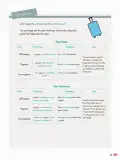
Grammar
Let's review the past simple vs the past continuous!
The past simple and the past continuous tenses help us describe events that happened in the past.
Past Simple
| Form | Structure | Examples | Use |
|---|---|---|---|
| Affirmative | subject + verb (past tense) | He worked hard all day. | The past simple is used to talk about an action that happened in the past. It tells us about events that began and ended at a specific time in the past. |
| Negative | subject + did not/didn't + verb (base form) | He did not work hard all day. | |
| Interrogative | did + subject + verb (base form) + ? | Did he work hard all day? |
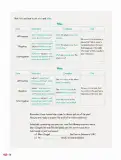
Past Continuous
| Form | Structure | Examples | Use |
|---|---|---|---|
| Affirmative | subject + was/were + verb (present participle) | She was reading a book when I called. | The past continuous is used for actions that were in progress at a specific time in the past. It can also be used to describe the background or setting of an event in the past simple. |
| Negative | subject + was/were not + verb (present participle) | She was not reading a book when I called. | |
| Interrogative | was/were + subject + verb (present participle) + ? | Was she reading a book when I called? |
Ejemplos resueltos
He worked hard all day. (afirmativa, past simple)
Sujeto He + verbo en pasado worked + complemento hard all day. Acción terminada en el pasado.
He did not work hard all day. (negativa, past simple)
Sujeto He + auxiliar did not + verbo en forma base work + complemento.
Did he work hard all day? (interrogativa, past simple)
Auxiliar Did + sujeto he + verbo en forma base work + complemento + signo de interrogación.
She was reading a book when I called. (afirmativa, past continuous)
Sujeto She + was + gerundio reading + complemento. La acción en progreso se interrumpe por when I called (past simple).
She was not reading a book when I called. (negativa, past continuous)
Sujeto She + was not + gerundio reading + complemento.
Was she reading a book when I called? (interrogativa, past continuous)
Was + sujeto she + gerundio reading + complemento + signo de interrogación.
Tablas (2)
| Form | Structure | Examples | Use |
|---|---|---|---|
| Affirmative | subject + verb (past tense) | He worked hard all day. | The past simple is used to talk about an action that happened in the past. It tells us about events that began and ended at a specific time in the past. |
| Negative | subject + did not/didn't + verb (base form) | He did not work hard all day. | |
| Interrogative | did + subject + verb (base form) + ? | Did he work hard all day? |
| Form | Structure | Examples | Use |
|---|---|---|---|
| Affirmative | subject + was/were + verb (present participle) | She was reading a book when I called. | The past continuous is used for actions that were in progress at a specific time in the past. It can also be used to describe the background or setting of an event in the past simple. |
| Negative | subject + was/were not + verb (present participle) | She was not reading a book when I called. | |
| Interrogative | was/were + subject + verb (present participle) + ? | Was she reading a book when I called? |
Diagrama
graph TD
  A[Tiempos del pasado] --> B[Past Simple]
  A --> C[Past Continuous]
  B --> B1[Acción terminada]
  B --> B2[did + base form]
  B --> B3[when]
  C --> C1[Acción en progreso]
  C --> C2[was/were + -ing]
  C --> C3[while]
Glosario (5)
- past simple
- Tiempo verbal que expresa una acción terminada en un momento específico del pasado.
- past continuous
- Tiempo verbal que expresa una acción en progreso en un momento del pasado.
- base form
- Forma base del verbo, sin conjugar (work, read, call).
- present participle
- Gerundio del verbo, terminado en -ing (reading, working).
- auxiliary verb
- Verbo auxiliar que ayuda a formar negativas e interrogativas (did, was, were).
Preguntas para practicar
¿Cuál es la diferencia principal entre el past simple y el past continuous?
El past simple describe una acción terminada que comenzó y acabó en un momento específico del pasado, mientras que el past continuous describe una acción que estaba en progreso en ese momento. A menudo se combinan: el past continuous da el contexto y el past simple indica la acción que interrumpe.
¿Por qué en la negativa e interrogativa del past simple el verbo vuelve a su forma base?
Porque el auxiliar *did* ya carga el tiempo pasado; el verbo principal no necesita conjugarse de nuevo. Por eso se dice *Did he work?* y no *Did he worked?*.
Temas y conceptos clave
Figuras de la página (1)

Preguntas que la gente también hace
¿Cuál es la diferencia entre past simple y past continuous?
¿Cuándo se usa was y cuándo were en past continuous?
¿Cómo se combinan when y while con estos tiempos verbales?
- • Conjugación del verbo to be en pasado (was/were)
- • Formación del pasado simple de verbos regulares e irregulares
- • Uso del auxiliar did para negativas e interrogativas
- • Formación del gerundio (-ing)
📝 Transcripción de la página (texto seleccionable) 1554 caracteres
Let's review the past simple vs the past continuous!
The past simple and the past continuous tenses help us describe events that happened in the past.
Grammar

Past Simple
| Form | Structure | Examples | Use |
| Affirmative | subject + verb(past tense) | He wonked hand allday. | The past simple is used to talk about an action that happened in the past. It tells us about events that began and ended at a specific time in the past. |
| Negative | subject + did not/didn't+ venb (base form) | He did not wonk hand allday. | |
| Interrogative | did+ subject + venb(base form)+ ? | Did he wonk hand allday? |
Past Continuous
| Form | Structure | Examples | Use |
| Affirmative | subject + was/wene + venb (present participle) | She was reading a book when I called. | The past continuous is used for actions that were in progress at a specific time in the past. It can also be used to describe the background or setting of an event in the past simple. |
| Negative | subject + was/ were nof+ verb (present participle) | She was not reading a book when I called. | |
| Interrogative | was/were + subject + venb (present participle) + ? | Was she reading a book when I called? |
59 80
Otros libros recomendados
Colección Sk´asolil. Lenguajes. Libro de Educación Secundaria Grado 2° Ciclo Escolar 2025 - 2026
SEP/CONALITEG
323 págs.
Colección Sk´asolil. Saberes y pensamiento científico. Libro de Educación Secundaria Grado 2° Ciclo Escolar 2025 - 2026
SEP/CONALITEG
339 págs.
Colección Sk´asolil. Ética, naturaleza y sociedades. Libro de Educación Secundaria Grado 2° Ciclo Escolar 2025 - 2026
SEP/CONALITEG
355 págs.
Fichas de Matemática 2 · 2024
Larisa Mansilla Fernández y equipo
100 págs.
Comprensión lectora : manual para el docente de segundo grado de Secundaria 2018 · 2018
MINEDU
194 págs.
Comprensión lectora 2 : manual para el docente de segundo grado de Secundaria · 2017
MINEDU
130 págs.
Fichas de aprendizaje de Comunicación 2 · 2024
Carmen Patricia Cáceres Villanueva y equipo
100 págs.
Uérakua anapu uantakua. Projects and Readings. Libro de Educación Telesecundaria Grado 3° Ciclo Escolar 2025 - 2026
SEP/CONALITEG
187 págs.