Saltar al contenido
MisLibrosTexto
Ad

Environmental Problems: Risk Levels and Vocabulary

📄 ejercicios ciencias-naturales 🎓 otro · 1° TELESECUNDARIA México 🇲🇽 MX 🗣 Español
Página 163
163 de 187
Página 163 de Uérakua anapu uantakua. Projects and Readings.  Libro de Educación Telesecundaria Grado 1°  Ciclo Escolar 2025 - 2026
Anterior Página 163 / 187 Siguiente

Respuesta rápida

  1. Riesgos: alto (agua contaminada), medio (basura en espacios públicos), bajo (no reciclar). 2. Causas: falta de conciencia, sequías, drenaje. Vocabulary: a) biodegradable, b) fuel, c) drought, d) pollution, e) climate change, f) flood, g) litter, h) renewable energy, i) pollution.
📚 exercise ciencias-naturales ⭐⭐ Dificultad 2/5 ⏱ 10 min lectura

Solución — Página 163

Uérakua anapu uantakua. Projects and Readings. Libro de Educación Telesecundaria Grado 1° Ciclo Escolar 2025 - 2026

1
Ejercicio 1

In assembly, analyze the level of risk to health and the environment posed by problems identified in your community. There are three levels: high (red), medium (yellow), and low (green).

  1. Identifica un problema ambiental de tu comunidad, por ejemplo, agua contaminada.
  2. Clasifícalo según su impacto en la salud y el ambiente: alto, medio o bajo.
  3. Justifica la clasificación con un ejemplo concreto.

Respuesta orientativa: Un problema de riesgo alto (rojo) es el agua contaminada que no se puede beber, porque afecta gravemente la salud y el ambiente. Un riesgo medio (amarillo) son los espacios públicos abandonados usados como basureros. Un riesgo bajo (verde) es que los vecinos no reciclen correctamente.

2
Ejercicio 2

In your notebook, list the possible causes of these problems.

  1. Identifica las causas de los problemas ambientales observados.
  2. Relaciona cada causa con el problema correspondiente.
  3. Escribe una lista en tu cuaderno.

Respuesta orientativa: Las causas incluyen falta de conciencia ambiental, espacios públicos descuidados, sequías, fallas en el sistema de drenaje, consumo excesivo de combustibles fósiles y deforestación.

Vocabulary

1
Ejercicio 1

Look up the meanings of: pollution, acid rain, climate change, biodegradable, fuel, renewable energy, drought, litter, flood.

Respuesta orientativa:

  • pollution: contaminación
  • acid rain: lluvia ácida
  • climate change: cambio climático
  • biodegradable: biodegradable
  • fuel: combustible
  • renewable energy: energía renovable
  • drought: sequía
  • litter: basura
  • flood: inundación
Ad
2
Ejercicio 2

Complete the sentences using the researched words.

a
Parte 2.a

Most detergents are __________, they dissolve in the environment.

  1. El detergente se disuelve en el ambiente.
  2. La palabra que indica que puede descomponerse es biodegradable.
Respuesta

biodegradable

b
Parte 2.b

Gasoline is a kind of __________, it makes cars work.

  1. La gasolina es un tipo de combustible.
  2. La palabra es fuel.
Respuesta

fuel

c
Parte 2.c

When it doesn't rain for a very long time, there is a __________.

  1. La falta prolongada de lluvia se llama sequía.
  2. La palabra es drought.
Respuesta

drought

d
Parte 2.d

__________ is very dangerous for plants and animals; the water has chemicals.

  1. El agua con químicos es contaminación.
  2. La palabra es pollution.
Respuesta

pollution

e
Parte 2.e

__________ is a problem for the whole planet. The temperature is getting higher!

  1. El aumento de temperatura global es el cambio climático.
  2. La palabra es climate change.
Respuesta

climate change

f
Parte 2.f

Hurricanes cause big __________ in towns and larger cities.

  1. Los huracanes provocan grandes inundaciones.
  2. La palabra es flood.
Respuesta

flood

g
Parte 2.g

Please, don't throw __________ or trash in the streets.

  1. No arrojar basura en las calles.
  2. La palabra es litter.
Respuesta

litter

h
Parte 2.h

We all must consider using __________ to save the planet.

  1. Para salvar el planeta se debe usar energía renovable.
  2. La palabra es renewable energy.
Respuesta

renewable energy

i
Parte 2.i

__________ is a synonym of contamination. Prevent it!

  1. Contaminación es sinónimo de pollution.
  2. La palabra es pollution.
Respuesta

pollution

Contenido de la página

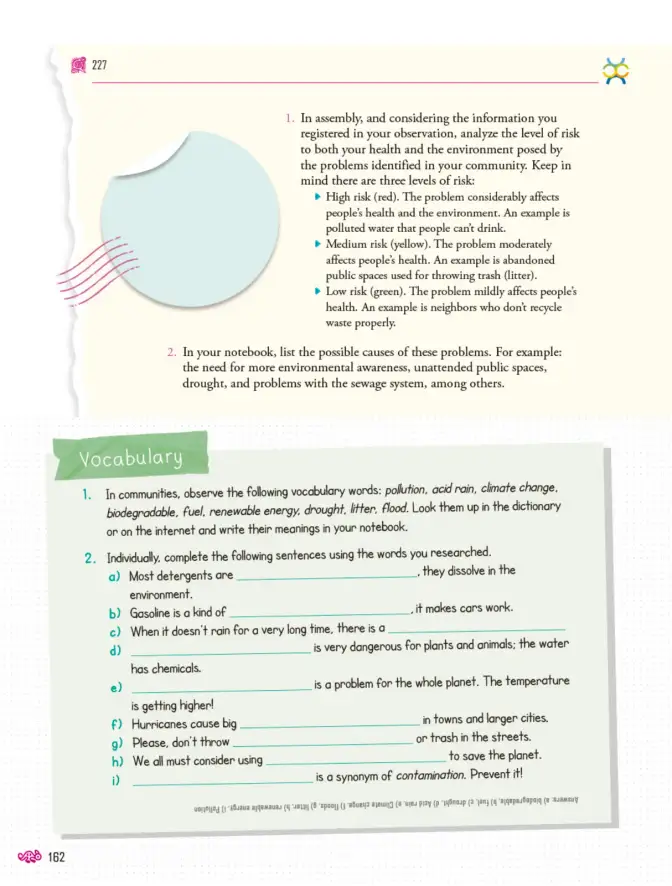
  1. In assembly, and considering the information you registered in your observation, analyze the level of risk to both your health and the environment posed by the problems identified in your community. Keep in mind there are three levels of risk:
  • High risk (red). The problem considerably affects people's health and the environment. An example is polluted water that people can't drink.
  • Medium risk (yellow). The problem moderately affects people's health. An example is abandoned public spaces used for throwing trash (litter).
  • Low risk (green). The problem mildly affects people's health. An example is neighbors who don't recycle waste properly.
  1. In your notebook, list the possible causes of these problems. For example: the need for more environmental awareness, unattended public spaces, drought, and problems with the sewage system, among others.

Vocabulary

  1. In communities, observe the following vocabulary words: pollution, acid rain, climate change, biodegradable, fuel, renewable energy, drought, litter, flood. Look them up in the dictionary or on the internet and write their meanings in your notebook.

  2. Individually, complete the following sentences using the words you researched.

a) Most detergents are __________, they dissolve in the environment.

b) Gasoline is a kind of __________, it makes cars work.

c) When it doesn't rain for a very long time, there is a __________.

d) __________ is very dangerous for plants and animals; the water has chemicals.

e) __________ is a problem for the whole planet. The temperature is getting higher!

f) Hurricanes cause big __________ in towns and larger cities.

g) Please, don't throw __________ or trash in the streets.

h) We all must consider using __________ to save the planet.

i) __________ is a synonym of contamination. Prevent it!

Glosario (9)

pollution
contaminación
acid rain
lluvia ácida
climate change
cambio climático
biodegradable
biodegradable
fuel
combustible
renewable energy
energía renovable
drought
sequía
litter
basura
flood
inundación

Preguntas para practicar

What are the three levels of environmental risk?

High risk (red) considerably affects health and environment; medium risk (yellow) moderately affects health; low risk (green) mildly affects health.

Why is it important to classify environmental problems by risk level?

Clasificar los problemas por nivel de riesgo permite priorizar acciones y recursos para proteger la salud y el ambiente de manera eficiente.

Temas y conceptos clave

Medio ambienteNiveles de riesgoVocabulario en inglésRiesgo altoRiesgo medioRiesgo bajoContaminaciónBiodegradableEnergía renovable
¿Te fue útil esta página?

Figuras de la página (1)

Ilustración de una hoja de papel con líneas rosadas, similar a un sobre o carta.
Figura 1 image

Preguntas que la gente también hace

¿Cuáles son los tres niveles de riesgo ambiental?
Consulta la solución completa arriba o explora el libro entero para temas relacionados.
¿Qué significa biodegradable en inglés?
Consulta la solución completa arriba o explora el libro entero para temas relacionados.
¿Cómo se dice sequía en inglés?
Consulta la solución completa arriba o explora el libro entero para temas relacionados.
📌 Antes de leer esto
  • • Conocimientos básicos de vocabulario en inglés
  • • Identificación de problemas ambientales
Siguiente tema sugerido
Soluciones a problemas ambientales y reciclaje
📝 Transcripción de la página (texto seleccionable) 1686 caracteres
  1. In assembly, and considering the information you registered in your observation, analyze the level of risk to both your health and the environment posed by the problems identified in your community. Keep in mind there are three levels of risk:

High risk (red). The problem considerably affects people's health and the environment. An example is polluted water that people can't drink.

Medium risk (yellow). The problem moderately affects people's health. An example is abandoned public spaces used for throwing trash (litter).

Low risk (green). The problem mildly affects people's health. An example is neighbors who don't recycle waste properly.

  1. In your notebook, list the possible causes of these problems. For example:the need for more environmental awareness, unattended public spaces,drought, and problems with the sewage system, among others.

Vocabulary

1.In communities, observe the following vocabulary words: pollution, acid rain, climate change,biodegradable, fuel, renewable energy, drought, litter, flood. Look them up in the dictionary or on the internet and wnite their meanings in your notebook.

2.]

a) Most detergents are .they dissolve in the enyironment.

b)Gasoline is a kind of , it makes cars work.

c)When it doesn't rain for a very long time, there is a

cw d)is very dangerous for plants and animals; the waten has chemicals.

e)is a problem for the whole planet. The temperatune is getting higher!

f)Hurnicanes cause big in towns and larger cities.

g)Please, don't throw or trash in the streets.

.h)We all must consider using to save the planet.

i)isa synonym of contamination. Prevent it!

227

X

![](page=0,bbox=[98, 197, 510, 570])

162
Ad

Otros libros recomendados

Ver todos →
Ad

Usamos cookies propias y de terceros para personalizar contenido, mostrar publicidad y analizar el tráfico. Las cookies necesarias siempre están activas.