














Página — Uerakua Anapu Uantakua Projects And Readings 1 (pág. 164)
Solución no disponible aún
Esta página está en proceso de revisión.
Pídela y la resolveremos antes. Sin registro.
📝 Transcripción de la página (texto seleccionable) 1894 caracteres
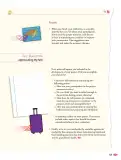
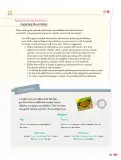
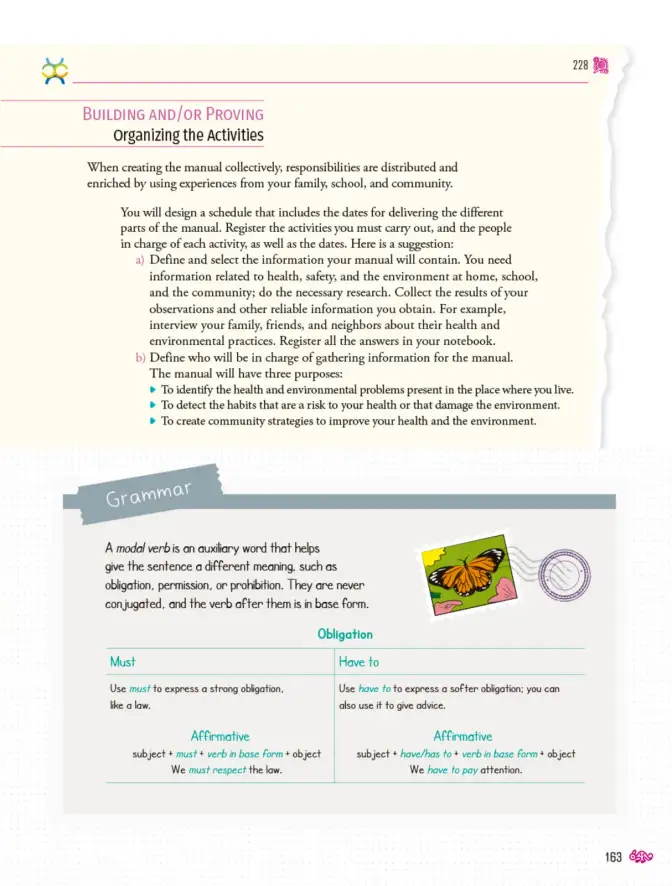
BUILDING AND/OR PROVING Organizing the Activities
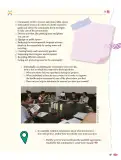
When creating the manual collectively, responsibilities are distributed and enriched by using experiences from your family, school, and community.
You will design a schedule that includes the dates for delivering the different parts of the manual. Register the activities you must carry out, and the people in charge of each activity, as well as the dates. Here is a suggestion:
Define and select the information your manual will contain. You need information related to health, safety, and the environment at home, school,and the community; do the necessary research. Collect the results of your observations and other reliable information you obtain. For example,interview your family, friends, and neighbors about their health and environmental practices. Register all the answers in your notebook.
b) Define who will be in charge of gathering information for the manual.The manual will have three purposes:
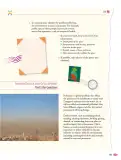
To identify the health and environmental problems present in the place where you live. To detect the habits that are a risk to your health or that damage the environment.
To create community strategies to improve your health and the environment.
Grammar
A modal verb is an auxiliary word that helps give the sentence a different meaning, such as obligation, permission, or prohibition. They are never conjugated, and the verb after them is in base form.
8
2280

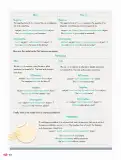
Obligation
| Must | Have to |
| Use must to express a strong obligation, like a law. Affirmative subject +must+ verb in base form+ object We must respect the law. | Use have toto express a softer obligation; you can also use it to give advice. Affirmative subject + have/has to + verb in base form+ object We have to pay attention. |
Otros libros recomendados

Uérakua anapu uantakua. Projects and Readings. Libro de Educación Telesecundaria Grado 3° Ciclo Escolar 2025 - 2026
SEP/CONALITEG
187 págs.

Uérakua anapu uantakua. Projects and Readings. Libro de Educación Telesecundaria Grado 2° Ciclo Escolar 2025 - 2026
SEP/CONALITEG
171 págs.

Colección Ximhai. De lo humano y lo comunitario. Libro de Educación Telesecundaria Grado 1° Ciclo Escolar 2025 - 2026
SEP/CONALITEG
259 págs.

Colección Ximhai. Nuestro libro de Proyectos. Tomo II. Libro de Educación Telesecundaria Grado 1° Ciclo Escolar 2025 - 2026
SEP/CONALITEG
267 págs.

Un libro sin recetas para la maestra y el maestro. Fase 6. Libro de Educación Telesecundaria Grado 1°, 2°, 3° Ciclo Escolar 2025 - 2026
SEP/CONALITEG
203 págs.

Colección Ximhai. Saberes y pensamiento científico. Libro de Educación Telesecundaria Grado 1° Ciclo Escolar 2025 - 2026
SEP/CONALITEG
339 págs.

Colección Ximhai. Nuestro libro de Proyectos. Tomo I. Libro de Educación Telesecundaria Grado 1° Ciclo Escolar 2025 - 2026
SEP/CONALITEG
307 págs.

Colección Ximhai. Nuestro libro de Proyectos. Tomo III. Libro de Educación Telesecundaria Grado 1° Ciclo Escolar 2025 - 2026
SEP/CONALITEG
275 págs.