Saltar al contenido
MisLibrosTexto
Ad

The Relationship Between Food, Culture, and Identity

📄 introduccion ingles 🎓 otro · 1° TELESECUNDARIA México 🇲🇽 MX 🗣 Español
Página 47
47 de 187
Página 47 de Uérakua anapu uantakua. Projects and Readings.  Libro de Educación Telesecundaria Grado 1°  Ciclo Escolar 2025 - 2026
Anterior Página 47 / 187 Siguiente

Respuesta rápida

1.a) Domingo en familia. 1.b) Casa de la abuela. 1.c) La abuela. 1.d) Tomate asado, cilantro y tortillas. 1.e) Maíz, tomate, cebolla, chile y cilantro. 2) Comparar respuestas. 3) La comida evoca recuerdos y transmite herencia cultural.

ingles ⭐ Dificultad 1/5 ⏱ 8 min lectura

Solución — Página 47

Uérakua anapu uantakua. Projects and Readings. Libro de Educación Telesecundaria Grado 1° Ciclo Escolar 2025 - 2026

1
Ejercicio 1

Individually, think of your favorite food and answer the questions.

a
Parte 1.a

When do you eat it?

Respuesta orientativa: I usually eat it on Sunday afternoons, when my whole family gets together for lunch.

b
Parte 1.b

Where do you eat it?

Respuesta orientativa: I eat it at my grandmother's house, around the big wooden table in the kitchen.

c
Parte 1.c

Who prepares it?

Respuesta orientativa: My grandmother prepares it, sometimes with the help of my mother and my aunts.

d
Parte 1.d

Which specific aromas do you associate with it?

Respuesta orientativa: I associate it with the aroma of roasted tomatoes, cilantro, and fresh corn tortillas.

e
Parte 1.e

What ingredients are used for its preparation?

Respuesta orientativa: It is prepared with corn, tomatoes, onion, garlic, cilantro, chili, and sometimes chicken or cheese.

2
Ejercicio 2

Write the answers in your notebook and compare them with two or three classmates.

Respuesta orientativa: Al comparar respuestas se descubre que muchas familias comparten platillos, horarios y aromas parecidos, pero cada estudiante aporta variantes regionales. Eso demuestra que la comida funciona como marcador de identidad individual y colectiva.

3
Ejercicio 3

In community, read the text about food and culture.

Respuesta orientativa: El texto explica que la comida es mucho más que alimento: su aroma evoca recuerdos familiares y lugares, y su preparación transmite conocimientos, costumbres sociales y herencia cultural de una generación a otra. Por eso la comida también representa la etnicidad, pues se vincula con actividades, hábitos, celebraciones, clima y estaciones.

Contenido de la página

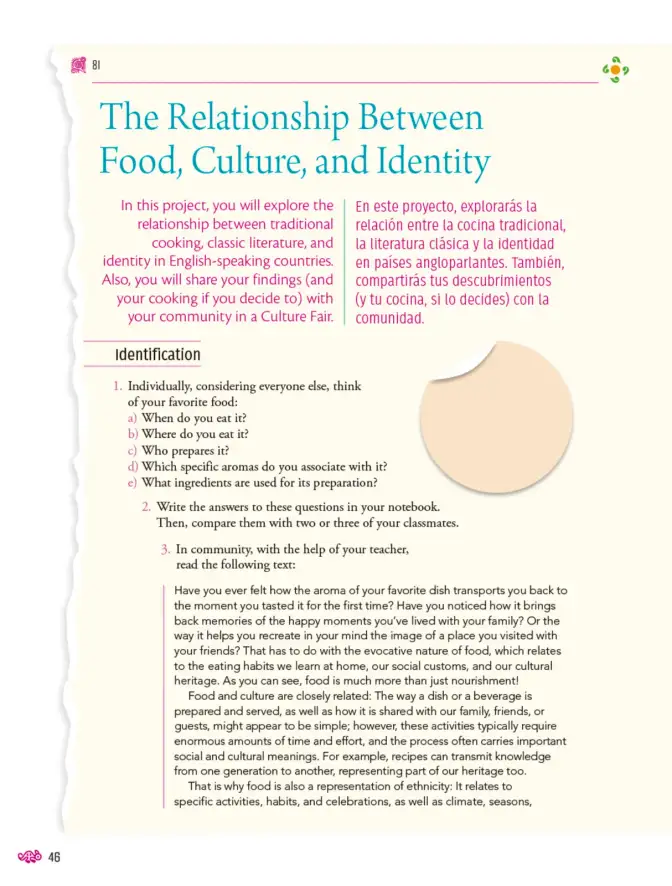
The Relationship Between Food, Culture, and Identity

In this project, you will explore the relationship between traditional cooking, classic literature, and identity in English-speaking countries. Also, you will share your findings (and your cooking if you decide to) with your community in a Culture Fair.

En este proyecto, explorarás la relación entre la cocina tradicional, la literatura clásica y la identidad en países angloparlantes. También, compartirás tus descubrimientos (y tu cocina, si lo decides) con la comunidad.

Identification

  1. Individually, considering everyone else, think of your favorite food: a) When do you eat it? b) Where do you eat it? c) Who prepares it? d) Which specific aromas do you associate with it? e) What ingredients are used for its preparation?

  2. Write the answers to these questions in your notebook. Then, compare them with two or three of your classmates.

  3. In community, with the help of your teacher, read the following text:

Have you ever felt how the aroma of your favorite dish transports you back to the moment you tasted it for the first time? Have you noticed how it brings back memories of the happy moments you've lived with your family? Or the way it helps you recreate in your mind the image of a place you visited with your friends? That has to do with the evocative nature of food, which relates to the eating habits we learn at home, our social customs, and our cultural heritage. As you can see, food is much more than just nourishment!

Food and culture are closely related: The way a dish or a beverage is prepared and served, as well as how it is shared with our family, friends, or guests, might appear to be simple; however, these activities typically require enormous amounts of time and effort, and the process often carries important social and cultural meanings. For example, recipes can transmit knowledge from one generation to another, representing part of our heritage too.

That is why food is also a representation of ethnicity: It relates to specific activities, habits, and celebrations, as well as climate, seasons,

Diagrama

mindmap
  root((Food, Culture and Identity))
    Evocative nature
      Aromas
      Memories
      Places
    Cultural heritage
      Recipes
      Generations
      Social customs
    Ethnicity
      Activities
      Habits
      Celebrations
      Climate and seasons

Glosario (6)

nourishment
alimento o sustento necesario para vivir
evocative
que trae a la mente recuerdos o emociones
heritage
herencia cultural transmitida entre generaciones
ethnicity
identidad cultural de un grupo humano
beverage
bebida
customs
costumbres o prácticas sociales

Preguntas para practicar

Have you ever felt how the aroma of your favorite dish transports you back to the moment you tasted it for the first time?

Sí, los aromas activan la memoria afectiva y traen recuerdos de momentos familiares. La comida funciona como un puente entre el presente y el pasado.

Why is food also a representation of ethnicity?

Porque se relaciona con actividades, hábitos y celebraciones propias de un grupo, así como con el clima y las estaciones de su región. Así, cada platillo expresa la identidad de un pueblo.

Temas y conceptos clave

Comida tradicionalCultura e identidadLiteratura clásicaPaíses angloparlantesFeria culturalIdentidadHerencia culturalEtnicidadNaturaleza evocadora de la comidaCostumbres sociales
¿Te fue útil esta página?

Figuras de la página (1)

Ícono decorativo con hojas verdes y puntos naranjas
Figura 1 image

Preguntas que la gente también hace

¿Cómo se relaciona la comida con la identidad cultural?
Consulta la solución completa arriba o explora el libro entero para temas relacionados.
¿Qué significa que la comida sea una representación de etnicidad?
Consulta la solución completa arriba o explora el libro entero para temas relacionados.
¿Por qué los aromas de la comida evocan recuerdos familiares?
Consulta la solución completa arriba o explora el libro entero para temas relacionados.
📌 Antes de leer esto
  • • Vocabulario básico de alimentos en inglés
  • • Presente simple en inglés
  • • Identificar ideas principales en un texto
Siguiente tema sugerido
Classic literature and food: reading and analysis
📝 Transcripción de la página (texto seleccionable) 2147 caracteres

The Relationship Between Food, Culture, and Identity

In this project, you will explore the relationship between traditional cooking, classic literature, and identity in English-speaking countries.Also, you will share your findings (and your cooking if you decide to) with your community in a Culture Fair.

En este proyecto, explorarás la relación entre la cocina tradicional,la literatura clásica y la identidad en paises angloparlantes. También,compartirás tus descubrimientos (y tu cocina, si lo decides) con la comunidad.

Have you ever felt how the aroma of your favorite dish transports you back to the moment you tasted it for the first time? Have you noticed how it brings back memories of the happy moments you've lived with your family? Or the way it helps you recreate in your mind the image of a place you visited with your friends? That has to do with the evocative nature of food, which relates to the eating habits we learn at home, our social customs, and our cultural heritage. As you can see, food is much more than just nourishment!

Food and culture are closely related: The way a dish or a beverage is prepared and served, as well as how it is shared with our family, friends, or guests, might appear to be simple; however, these activities typically require enormous amounts of time and effort, and the process often carries important social and cultural meanings. For example, recipes can transmit knowledge from one generation to another, representing part of our heritage too.

That is why food is also a representation of ethnicity: It relates to specific activities, habits, and celebrations, as well as climate, seasons,

Identification

  1. Individually, considering everyone else, think of your favorite food:a) When do you eat it? b) Where do you eat it? c)Who prepares it? d) Which specific aromas do you associate with it? e)What ingredients are used for its preparation?

  2. Write the answers to these questions in your notebook.Then, compare them with two or three of your classmates.

  3. In community, with the help of your teacher,read the following text:

81

![](page=0,bbox=[753, 611, 1038, 894])

乐

46
Ad

Otros libros recomendados

Ver todos →
Ad

Usamos cookies propias y de terceros para personalizar contenido, mostrar publicidad y analizar el tráfico. Las cookies necesarias siempre están activas.