














Saltar al contenido
MisLibrosTexto
Ad

Culture, Cultural Heritage and Question Words

📄 teoria ingles 🎓 otro · 1° TELESECUNDARIA México 🇲🇽 MX 🗣 Español
Página 50
50 de 187
Página 50 de Uérakua anapu uantakua. Projects and Readings.  Libro de Educación Telesecundaria Grado 1°  Ciclo Escolar 2025 - 2026
Anterior Página 50 / 187 Siguiente

Respuesta rápida

1.a) Los roles de género excluyen a los jóvenes de la cocina y rompen la transmisión cultural. 1.b) La desvalorización de la comida típica lleva a su abandono. 1.c) Sin difusión ni registro no se protege el patrimonio alimentario. Grammar: who = persona, where = lugar, when = tiempo.

📚 theory ingles ⭐⭐ Dificultad 2/5 ⏱ 8 min lectura

Solución — Página 50

Uérakua anapu uantakua. Projects and Readings. Libro de Educación Telesecundaria Grado 1° Ciclo Escolar 2025 - 2026

1
Ejercicio 1

In communities, read the following causes and discuss why they contribute to the above-mentioned problem situations in "Retrieval." If necessary, write another reason.

a
Parte 1.a

Cause 1. Young people do not frequently participate in food preparation, due to gender roles.

  1. Los roles de género asignan la cocina tradicional a las mujeres adultas, por lo que los jóvenes quedan excluidos de esa práctica.
  2. Al no participar, los jóvenes no aprenden recetas, técnicas ni el significado cultural de los platillos.
  3. Sin esa transmisión intergeneracional, la tradición culinaria pierde continuidad y puede desaparecer.
Respuesta

Esta causa contribuye al problema porque la división de tareas por género impide que los jóvenes adquieran el conocimiento culinario de la comunidad, rompiendo la cadena de transmisión cultural.

b
Parte 1.b

Cause 2. The preparation and presentation of typical food from the community or region is not important nor culturally or artistically representative.

  1. Si la comunidad considera que su comida típica no es importante ni representativa, deja de prepararla en fiestas y celebraciones.
  2. La falta de valoración cultural reduce la motivación para conservar recetas y presentaciones tradicionales.
  3. Con el tiempo, los platillos típicos son reemplazados por alimentos industrializados o de otras regiones.
Respuesta

Esta causa contribuye porque la desvalorización cultural de la comida típica lleva a su abandono, debilitando la identidad y el patrimonio gastronómico local.

c
Parte 1.c

Cause 3. There are no tools to promote the region's typical food or to identify which foods are part of the community's cultural heritage.

  1. Sin herramientas de promoción (ferias, recetarios, redes, museos comunitarios), la comida típica no se difunde fuera de la comunidad.
  2. Sin un registro o inventario, no se sabe con certeza qué platillos forman parte del patrimonio cultural.
  3. Esa ausencia de identificación dificulta protegerlos y enseñarlos a las nuevas generaciones.
Respuesta

Esta causa contribuye porque la falta de difusión y de registro impide reconocer y proteger los alimentos como patrimonio cultural, favoreciendo su olvido.

d
Parte 1.d

(razón adicional)

Another reason: Many young people migrate to cities or other countries and stop cooking traditional food.

Grammar

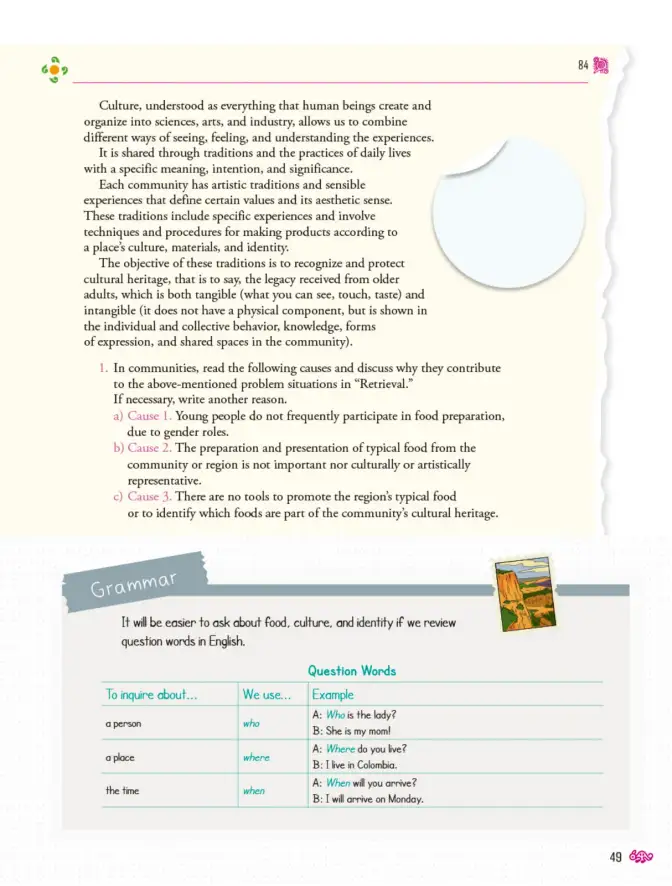
It will be easier to ask about food, culture, and identity if we review question words in English.

To inquire about... We use... Example
a person who A: Who is the lady? B: She is my mom!
a place where A: Where do you live? B: I live in Colombia.
the time when A: When will you arrive? B: I will arrive on Monday.

Respuesta orientativa: Las question words sirven para preguntar por información específica: who para personas, where para lugares y when para el tiempo. Se colocan al inicio de la pregunta y van seguidas de un verbo auxiliar o del verbo to be.

Respuesta

La migración juvenil aleja a los jóvenes de las prácticas culinarias de su comunidad, lo que también provoca la pérdida de recetas y tradiciones alimentarias.


Contenido de la página

Culture, understood as everything that human beings create and organize into sciences, arts, and industry, allows us to combine different ways of seeing, feeling, and understanding the experiences.

It is shared through traditions and the practices of daily lives with a specific meaning, intention, and significance.

Each community has artistic traditions and sensible experiences that define certain values and its aesthetic sense. These traditions include specific experiences and involve techniques and procedures for making products according to a place's culture, materials, and identity.

The objective of these traditions is to recognize and protect cultural heritage, that is to say, the legacy received from older adults, which is both tangible (what you can see, touch, taste) and intangible (it does not have a physical component, but is shown in the individual and collective behavior, knowledge, forms of expression, and shared spaces in the community).

  1. In communities, read the following causes and discuss why they contribute to the above-mentioned problem situations in "Retrieval." If necessary, write another reason.

a) Cause 1. Young people do not frequently participate in food preparation, due to gender roles.

b) Cause 2. The preparation and presentation of typical food from the community or region is not important nor culturally or artistically representative.

c) Cause 3. There are no tools to promote the region's typical food or to identify which foods are part of the community's cultural heritage.

Grammar

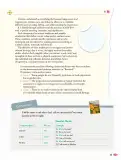
It will be easier to ask about food, culture, and identity if we review question words in English.

Question Words

To inquire about... We use... Example
a person who A: Who is the lady? B: She is my mom!
a place where A: Where do you live? B: I live in Colombia.
the time when A: When will you arrive? B: I will arrive on Monday.

Ejemplos resueltos

A: Who is the lady? B: She is my mom!

Who se usa para preguntar por una persona. La respuesta identifica a la persona: She is my mom!

A: Where do you live? B: I live in Colombia.

Where se usa para preguntar por un lugar. La respuesta indica el lugar: I live in Colombia.

A: When will you arrive? B: I will arrive on Monday.

When se usa para preguntar por el tiempo. La respuesta indica cuándo: I will arrive on Monday.

Tabla

To inquire about... We use... Example
a person who A: Who is the lady? B: She is my mom!
a place where A: Where do you live? B: I live in Colombia.
the time when A: When will you arrive? B: I will arrive on Monday.

Diagrama

mindmap
  root((Culture))
    Tangible Heritage
      Food
      Crafts
      Buildings
    Intangible Heritage
      Traditions
      Knowledge
      Language
    Question Words
      Who
      Where
      When

Glosario (6)

Culture
Todo lo que los seres humanos crean y organizan en ciencias, artes e industria.
Cultural heritage
Legado recibido de los mayores, tangible e intangible.
Tangible
Que se puede ver, tocar o saborear.
Intangible
Sin componente físico; se muestra en comportamientos, conocimientos y expresiones.
Gender roles
Expectativas sociales asignadas a hombres y mujeres.
Question words
Palabras interrogativas en inglés: who, where, when, etc.

Preguntas para practicar

Why do young people not frequently participate in food preparation?

Because gender roles traditionally assign cooking to women, so young people are excluded from learning these practices.

How can we promote the region's typical food?

We can organize food fairs, create community recipe books, and share traditional dishes on social media to value them.

Temas y conceptos clave

CulturaPatrimonio culturalTradiciones alimentariasQuestion wordsCulturaPatrimonio tangiblePatrimonio intangibleIdentidadWhoWhereWhen
¿Te fue útil esta página?

Figuras de la página (2)

Recuadro blanco con borde curvo, probablemente para escribir o ilustrar.
Figura 1 image
Pequeña ilustración de un paisaje con un camino y montañas.
Figura 2 image

Preguntas que la gente también hace

¿Qué es el patrimonio cultural tangible e intangible?
Consulta la solución completa arriba o explora el libro entero para temas relacionados.
¿Cómo se usan las question words who, where y when en inglés?
Consulta la solución completa arriba o explora el libro entero para temas relacionados.
¿Por qué se pierden las tradiciones alimentarias en las comunidades?
Consulta la solución completa arriba o explora el libro entero para temas relacionados.
📌 Antes de leer esto
  • • Vocabulario básico en inglés sobre comida y cultura
  • • Uso del verbo to be y auxiliares do/does/will
  • • Noción general de cultura y tradición
Siguiente tema sugerido
Preguntas con question words sobre comida, cultura e identidad
📝 Transcripción de la página (texto seleccionable) 2148 caracteres

Culture, understood as everything that human beings create and organize into sciences, arts, and industry, allows us to combine different ways of seeing, feeling, and understanding the experiences

It is shared through traditions and the practices of daily lives with a specific meaning, intention, and significance.

Each community has artistic traditions and sensible experiences that define certain values and its aesthetic sense.These traditions include specific experiences and involve techniques and procedures for making products according to a place's culture, materials, and identity.

The objective of these traditions is to recognize and protect cultural heritage, that is to say, the legacy received from older adults, which is both tangible (what you can see, touch, taste) and intangible (it does not have a physical component, but is shown in the individual and collective behavior, knowledge, forms of expression, and shared spaces in the community).

  1. In communities, read the following causes and discuss why they contribute to the above-mentioned problem situations in "Retrieval."

If necessary, write another reason.

a) Cause 1. Young people do not frequently participate in food preparation,due to gender roles.

b) Cause 2. The preparation and presentation of typical food from the community or region is not important nor culturally or artistically representative.

c) Cause 3. There are no tools to promote the region's typical food or to identify which foods are part of the community's cultural heritage.

Grammar

It will be easier to ask about food, culture, and identity if we review question words in English.

,

84

![](page=0,bbox=[776, 243, 1061, 527])

![](page=0,bbox=[893, 1000, 1003, 1139])

Question Words

To inquire about...We use....Example
a pensonwhoA: Who is the lady? B: She is my mom!
a placewhereA: Whenedo you live? B: I live in Colombia.
the timewhenA: When will you arrive? B: I will arrive on Monday.

49

乐

Ad

Otros libros recomendados

Ver todos →
Ad

Usamos cookies propias y de terceros para personalizar contenido, mostrar publicidad y analizar el tráfico. Las cookies necesarias siempre están activas.