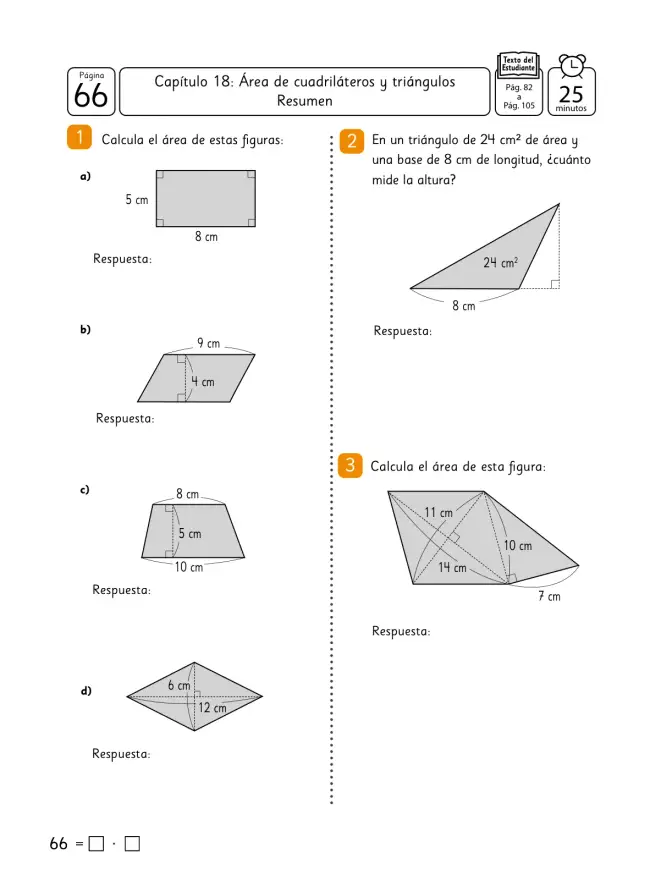
Ejercicio 1
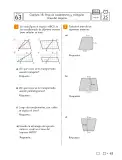
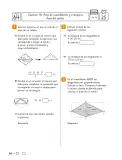
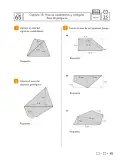
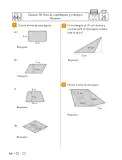
Calcula el área de estas figuras.
Parte 1.a
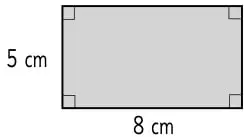
Rectángulo
- Datos: base b = 8\,\text{cm}, altura h = 5\,\text{cm}.
- Fórmula: A = b \cdot h.
- Sustituyo: A = 8 \cdot 5 = 40.
Respuesta
A = 40\,\text{cm}^{2}.
Parte 1.b
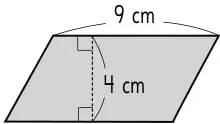
Paralelogramo
- Datos: base b = 9\,\text{cm}, altura h = 4\,\text{cm}.
- Fórmula: A = b \cdot h.
- Sustituyo: A = 9 \cdot 4 = 36.
Respuesta
A = 36\,\text{cm}^{2}.
Parte 1.c
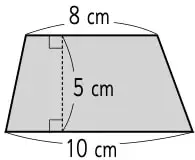
Trapecio
- Datos: base mayor B = 10\,\text{cm}, base menor b = 8\,\text{cm}, altura h = 5\,\text{cm}.
- Fórmula: A = \frac{(B + b) \cdot h}{2}.
- Sumo las bases: B + b = 10 + 8 = 18.
- Multiplico por la altura: 18 \cdot 5 = 90.
- Divido por 2: A = \frac{90}{2} = 45.
Respuesta
A = 45\,\text{cm}^{2}.
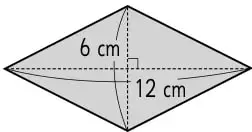
Parte 1.d
Rombo
- Datos: diagonal mayor D = 12\,\text{cm}, diagonal menor d = 6\,\text{cm}.
- Fórmula: A = \frac{D \cdot d}{2}.
- Multiplico las diagonales: 12 \cdot 6 = 72.
- Divido por 2: A = \frac{72}{2} = 36.
Respuesta
A = 36\,\text{cm}^{2}.