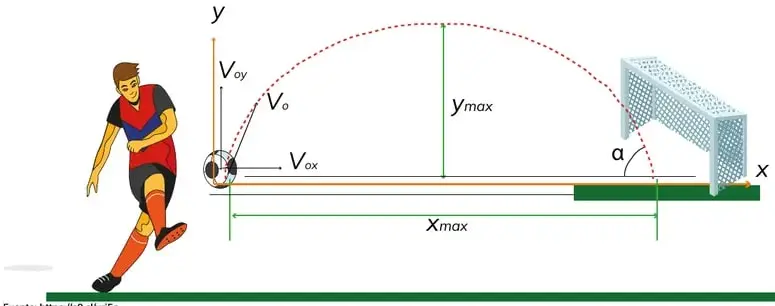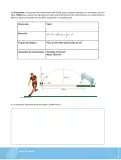

















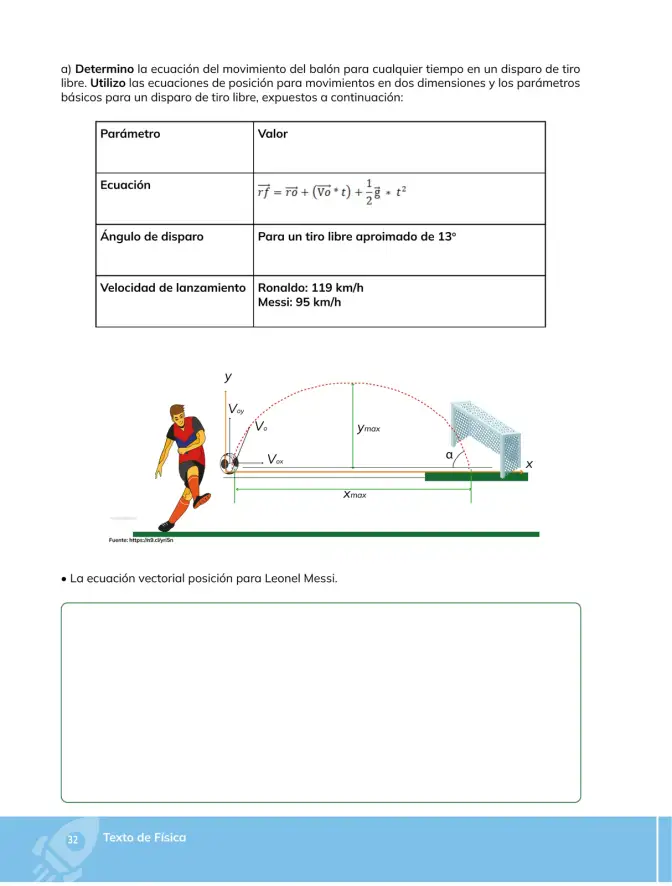
Determinar la ecuación vectorial de posición del balón para cualquier tiempo en el tiro libre de Lionel Messi, con θ = 13^\circ y v_{0} = 95\ \text{km/h}.
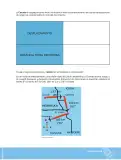
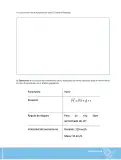
Datos del problema (tabla de la página): ecuación general \overrightarrow{r_{f}} = \overrightarrow{r_{o}} + (\overrightarrow{v_{o}}\cdot t) + \tfrac{1}{2}\overrightarrow{g}\,t^{2}; ángulo de disparo \alpha = 13^\circ; velocidad de Messi v_{o} = 95\ \text{km/h}.
Tomamos el origen de coordenadas en el punto de lanzamiento: \overrightarrow{r_{o}} = 0\,\hat{i} + 0\,\hat{j}.
Convertimos la velocidad a SI: v_{o} = \frac{95\ \text{km/h}}{3.6} = 26.39\ \text{m/s}
Descomponemos \overrightarrow{v_{o}} en sus componentes: v_{ox} = v_{o}\cos\alpha = 26.39\times\cos 13^\circ = 26.39\times 0.9744 = 25.71\ \text{m/s} v_{oy} = v_{o}\sen\alpha = 26.39\times\sen 13^\circ = 26.39\times 0.2250 = 5.94\ \text{m/s} \overrightarrow{v_{o}} = 25.71\,\hat{i} + 5.94\,\hat{j}\ (\text{m/s})
El vector gravedad apunta hacia abajo: \overrightarrow{g} = 0\,\hat{i} - 9.8\,\hat{j}\ \text{m/s}^{2}, por tanto \tfrac{1}{2}\overrightarrow{g}\,t^{2} = -4.90\,t^{2}\,\hat{j}
Sustituimos en la ecuación general: \overrightarrow{r_{f}}(t) = (0\,\hat{i}+0\,\hat{j}) + (25.71\,\hat{i} + 5.94\,\hat{j})\,t + (-4.90\,t^{2}\,\hat{j})
Agrupando componentes: \overrightarrow{r_{f}}(t) = (25.71\,t)\,\hat{i} + (5.94\,t - 4.90\,t^{2})\,\hat{j}
Equivalentemente, en forma escalar: x(t) = 25.71\,t y y(t) = 5.94\,t - 4.90\,t^{2}, con t en segundos y las coordenadas en metros.
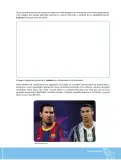
Comprobación opcional (Ronaldo, 119 km/h): v_{o} = 33.06\ \text{m/s}, \overrightarrow{v_{o}} = 32.21\,\hat{i} + 7.44\,\hat{j}, luego \overrightarrow{r_{f}}(t) = (32.21\,t)\,\hat{i} + (7.44\,t - 4.90\,t^{2})\,\hat{j}.
\overrightarrow{r_{f}}(t) = (25.71\,t)\,\hat{i} + (5.94\,t - 4.90\,t^{2})\,\hat{j} (m).