
















Ejercicio 1
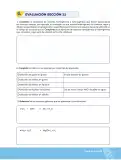
Ejercicio (caja 1)
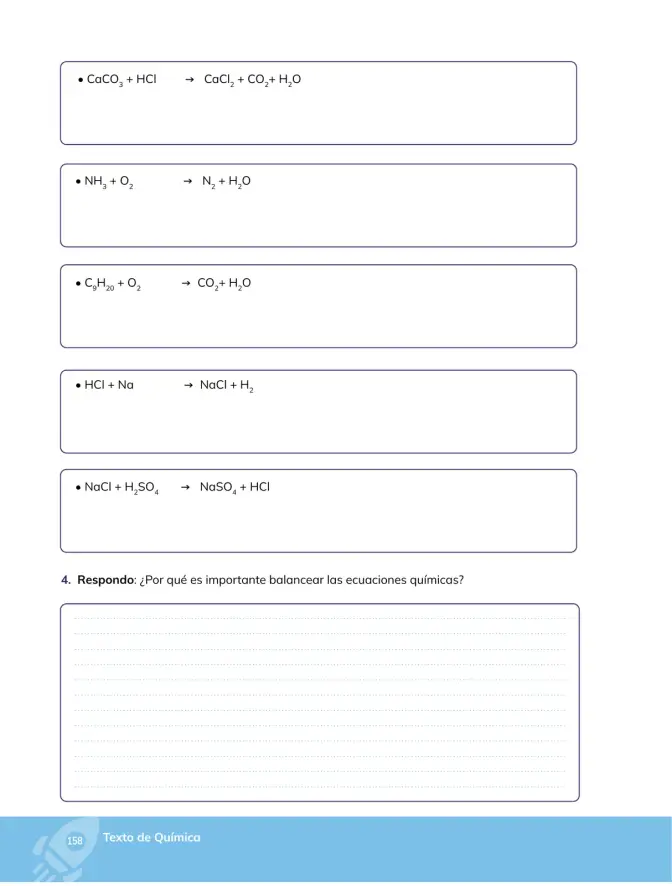
Balancear: \mathrm{CaCO_3 + HCl \rightarrow CaCl_2 + CO_2 + H_2O}
- Conteo de átomos en los reactivos: \mathrm{Ca}=1, \mathrm{C}=1, \mathrm{O}=3, \mathrm{H}=1, \mathrm{Cl}=1.
- Conteo en los productos: \mathrm{Ca}=1 ✓, \mathrm{C}=1 ✓, \mathrm{O}=2+1=3 ✓, \mathrm{Cl}=2 ✗, \mathrm{H}=2 ✗.
- Para equilibrar \mathrm{Cl} y \mathrm{H} se colocan 2 delante de \mathrm{HCl}: 2\times 1=2 de \mathrm{Cl} y 2 de \mathrm{H}.
- Verificación: \mathrm{Ca}=1=1; \mathrm{C}=1=1; \mathrm{O}=3=2+1=3; \mathrm{H}=2=2; \mathrm{Cl}=2=2.
Ejercicio (caja 2)
Balancear: \mathrm{NH_3 + O_2 \rightarrow N_2 + H_2O}
- Reactivos: \mathrm{N}=1, \mathrm{H}=3, \mathrm{O}=2. Productos: \mathrm{N}=2, \mathrm{H}=2, \mathrm{O}=1.
- Equilibro \mathrm{N} con 2 de \mathrm{NH_3}: \mathrm{H}=6; por lo tanto se necesitan 3\,\mathrm{H_2O} para tener 6 de \mathrm{H}.
- Con 3\,\mathrm{H_2O} hay 3 de \mathrm{O}, es decir \tfrac{3}{2} moléculas de \mathrm{O_2}; para eliminar la fracción se multiplica toda la ecuación por 2.
- Verificación: \mathrm{N}=4=4; \mathrm{H}=12=12; \mathrm{O}=6=6.
Respuesta: \mathrm{4NH_3 + 3O_2 \rightarrow 2N_2 + 6H_2O}
Ejercicio (caja 3)
Balancear: \mathrm{C_9H_{20} + O_2 \rightarrow CO_2 + H_2O}
- Reactivos: \mathrm{C}=9, \mathrm{H}=20, \mathrm{O}=2.
- Los 9 de \mathrm{C} exigen 9\,\mathrm{CO_2}; los 20 de \mathrm{H} exigen 10\,\mathrm{H_2O} (ya que cada \mathrm{H_2O} tiene 2 de \mathrm{H}).
- Átomos de \mathrm{O} en los productos: (9\times 2)+(10\times 1)=18+10=28.
- 28 de \mathrm{O} corresponden a \dfrac{28}{2}=14 moléculas de \mathrm{O_2}.
- Verificación: \mathrm{C}=9=9; \mathrm{H}=20=20; \mathrm{O}=28=28.
Respuesta: \mathrm{C_9H_{20} + 14O_2 \rightarrow 9CO_2 + 10H_2O}
Ejercicio (caja 4)
Balancear: \mathrm{HCl + Na \rightarrow NaCl + H_2}
- Reactivos: \mathrm{H}=1, \mathrm{Cl}=1, \mathrm{Na}=1. Productos: \mathrm{H}=2, \mathrm{Cl}=1, \mathrm{Na}=1.
- El \mathrm{H_2} producto exige 2 de \mathrm{H} en los reactivos, es decir 2\,\mathrm{HCl}.
- Con 2\,\mathrm{HCl} hay 2 de \mathrm{Cl}, por lo tanto 2\,\mathrm{NaCl} y, en consecuencia, 2\,\mathrm{Na}.
- Verificación: \mathrm{H}=2=2; \mathrm{Cl}=2=2; \mathrm{Na}=2=2.
Respuesta: \mathrm{2HCl + 2Na \rightarrow 2NaCl + H_2}
Ejercicio (caja 5)
Balancear: \mathrm{NaCl + H_2SO_4 \rightarrow Na_2SO_4 + HCl}
- Reactivos: \mathrm{Na}=1, \mathrm{Cl}=1, \mathrm{H}=2, \mathrm{SO_4}=1. Productos: \mathrm{Na}=2, \mathrm{Cl}=1, \mathrm{H}=1, \mathrm{SO_4}=1.
- El sulfato de sodio correcto es \mathrm{Na_2SO_4} (el texto imprime \mathrm{NaSO_4}; se corrige porque el sulfato de sodio es \mathrm{Na_2SO_4}).
- Para equilibrar \mathrm{Na} se colocan 2 de \mathrm{NaCl}: \mathrm{Cl}=2.
- \mathrm{Cl}=2 exige 2\,\mathrm{HCl}, lo que aporta 2 de \mathrm{H}, ya equilibrados con \mathrm{H_2SO_4}.
- Verificación: \mathrm{Na}=2=2; \mathrm{Cl}=2=2; \mathrm{H}=2=2; \mathrm{SO_4}=1=1.
Respuesta: \mathrm{2NaCl + H_2SO_4 \rightarrow Na_2SO_4 + 2HCl}
Respuesta
\mathrm{CaCO_3 + 2HCl \rightarrow CaCl_2 + CO_2 + H_2O}