















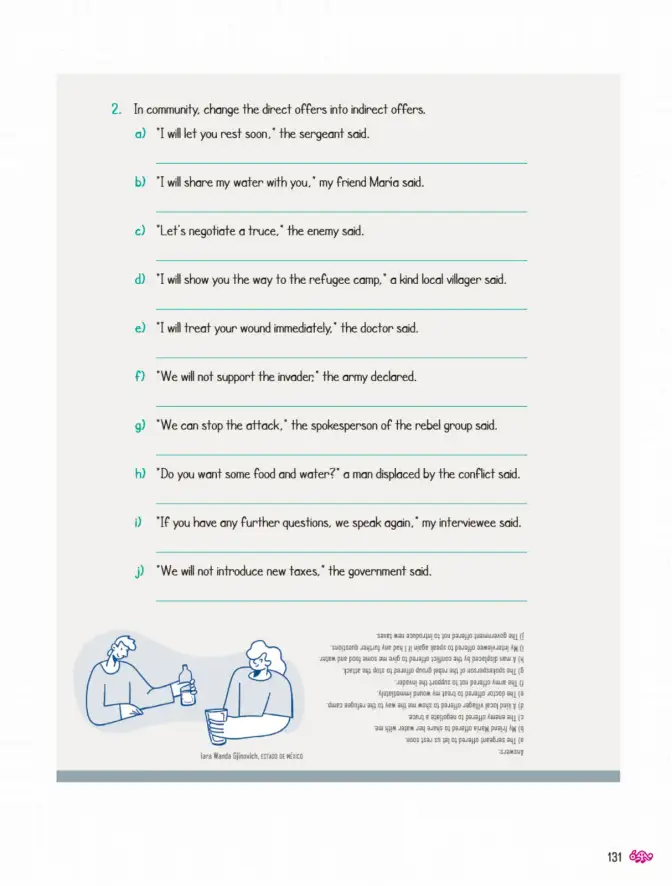
In community, change the direct offers into indirect offers.
"I will let you rest soon," the sergeant said.
- Verbo introductorio en pasado: said.
- El ofrecimiento con will pasa a would.
- El pronombre you se mantiene porque el destinatario sigue siendo la misma persona.
The sergeant said (that) he would let me/us rest soon.
"I will share my water with you," my friend Maria said.
- Verbo introductorio: said.
- will → would.
- my → her; you → me.
My friend Maria said (that) she would share her water with me.
"Let's negotiate a truce," the enemy said.
- Let's expresa sugerencia; en estilo indirecto se usa suggested + -ing.
- Verbo introductorio: said → suggested.
The enemy suggested negotiating a truce.
"I will show you the way to the refugee camp," a kind local villager said.
- will → would.
- you → me; I → he/she.
A kind local villager said (that) he/she would show me the way to the refugee camp.
"I will treat your wound immediately," the doctor said.
- will → would.
- your → my; I → he/she.
The doctor said (that) he/she would treat my wound immediately.
"We will not support the invader," the army declared.
- will not → would not.
- We → they.
The army declared (that) they would not support the invader.
"We can stop the attack," the spokesperson of the rebel group said.
- can → could.
- We → they.
The spokesperson of the rebel group said (that) they could stop the attack.
"Do you want some food and water?" a man displaced by the conflict said.
- Pregunta directa de sí/no → asked if/whether.
- Do you want → I wanted; some → some/any.
A man displaced by the conflict asked if I wanted some food and water.
"If you have any further questions, we speak again," my interviewee said.
- have → had; speak → would speak.
- you → I; we → they.
My interviewee said (that) if I had any further questions, they would speak again.
"We will not introduce new taxes," the government said.
- will not → would not.
- We → they.
The government said (that) they would not introduce new taxes.