
















Saltar al contenido
MisLibrosTexto
Ad

Hot Potato: compartir opiniones y reflexionar sobre las fuentes de información

📄 ejercicios ingles 🎓 otro · 2° TELESECUNDARIA México 🇲🇽 MX 🗣 Español
Página 12
12 de 171
Página 12 de Uérakua anapu uantakua. Projects and Readings.  Libro de Educación Telesecundaria Grado 2°  Ciclo Escolar 2025 - 2026
Anterior Página 12 / 171 Siguiente

Respuesta rápida

3.c-j: dinámica Hot Potato para compartir opiniones y fuentes. 4.1: los medios uniforman la opinión y reducen el pensamiento crítico; hay que verificar fuentes.

📚 exercise ingles ⭐⭐ Dificultad 2/5 ⏱ 8 min lectura

Solución — Página 12

Uérakua anapu uantakua. Projects and Readings. Libro de Educación Telesecundaria Grado 2° Ciclo Escolar 2025 - 2026

1
Ejercicio 1

Actividad 3 (continuación): Hot Potato

Enunciado (traducido): En comunidad, realicen la dinámica del "hot potato" para compartir opiniones sobre un tema elegido y luego reflexionen sobre lo aprendido.

c
Parte 1.c
  1. Discutan en grupo qué saben sobre los temas propuestos.
  2. Cada estudiante menciona la fuente de donde obtuvo la información: libros, noticias, redes sociales, conversaciones, etc.
  3. Se registran las fuentes en el pizarrón para comparar su confiabilidad.

Respuesta orientativa: Se comparten conocimientos previos y se identifican las fuentes (medios, internet, familia). Esto permite distinguir entre información verificada y rumores.

d
Parte 1.d
  1. El grupo propone varios temas de interés.
  2. Se vota o se elige democráticamente uno solo.
  3. El tema elegido guiará todas las participaciones del juego.

Respuesta orientativa: El tema debe ser relevante para la comunidad escolar, por ejemplo: el uso de redes sociales, el cuidado del agua o la violencia escolar.

e
Parte 1.e
  1. Se consigue un objeto para pasar: pelota, juguete o pañuelo.
  2. Ese objeto será la "hot potato" (papa caliente).
  3. Se explica que quien lo tenga cuando pare la música deberá hablar.

Respuesta orientativa: El objeto simboliza la oportunidad de participar; todos deben estar atentos para no quedarse con él.

f
Parte 1.f
  1. Se elige a una persona responsable de la música.
  2. Puede cantar, usar el celular o hacer ruido.
  3. La música marca el inicio y el alto del juego.

Respuesta orientativa: La música crea un ambiente dinámico y marca el ritmo de las participaciones.

g
Parte 1.g
  1. Al iniciar la música, el objeto se pasa rápidamente.
  2. Todos los integrantes del círculo participan.
  3. Se evita detener el objeto para no quedarse con él.

Respuesta orientativa: El movimiento rápido mantiene la atención y la emoción del juego.

h
Parte 1.h
  1. La música se detiene de forma sorpresiva.
  2. Quien tenga la "hot potato" expresa su opinión sobre el tema.
  3. Comparte también la información que posee al respecto.

Respuesta orientativa: Es el momento central: se argumenta con respeto y se escucha a los demás.

i
Parte 1.i
  1. Al terminar la participación, el objeto vuelve a circular.
  2. Se repite el proceso hasta que todos participen.
  3. Se garantiza la participación de toda la comunidad.

Respuesta orientativa: La dinámica asegura que nadie quede excluido y que todas las voces sean escuchadas.

j
Parte 1.j
  1. El grupo comparte reflexiones sobre lo vivido.
  2. Se identifican aprendizajes, datos curiosos, temas controvertidos y opiniones encontradas.
  3. Se contrasta la información científica con la de los medios.

Respuesta orientativa: Se concluye que existen diversas formas de acercarse a la información y que es necesario contrastar fuentes para evitar la desinformación.


4
Ejercicio 4

Enunciado (traducido): En comunidad, lean y reflexionen sobre la situación problemática 1 y su relación con la comunidad escolar.

4
Ejercicio 4

1

  1. Se lee la situación: la información de los medios se considera verdadera por la mayoría.
  2. Esto genera una opinión pública uniforme.
  3. Se pierde el pensamiento crítico.

Respuesta orientativa: En la escuela ocurre algo similar cuando se cree todo lo que circula en redes sociales sin verificar. Se propone fomentar el debate, consultar varias fuentes y preguntar a los docentes antes de compartir información.

Contenido de la página

c) Discuss what you know about the topics and share the sources where you got the information.

d) Choose one of the topics you suggested.

e) You'll need something to pass around, like a ball, a toy, or even just a tissue. This will be the "hot potato"!

f) One person will be in charge of playing the music (for example, singing a song, using a phone, or anything that makes noise).

g) When the music starts, pass the hot potato around the circle as fast as you can go!

h) Suddenly, the music will stop! Whoever is holding the hot potato will express and share their opinion on the topic previously chosen, as well as the information they have about it.

i) Once their participation finishes, the hot potato will pass around again. Repeat the process. The whole community must participate.

j) Now share your reflections on the following topics:

  • Learnings about the topic discussed
  • Finding out interesting data
  • Controversial issues
  • Conflicting opinions
  • Science information
  • Information from the media
  • Research findings

As you can see, each person approaches information differently. There are those who are more critical than others regarding the sources of information that underpin their opinions. This is a reminder that it is necessary to avoid disinformation and to research trustworthy sources on topics of interest.

  1. In community, read and reflect on the following situations, and how they relate to your school community. If you believe it is necessary, with the guidance of your teacher, modify the approach as you see fit.

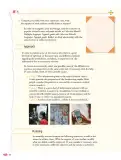
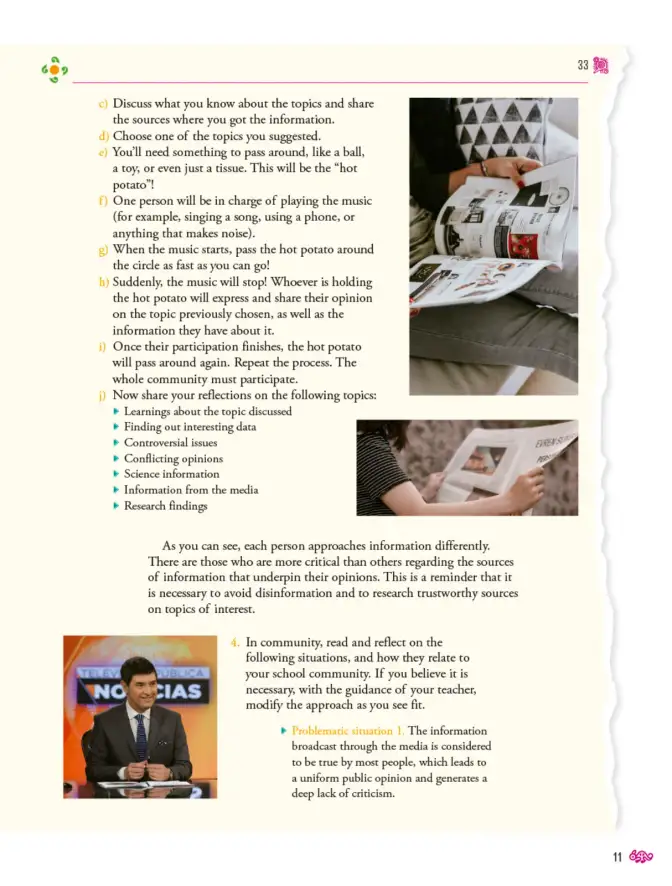
Problematic situation 1. The information broadcast through the media is considered to be true by most people, which leads to a uniform public opinion and generates a deep lack of criticism.

Glosario (5)

hot potato
Juego en el que un objeto se pasa rápidamente mientras suena la música; quien lo tiene al parar debe participar.
trustworthy sources
Fuentes confiables o fiables de información.
disinformation
Desinformación; información falsa difundida intencionalmente.
public opinion
Opinión pública; creencia colectiva de la sociedad.
critical thinking
Pensamiento crítico; capacidad de analizar y evaluar información.

Preguntas para practicar

What do you know about the topics and what sources did you use?

I know about social media and water care from news, family and school. It is important to check if the source is reliable before sharing information.

How does Problematic situation 1 relate to your school community?

In school, many students believe everything they see on social media without checking. This creates a uniform opinion and reduces critical thinking. We can avoid it by asking questions and consulting different sources.

Temas y conceptos clave

Dinámica Hot PotatoFuentes de informaciónPensamiento críticoMedios de comunicaciónhot potatotrustworthy sourcesdisinformationcritical thinkingpublic opinion
¿Te fue útil esta página?

Figuras de la página (3)

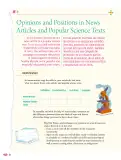
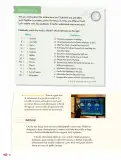
Persona leyendo un periódico con las piernas cruzadas.
Figura 1 image
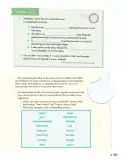
Persona sosteniendo un periódico con el titular 'EVERY STUDENT'.
Figura 2 image
Presentador de noticias en un set de televisión con el letrero 'TELECOMUNICACIONES NO CIAS'.
Figura 3 image

Preguntas que la gente también hace

¿Cómo saber si una fuente de información es confiable?
Consulta la solución completa arriba o explora el libro entero para temas relacionados.
¿Qué es la desinformación y cómo evitarla?
Consulta la solución completa arriba o explora el libro entero para temas relacionados.
¿Por qué los medios pueden generar una opinión uniforme?
Consulta la solución completa arriba o explora el libro entero para temas relacionados.
📌 Antes de leer esto
  • • Vocabulario básico en inglés sobre opiniones y medios
  • • Identificar fuentes de información
  • • Participar en dinámicas grupales
Siguiente tema sugerido
Problematic situation 2: análisis de noticias falsas y verificación de datos
📝 Transcripción de la página (texto seleccionable) 1866 caracteres

c)Discuss what you know about the topics and share the sources where you got the information.

d) Choose one of the topics you suggested.

e) You'll need something to pass around, like a ball,a toy, or even just a tissue. This will be the "hot potato"!

广One person will be in charge of playing the music (for example, singing a song, using a phone, or anything that makes noise).

g)When the music starts, pass the hot potato around the circle as fast as you can go!

h) Suddenly, the music will stop! Whoever is holding the hot potato will express and share their opinion on the topic previously chosen, as well as the information they have about it.

i)Once their participation finishes, the hot potato will pass around again. Repeat the process. The whole community must participate.

)Now share your reflections on the following topics:

c Learnings about the topic discussed

(ci F inding out interesting data

Controversial issues

Conflicting opinions

Science information

c Information from the media

c esearch findings

As you can see, each person approaches information differently.There are those who are more critical than others regarding the sources of information that underpin their opinions. This is a reminder that it is necessary to avoid disinformation and to research trustworthy sources on topics of interest.

  1. In community, read and reflect on the following situations, and how they relate to your school community. If you believe it is necessary, with the guidance of your teacher,modify the approach as you see fit.

Problematic situation 1. The information broadcast through the media is considered to be true by most people, which leads to a uniform public opinion and generates a deep lack of criticism.

33

![](page=0,bbox=[642, 755, 1042, 929])

![](page=0,bbox=[737, 174, 1043, 712])

![](page=0,bbox=[114, 1146, 391, 1439])

11

Ad

Páginas cercanas

Otros libros recomendados

Ver todos →
Ad

Usamos cookies propias y de terceros para personalizar contenido, mostrar publicidad y analizar el tráfico. Las cookies necesarias siempre están activas.