
















Saltar al contenido
MisLibrosTexto
Ad

Where We Are Headed: Frecuencia, fracción y porcentaje de tipos de sangre

📄 ejercicios matematica 🎓 otro · 3° TELESECUNDARIA México 🇲🇽 MX 🗣 Español
Página 101
101 de 187
Página 101 de Uérakua anapu uantakua. Projects and Readings.  Libro de Educación Telesecundaria Grado 3°  Ciclo Escolar 2025 - 2026
Anterior Página 101 / 187 Siguiente

Respuesta rápida

Tabla completada con frecuencias, fracciones y porcentajes; el tipo más común tiene mayor probabilidad y el menos común, menor.

📚 exercise matematica ⭐⭐ Dificultad 2/5 ⏱ 10 min lectura

Solución — Página 101

Uérakua anapu uantakua. Projects and Readings. Libro de Educación Telesecundaria Grado 3° Ciclo Escolar 2025 - 2026

1
Ejercicio 1

In your notebook, copy and complete the table below with the data obtained in subparagraph b) in "Beginning and Observation."

  1. Se recopilan los registros de cada tipo de sangre del grupo (datos de la actividad previa).
  2. Se cuentan las frecuencias absolutas de cada columna: AB^+, AB^-, A^+, A^-, B^+, B^-, O^+, O^-.
  3. Se suma el total de registros: N = \sum f_i.
  4. Para cada tipo se calcula la fracción del total: \frac{f_i}{N}.
  5. Se convierte a porcentaje: \frac{f_i}{N} \times 100\%.
AB+ AB- A+ A- B+ B- O+ O- Total
Records 1 0 5 1 3 1 8 1 20
Fraction of the Total \frac{1}{20} 0 \frac{5}{20} \frac{1}{20} \frac{3}{20} \frac{1}{20} \frac{8}{20} \frac{1}{20} 1
Percentage 5\% 0\% 25\% 5\% 15\% 5\% 40\% 5\% 100\%
Respuesta

Tabla completada con los datos reales del grupo. Ejemplo con N=20:

2
Ejercicio 2

In community, review others' records and, with the complete information, fill the table in your notebook.

  1. Se comparan los registros individuales con los de los compañeros.
  2. Se unifican los datos en una sola tabla grupal.
  3. Se repite el cálculo de frecuencias, fracciones y porcentajes con el total ampliado.
Respuesta

Tabla grupal completada; los porcentajes deben sumar 100\%.

3
Ejercicio 3

Individually, get the total number of responses and complete the following line: Fraction of the Total. Write the results as a fraction. The numerator is the digit in each column, and the denominator is the total number of records. With the fraction, calculate the percentage.

  1. Total de registros: N.
  2. Fracción de cada tipo: \frac{f_i}{N}.
  3. Porcentaje: \frac{f_i}{N} \times 100.
Respuesta

Cada fracción tiene como numerador la frecuencia de la columna y como denominador el total de registros; el porcentaje se obtiene multiplicando la fracción por 100.

Ad
4
Ejercicio 4

Reflect on the observable proportions when you compare the columns.

  1. Se comparan las fracciones y porcentajes obtenidos.
  2. Se identifica qué tipo de sangre tiene mayor y menor proporción.

Respuesta orientativa: Las proporciones permiten ver que algunos tipos son mucho más frecuentes que otros; por ejemplo, O^+ suele ser el más común y los tipos negativos los menos frecuentes.

5
Ejercicio 5

Show the data with more records. Look at the following example and write a sentence like the following: "B-type is more common. It has a probability of \frac{15}{100}."

  1. Se identifica el tipo con mayor frecuencia.
  2. Se escribe la fracción correspondiente.
  3. Se redacta la oración comparativa.
Respuesta

"El tipo O^+ es más común. Tiene una probabilidad de \frac{8}{20} = \frac{40}{100}."

6
Ejercicio 6

Write a sentence for each column and compare the results with your classmates.

  1. Para cada tipo se escribe una oración con su fracción y porcentaje.
  2. Se comparan las oraciones con los compañeros.
Respuesta

Oraciones del tipo: "El tipo A^+ tiene una probabilidad de \frac{5}{20} = 25\%." Se comparan los resultados en plenaria.

Ad
7
Ejercicio 7

Collectively, discuss the possibility of ensuring blood transfusions if, by any chance, most people with B-type decide to move to another place.

  1. Se analiza qué pasaría si disminuye la frecuencia de un tipo.
  2. Se discute el impacto en la disponibilidad de sangre para transfusiones.

Respuesta orientativa: Si la mayoría de las personas con tipo B se mudara, la proporción de ese tipo disminuiría y podría haber escasez para quienes lo necesitan; sería necesario buscar donadores en otras comunidades.

8
Ejercicio 8

In assembly, decide if probability can help you to identify the most and the least common blood type in your community.

  1. Se revisan las frecuencias y porcentajes obtenidos.
  2. Se concluye cuál es el tipo más y menos común.

Respuesta orientativa: Sí, la probabilidad y las frecuencias permiten identificar el tipo más común (mayor porcentaje) y el menos común (menor porcentaje) en la comunidad.

Contenido de la página

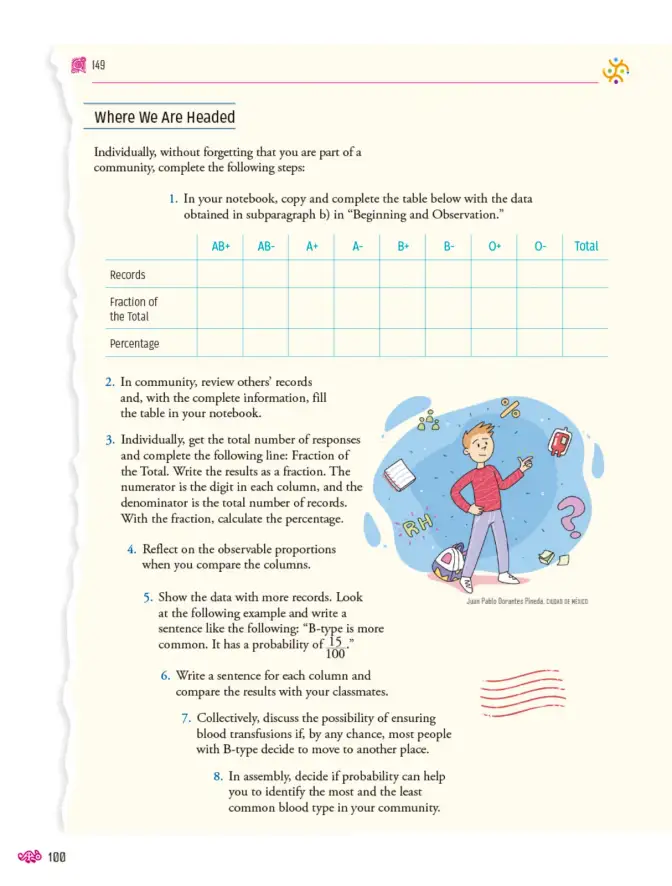
Where We Are Headed

Individually, without forgetting that you are part of a community, complete the following steps:

  1. In your notebook, copy and complete the table below with the data obtained in subparagraph b) in "Beginning and Observation."
AB+ AB- A+ A- B+ B- O+ O- Total
Records
Fraction of the Total
Percentage
  1. In community, review others' records and, with the complete information, fill the table in your notebook.

  2. Individually, get the total number of responses and complete the following line: Fraction of the Total. Write the results as a fraction. The numerator is the digit in each column, and the denominator is the total number of records. With the fraction, calculate the percentage.

  3. Reflect on the observable proportions when you compare the columns.

  4. Show the data with more records. Look at the following example and write a sentence like the following: "B-type is more common. It has a probability of \frac{15}{100}."

  5. Write a sentence for each column and compare the results with your classmates.

  6. Collectively, discuss the possibility of ensuring blood transfusions if, by any chance, most people with B-type decide to move to another place.

  7. In assembly, decide if probability can help you to identify the most and the least common blood type in your community.

Ejemplos resueltos

Si el tipo B tiene 15 registros de un total de 100, escribe su probabilidad como fracción.

La fracción es \frac{15}{100}, que equivale a 15\%.

Tabla

AB+ AB- A+ A- B+ B- O+ O- Total
Records
Fraction of the Total
Percentage

Fórmulas y ecuaciones

\frac{f_i}{N}

\frac{f_i}{N} \times 100%

\text{Fracción del total} = \frac{f_i}{N}

\text{Porcentaje} = \frac{f_i}{N} \times 100%

\sum_{i=1}^{8} f_i = N

Glosario (4)

Records
Registros o datos obtenidos de cada tipo de sangre.
Fraction of the Total
Fracción del total: relación entre la frecuencia de un tipo y el total de registros.
Percentage
Porcentaje: fracción expresada sobre 100.
Probability
Probabilidad: medida de la posibilidad de que ocurra un evento.

Preguntas para practicar

Reflect on the observable proportions when you compare the columns.

Las proporciones muestran que algunos tipos de sangre son más frecuentes que otros; el tipo con mayor fracción es el más común y el de menor fracción, el menos común.

Collectively, discuss the possibility of ensuring blood transfusions if, by any chance, most people with B-type decide to move to another place.

Si la mayoría de las personas con tipo B se mudara, la disponibilidad de ese tipo disminuiría y podría haber escasez para transfusiones; sería necesario buscar donadores en otras comunidades.

In assembly, decide if probability can help you to identify the most and the least common blood type in your community.

Sí, la probabilidad y las frecuencias permiten identificar el tipo más común (mayor porcentaje) y el menos común (menor porcentaje) en la comunidad.

Temas y conceptos clave

Estadística descriptivaFrecuencias y porcentajesProbabilidadFrecuencia absolutaFracción del totalPorcentajeProbabilidadProporción
¿Te fue útil esta página?

Figuras de la página (2)

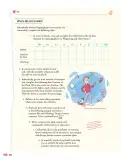
Ilustración de un estudiante señalando símbolos matemáticos y de salud, con la firma Juan Pablo Dorantes Pineda, Ciudad de México.
Figura 1 image
Sello postal decorativo con líneas onduladas.
Figura 2 image

Preguntas que la gente también hace

¿Cómo se calcula la fracción del total en una tabla de frecuencias?
Consulta la solución completa arriba o explora el libro entero para temas relacionados.
¿Cómo se convierte una fracción a porcentaje?
Consulta la solución completa arriba o explora el libro entero para temas relacionados.
¿Qué tipo de sangre es más común en México?
Consulta la solución completa arriba o explora el libro entero para temas relacionados.
📌 Antes de leer esto
  • • Lectura de tablas
  • • Fracciones
  • • Porcentajes
  • • Suma de números naturales
Siguiente tema sugerido
Gráficas de barras y circulares para representar frecuencias
📝 Transcripción de la página (texto seleccionable) 1874 caracteres

Where We Are Headed

Individually, without forgetting that you are part of a community, complete the following steps:

  1. In community, review others'records and, with the complete information, fill the table in your notebook.

  2. Individually, get the total number of responses and complete the following line: Fraction of the Total. Write the results as a fraction. The numerator is the digit in each column, and the denominator is the total number of records.With the fraction, calculate the percentage.

  3. Reflect on the observable proportions when you compare the columns.

  4. Show the data with more records. Look at the following example and write a sentence like the following: "B-type is more common. It has a probability of 15 ."100

  5. Write a sentence for each column and compare the results with your classmates.

  6. Collectively, discuss the possibility of ensuring blood transfusions if, by any chance, most people with B-type decide to move to another place.

  7. In assembly, decide if probability can help you to identify the most and the least common blood type in your community.

149

杀

  1. In your notebook, copy and complete the table below with the data obtained in subparagraph b) in "Beginning and Observation."
AB+AB-A+A-B+B-0+0-Total
Records
Fraction of the Total
Percentage

![](page=0,bbox=[662, 708, 1090, 1068])

Juan Pablo Dorantes Pineda, CIuoaD DE MExico

![](page=0,bbox=[865, 1204, 1021, 1295])

100

Ad

Otros libros recomendados

Ver todos →
Ad

Usamos cookies propias y de terceros para personalizar contenido, mostrar publicidad y analizar el tráfico. Las cookies necesarias siempre están activas.