

















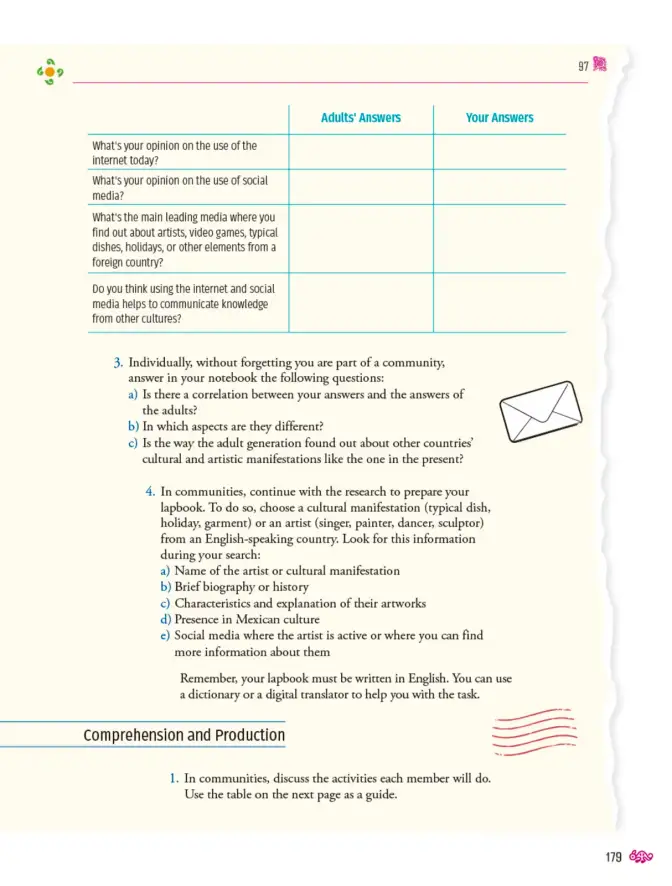
Individually, without forgetting you are part of a community, answer in your notebook the following questions:
Is there a correlation between your answers and the answers of the adults?
- Se comparan las columnas Adults' Answers y Your Answers de la tabla.
- Se identifica en qué preguntas coinciden las opiniones (por ejemplo, ambos reconocen que internet es útil para informarse).
- Se concluye que existe correlación parcial: hay acuerdo en la utilidad de internet y las redes, pero diferencias en el medio principal que usan para conocer otras culturas.
Respuesta orientativa: Yes, there is a partial correlation. Both generations agree that the internet and social media are useful to learn about other cultures, but adults tend to mention television, radio or books, while teenagers mainly mention social media.
In which aspects are they different?
- Se contrastan las respuestas sobre el medio principal de información.
- Se observa que los adultos prefieren medios tradicionales (TV, radio, periódicos) y los estudiantes prefieren plataformas digitales (TikTok, Instagram, YouTube).
- También difieren en la frecuencia y el tipo de contenido que consumen.
Respuesta orientativa: They differ mainly in the leading media they use: adults rely more on television, radio and printed materials, while teenagers use social media and streaming platforms. They also differ in how much they trust online information.
Is the way the adult generation found out about other countries' cultural and artistic manifestations like the one in the present?
- Se identifica cómo se informaban los adultos: viajes, libros, revistas, televisión, radio, intercambios escolares.
- Se identifica cómo se informan los jóvenes hoy: redes sociales, videos, videojuegos, plataformas de streaming.
- Se comparan ambos procesos: el acceso actual es más rápido e inmediato, pero también menos filtrado.
Respuesta orientativa: No, it is not the same. Adults usually learned through books, television, radio or personal travel, while young people now learn instantly through social media, videos and online platforms. The main difference is speed and global reach, although today there is also more risk of misinformation.