

















Present Perfect and Simple Past: formas y usos
Respuesta rápida
Present perfect: have/has + participio (acción que continúa). Simple past: verbo en pasado / did + base (acción terminada).
Solución — Página 39
Uérakua anapu uantakua. Projects and Readings. Libro de Educación Telesecundaria Grado 3° Ciclo Escolar 2025 - 2026
Explicación de la página
Esta página es teoría gramatical (no hay ejercicios que resolver). Se comparan dos tiempos verbales del inglés: present perfect y simple past.
Present Perfect (presente perfecto)
Se forma con el auxiliar have/has + participio pasado del verbo.
Affirmative (afirmativa)
\text{subject} + \text{have/has} + \text{verb in past participle} + \text{object or complement}
Ejemplo: I have studied all the lessons for the exam.
Negative (negativa)
\text{subject} + \text{have/has} + \text{not} + \text{verb in past participle} + \text{object or complement}
Ejemplo: She has not taken chemistry this period.
Interrogative (interrogativa)
\text{have/has} + \text{subject} + \text{verb in past participle} + \text{object or complement} + ?
Ejemplo: Have you ever performed an experiment at the new lab?
Se usa con expresiones de tiempo que indican "hasta ahora": today, this year, in the last six months.
Simple Past (pasado simple)
Affirmative
\text{subject} + \text{verb in the past form} + \text{object or complement}
Ejemplo: I completed all my homework yesterday.
Negative
\text{subject} + \text{did} + \text{not} + \text{verb in the base form} + \text{object or complement}
Ejemplo: She did not take chemistry last semester.
Question (pregunta)
\text{did} + \text{subject} + \text{verb in the base form} + \text{object or complement} + ?
Ejemplo: Did you perform an experiment last period?
Se usa con expresiones de tiempo pasado: yesterday, two weeks ago, last year.
Regla clave
- Simple past: la acción empezó en el pasado, terminó en el pasado y no continúa en el presente.
- Present perfect: la acción empezó en el pasado y continúa en el presente.
Respuesta orientativa: El presente perfecto conecta el pasado con el presente (I have studied = empecé antes y sigue vigente); el pasado simple sitúa la acción totalmente terminada en el pasado (I studied yesterday).
Contenido de la página
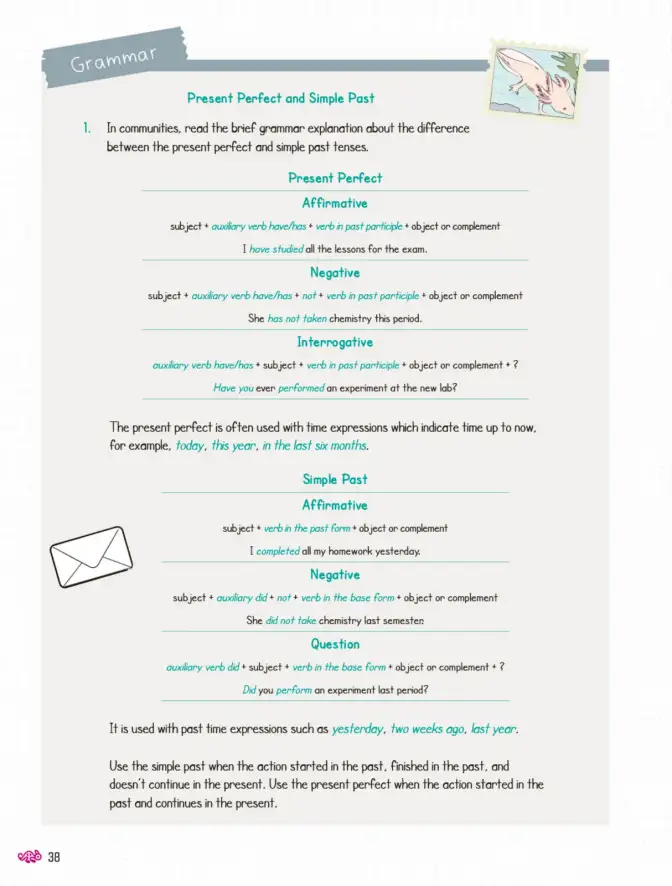
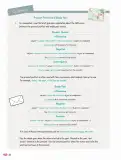
Present Perfect and Simple Past
In communities, read the brief grammar explanation about the difference between the present perfect and simple past tenses.
Present Perfect
Affirmative
subject + auxiliary verb have/has + verb in past participle + object or complement
I have studied all the lessons for the exam.
Negative
subject + auxiliary verb have/has + not + verb in past participle + object or complement
She has not taken chemistry this period.
Interrogative
auxiliary verb have/has + subject + verb in past participle + object or complement + ?
Have you ever performed an experiment at the new lab?
The present perfect is often used with time expressions which indicate time up to now, for example, today, this year, in the last six months.
Simple Past
Affirmative
subject + verb in the past form + object or complement
I completed all my homework yesterday.
Negative
subject + auxiliary did + not + verb in the base form + object or complement
She did not take chemistry last semester.
Question
auxiliary verb did + subject + verb in the base form + object or complement + ?
Did you perform an experiment last period?
It is used with past time expressions such as yesterday, two weeks ago, last year.
Use the simple past when the action started in the past, finished in the past, and doesn't continue in the present. Use the present perfect when the action started in the past and continues in the present.
Ejemplos resueltos
I have studied all the lessons for the exam.
Present perfect afirmativo: sujeto I + auxiliar have + participio studied + complemento.
She has not taken chemistry this period.
Present perfect negativo: sujeto She + has + not + participio taken.
Have you ever performed an experiment at the new lab?
Present perfect interrogativo: Have + sujeto you + participio performed + complemento + ?
I completed all my homework yesterday.
Pasado simple afirmativo: sujeto I + verbo en pasado completed + complemento + expresión yesterday.
She did not take chemistry last semester.
Pasado simple negativo: sujeto She + did + not + forma base take.
Did you perform an experiment last period?
Pasado simple interrogativo: Did + sujeto you + forma base perform + complemento + ?
Tabla
| Tiempo verbal | Afirmativa | Negativa | Interrogativa | Expresiones de tiempo |
|---|---|---|---|---|
| Present Perfect | subject + have/has + past participle | subject + have/has + not + past participle | have/has + subject + past participle + ? | today, this year, in the last six months |
| Simple Past | subject + past form | subject + did + not + base form | did + subject + base form + ? | yesterday, two weeks ago, last year |
Diagrama
flowchart TD
  A[Tiempos verbales] --> B[Present Perfect]
  A --> C[Simple Past]
  B --> B1[have/has + past participle]
  B --> B2[Acción que continúa en el presente]
  B --> B3[today, this year, in the last six months]
  C --> C1[verb in past form / did + base form]
  C --> C2[Acción terminada en el pasado]
  C --> C3[yesterday, two weeks ago, last year]
Fórmulas y ecuaciones
Present Perfect: have/has + past participle
Simple Past: past form / did + base form
\text{subject} + \text{have/has} + \text{past participle} + \text{complement}
\text{subject} + \text{have/has} + \text{not} + \text{past participle} + \text{complement}
\text{have/has} + \text{subject} + \text{past participle} + \text{complement} + ?
\text{subject} + \text{past form} + \text{complement}
\text{subject} + \text{did} + \text{not} + \text{base form} + \text{complement}
\text{did} + \text{subject} + \text{base form} + \text{complement} + ?
Glosario (6)
- present perfect
- Tiempo verbal que conecta una acción pasada con el presente; se forma con have/has + participio.
- simple past
- Tiempo verbal para acciones terminadas en el pasado; usa el verbo en pasado o did + forma base.
- past participle
- Participio pasado del verbo (studied, taken, performed).
- base form
- Forma base o infinitivo sin 'to' del verbo (take, perform).
- auxiliary verb
- Verbo auxiliar que ayuda a formar tiempos verbales: have, has, did.
- time expressions
- Expresiones de tiempo que indican cuándo ocurre la acción.
Preguntas para practicar
¿Cuál es la diferencia principal entre el present perfect y el simple past?
El present perfect se usa cuando la acción empezó en el pasado y continúa o tiene relevancia en el presente; el simple past se usa cuando la acción empezó y terminó en el pasado, sin conexión con el presente.
¿Qué expresiones de tiempo acompañan a cada tiempo verbal?
El present perfect se acompaña de *today, this year, in the last six months*; el simple past, de *yesterday, two weeks ago, last year*.
Temas y conceptos clave
Figuras de la página (2)


Preguntas que la gente también hace
¿Cuál es la diferencia entre present perfect y simple past?
¿Cuándo se usa have/has y cuándo se usa did?
¿Qué expresiones de tiempo acompañan al present perfect?
- • Conjugación del verbo to have en presente (have/has)
- • Formación del pasado simple de verbos regulares e irregulares
- • Participios pasados de verbos comunes
📝 Transcripción de la página (texto seleccionable) 1539 caracteres
Present Perfect and Simple Past
In communities, read the brief grammar explanation about the difference between the present perfect and simple past tenses.
Present Perfect
Affirmative subject+ auxiliary venb have/has + venb in past panticiple + object or complement I have studied all the lessons for the exam.
Negative
subject + auxiliary venb have/has +not + verb in past participle + object or complement
She has not taken chemistry this period.
Interrogative
auxiliary venb have/has + subject + venb in past participle + object or complement + ?
Have you ever penformed an experiment at the new lab?
The present perfect is often used with time expressions which indicate time up to now,for example, today, this year, in the last six months.
Simple Past
Affirmative subject + verb in the past fonm+ object or complement I completed all my homewonk yestenday.
Negative
subject + auxiliary did+ not + venb in the base form+ object or complement
She did not take chemistry last semester:
Question
auxiliary verb did + subject + venb in the base form+ object or complement+?Did you perform an expeniment last period?
It is used with past time expressions such as yesterday, fwo weeks ago, last year.
Use the simple past when the action started in the past, finished in the past, and doesn't continue in the present. Use the present perfect when the action started in the past and continues in the present.
Grammar


o
38
Otros libros recomendados

Colección Nanahuatzin. Lenguajes. Libro de Educación Telesecundaria Grado 3° Ciclo Escolar 2025 - 2026
SEP/CONALITEG
323 págs.
Colección Nanahuatzin. Ética, naturaleza y sociedades. Libro de Educación Telesecundaria Grado 3° Ciclo Escolar 2025 - 2026
SEP/CONALITEG
355 págs.
Colección Nanahuatzin. De lo humano y lo comunitario. Libro de Educación Telesecundaria Grado 3° Ciclo Escolar 2025 - 2026
SEP/CONALITEG
259 págs.

Colección Nanahuatzin. Nuestro libro de Proyectos. Tomo II. Libro de Educación Telesecundaria Grado 3° Ciclo Escolar 2025 - 2026
SEP/CONALITEG
275 págs.
Colección Nanahuatzin. Saberes y pensamiento científico. Libro de Educación Telesecundaria Grado 3° Ciclo Escolar 2025 - 2026
SEP/CONALITEG
339 págs.

Colección Nanahuatzin. Nuestro libro de Proyectos. Tomo I. Libro de Educación Telesecundaria Grado 3° Ciclo Escolar 2025 - 2026
SEP/CONALITEG
299 págs.

Colección Nanahuatzin. Nuestro libro de Proyectos. Tomo III. Libro de Educación Telesecundaria Grado 3° Ciclo Escolar 2025 - 2026
SEP/CONALITEG
291 págs.
Colección Nanahuatzin. Múltiples lenguajes. Libro de Educación Telesecundaria Grado 3° Ciclo Escolar 2025 - 2026
SEP/CONALITEG
163 págs.