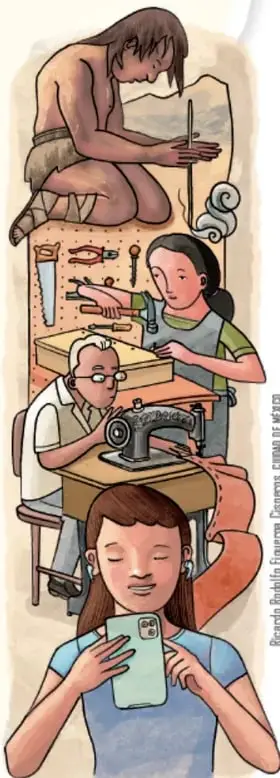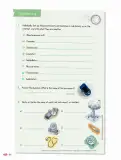
















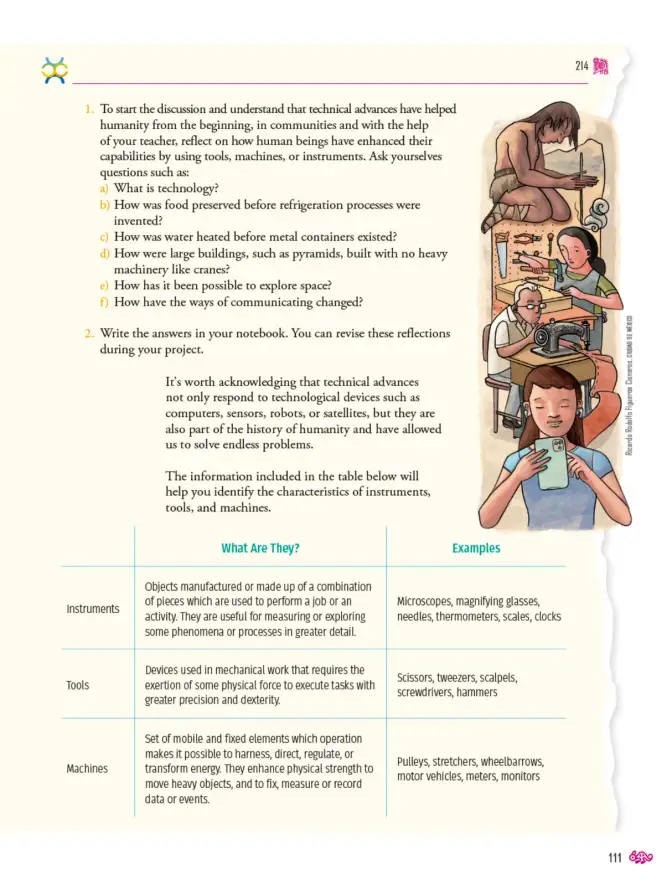
Reflect on how human beings have enhanced their capabilities by using tools, machines, or instruments. Answer questions a) to f).
What is technology?
- Technology is the set of knowledge, techniques, and artifacts created by humans to satisfy needs and solve problems.
- It includes both tangible objects (tools, machines) and intangible processes (methods, designs).
- It transforms the environment and amplifies human physical and mental capacities.
Technology is the organized knowledge and set of techniques, tools and machines that humans create to transform their environment, satisfy needs and solve problems.
How was food preserved before refrigeration processes were invented?
- Drying: removing water from food (sun, air, smoke) prevents microorganisms from growing.
- Salting and curing: salt absorbs moisture and inhibits bacteria.
- Fermentation: bacteria or yeasts transform food (cheese, yogurt, sauerkraut) and preserve it.
- Smoking, pickling in vinegar, storing in cool cellars, and preserving in honey or fat were also used.
Food was preserved by drying, salting, smoking, fermenting, pickling in vinegar, or storing in cool, dark places.
How was water heated before metal containers existed?
- Water was heated in clay, ceramic, or stone vessels placed over fire.
- Hot stones were dropped directly into water held in wooden or leather containers.
- In some cultures, water was heated in animal-skin bags or bamboo tubes near fire.
Water was heated in clay or stone pots over fire, or by dropping heated stones into water held in wood, leather or bamboo containers.
How were large buildings, such as pyramids, built with no heavy machinery like cranes?
- Ramps of earth or sand were built around the structure to drag stone blocks upward.
- Wooden sledges, rollers and levers moved the blocks; ropes and many workers provided force.
- Inclined planes, pulleys and counterweights were used to lift and place stones.
- Precise measurement and organization of thousands of workers made the construction possible.
Using ramps, sledges, rollers, levers, ropes and the coordinated labor of many workers instead of cranes.
How has it been possible to explore space?
- Rockets overcome Earth's gravity using chemical propulsion (liquid or solid fuels).
- Multi-stage rockets discard empty stages to reduce mass and gain speed.
- Satellites, probes and manned capsules carry instruments for navigation, communication and life support.
- Telescopes and remote sensing let us observe space from Earth and from orbit.
Through multi-stage rockets, chemical propulsion, navigation instruments, life-support systems and international cooperation.
How have the ways of communicating changed?
- From oral language and gestures to writing (clay tablets, papyrus, paper).
- From handwritten letters and messengers to the printing press, which mass-produced texts.
- From telegraph and telephone (electric signals) to radio, television and satellites.
- From the internet and mobile phones to instant global communication and social networks.
From oral and written messages carried by people, to printing, telegraph, telephone, radio, TV, internet and mobile phones.