













Saltar al contenido
MisLibrosTexto
Ad

What I Do Know and What I Want to Know: Sustainable Development Goals

📄 ejercicios ingles 🎓 bachillerato · 3° Secundaria México 🇲🇽 MX 🗣 Español
Página 111
111 de 187
Página 111 de Uérakua anapu uantakua. Projects and Readings.  Libro de Educación Secundaria Grado 3°  Ciclo Escolar 2025 - 2026
Anterior Página 111 / 187 Siguiente

Respuesta rápida

1.a) No de inmediato; dependemos de combustibles fósiles. 1.b) No en todos los casos; depende del clima, la región y la tecnología. 4) ODS 4, 6, 7, 11 y 13 son los más aplicables a la comunidad.

📚 exercise ingles ⭐⭐ Dificultad 2/5 ⏱ 8 min lectura

Solución — Página 111

Uérakua anapu uantakua. Projects and Readings. Libro de Educación Secundaria Grado 3° Ciclo Escolar 2025 - 2026

1
Ejercicio 1

Actividad 1

In assembly, reflect on the following: a) Can you stop using non-renewable energies? Why? b) Can renewable energies substitute non-renewable energies in all cases? Why?

a
Parte 1.a

Respuesta orientativa: No, hoy no es posible dejar de usar energías no renovables de forma inmediata, porque la industria, el transporte y la generación eléctrica dependen todavía del petróleo, el carbón y el gas. Además, las energías renovables aún requieren inversión, infraestructura y almacenamiento para cubrir toda la demanda. Por eso la transición debe ser gradual y acompañada de políticas públicas y cambios de consumo.

b
Parte 1.b

Respuesta orientativa: No en todos los casos, porque la disponibilidad de sol, viento o agua varía según la región y la época del año. También hay procesos industriales, como la aviación o la siderurgia, que necesitan combustibles de alta densidad energética difíciles de reemplazar. Sin embargo, con almacenamiento, interconexión de redes y eficiencia energética, la cobertura renovable puede ser cada vez mayor.

Actividad 2

Share your ideas and listen attentively and respectfully to what your classmates think about these questions.

Respuesta orientativa: Se espera que el estudiante escuche sin interrumpir, formule preguntas y compare su punto de vista con el de sus compañeros. Una buena práctica es anotar coincidencias y diferencias para enriquecer el debate.

Actividad 3

Decide if you need to research more about the questions in activity 1. You can ask your teacher for suggestions about how and where to expand your research.

Respuesta orientativa: Conviene investigar en fuentes confiables como la Agencia Internacional de Energía, la ONU o el INEGI para obtener datos locales sobre consumo energético. El docente puede orientar sobre búsqueda en sitios oficiales y verificación de fuentes.

Actividad 4

Read the following information about the 2030 Agenda for Sustainable Development United Nations initiative, and choose the goals you consider more meaningful and applicable to your community.

Respuesta orientativa: Los objetivos más aplicables a una comunidad mexicana suelen ser el ODS 4 (educación de calidad), el ODS 6 (agua y saneamiento), el ODS 7 (energía asequible y no contaminante), el ODS 11 (ciudades sostenibles) y el ODS 13 (acción por el clima). El estudiante debe justificar su elección con ejemplos concretos de su entorno, como la escasez de agua, la contaminación o la deserción escolar.


Contenido de la página

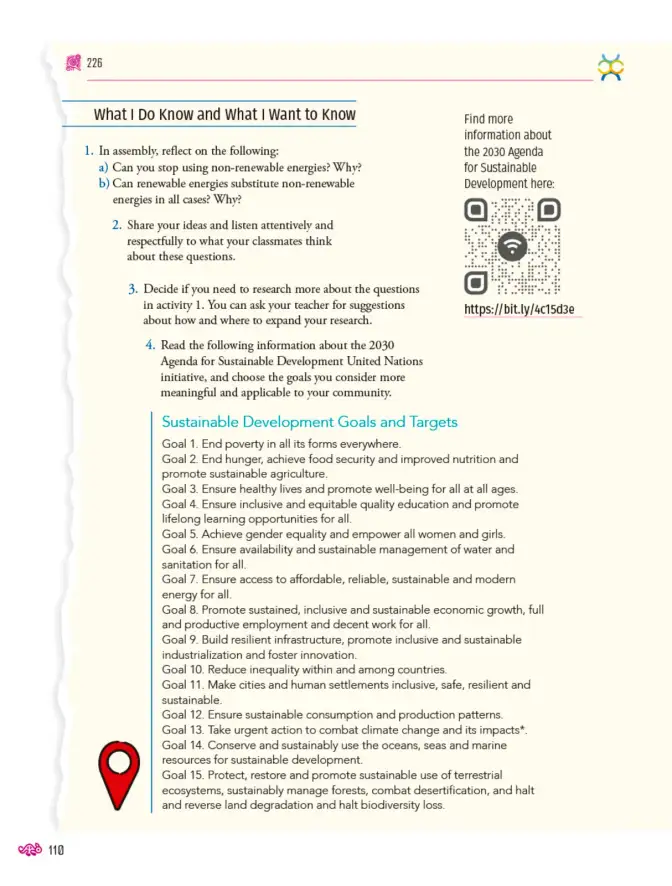
What I Do Know and What I Want to Know

  1. In assembly, reflect on the following: a) Can you stop using non-renewable energies? Why? b) Can renewable energies substitute non-renewable energies in all cases? Why?

  2. Share your ideas and listen attentively and respectfully to what your classmates think about these questions.

  3. Decide if you need to research more about the questions in activity 1. You can ask your teacher for suggestions about how and where to expand your research.

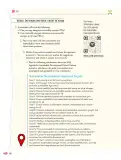
Find more information about the 2030 Agenda for Sustainable Development here:

https://bit.ly/4c15d3e

  1. Read the following information about the 2030 Agenda for Sustainable Development United Nations initiative, and choose the goals you consider more meaningful and applicable to your community.

Sustainable Development Goals and Targets

Goal 1. End poverty in all its forms everywhere. Goal 2. End hunger, achieve food security and improved nutrition and promote sustainable agriculture. Goal 3. Ensure healthy lives and promote well-being for all at all ages. Goal 4. Ensure inclusive and equitable quality education and promote lifelong learning opportunities for all. Goal 5. Achieve gender equality and empower all women and girls. Goal 6. Ensure availability and sustainable management of water and sanitation for all. Goal 7. Ensure access to affordable, reliable, sustainable and modern energy for all. Goal 8. Promote sustained, inclusive and sustainable economic growth, full and productive employment and decent work for all. Goal 9. Build resilient infrastructure, promote inclusive and sustainable industrialization and foster innovation. Goal 10. Reduce inequality within and among countries. Goal 11. Make cities and human settlements inclusive, safe, resilient and sustainable. Goal 12. Ensure sustainable consumption and production patterns. Goal 13. Take urgent action to combat climate change and its impacts*. Goal 14. Conserve and sustainably use the oceans, seas and marine resources for sustainable development. Goal 15. Protect, restore and promote sustainable use of terrestrial ecosystems, sustainably manage forests, combat desertification, and halt and reverse land degradation and halt biodiversity loss.

Glosario (6)

non-renewable energies
Energías no renovables: fuentes que se agotan, como el petróleo, el carbón y el gas natural.
renewable energies
Energías renovables: fuentes que se regeneran naturalmente, como el sol, el viento y el agua.
sustainable development
Desarrollo sostenible: satisfacer las necesidades actuales sin comprometer las de las generaciones futuras.
food security
Seguridad alimentaria: acceso físico y económico a alimentos suficientes e inocuos.
gender equality
Igualdad de género: mismos derechos y oportunidades para mujeres y hombres.
biodiversity loss
Pérdida de biodiversidad: disminución de la variedad de especies y ecosistemas.

Preguntas para practicar

Can you stop using non-renewable energies? Why?

No de inmediato, porque la economía y el transporte dependen de combustibles fósiles y la transición requiere tiempo, dinero y tecnología.

Can renewable energies substitute non-renewable energies in all cases? Why?

No en todos los casos, porque la disponibilidad varía por región y algunos procesos industriales necesitan combustibles de alta densidad energética.

Which SDGs are more meaningful and applicable to your community?

Los ODS 4, 6, 7, 11 y 13, porque abordan educación, agua, energía, ciudades y clima, problemas visibles en muchas comunidades mexicanas.

Temas y conceptos clave

Energías renovables y no renovablesAgenda 2030 para el Desarrollo SostenibleObjetivos de Desarrollo Sostenible (ODS)non-renewable energiesrenewable energies2030 Agenda for Sustainable DevelopmentSustainable Development Goalssustainabilityclimate change

Fuentes y referencias

  • https://bit.ly/4c15d3e
  • Organización de las Naciones Unidas (ONU) - Agenda 2030
¿Te fue útil esta página?

Figuras de la página (2)

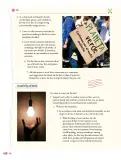
Código QR que enlaza a información sobre la Agenda 2030 para el Desarrollo Sostenible.
Figura 1 image
Icono de un pin de mapa rojo, que sugiere ubicación o contexto local.
Figura 2 image

Preguntas que la gente también hace

¿Qué son los Objetivos de Desarrollo Sostenible de la ONU?
Consulta la solución completa arriba o explora el libro entero para temas relacionados.
¿Cuáles son las diferencias entre energías renovables y no renovables?
Consulta la solución completa arriba o explora el libro entero para temas relacionados.
¿Cómo puedo aplicar los ODS en mi comunidad?
Consulta la solución completa arriba o explora el libro entero para temas relacionados.
📌 Antes de leer esto
  • • Vocabulario básico en inglés sobre medio ambiente y energía
  • • Conocimiento general sobre tipos de energía
  • • Habilidad para leer textos informativos en inglés
Siguiente tema sugerido
Metas e indicadores de los ODS y su seguimiento en México
📝 Transcripción de la página (texto seleccionable) 2323 caracteres

What I Do Know and What I Want to Know

  1. In assembly, reflect on the following:a) Can you stop using non-renewable energies? Why?b) Can renewable energies substitute non-renewable energies in all cases? Why?

  2. Share your ideas and listen attentively and respectfully to what your classmates think about these questions.

  3. Decide if you need to research more about the questions in activity 1. You can ask your teacher for suggestions about how and where to expand your research.

Find more information about the 2030 Agenda for Sustainable Development here:

https://bit.ly/4c15d3e

  1. Read the following information about the 2030Agenda for Sustainable Development United Nations initiative, and choose the goals you consider more meaningful and applicable to your community.

Sustainable Development Goals and Targets

Goal 1. End poverty in allits forms everywhere. Goal 2. End hunger, achieve food security and improved nutrition and promote sustainable agriculture. Goal 3. Ensure healthy lives and promote well-being for all at all ages. Goal 4. Ensure inclusive and equitable quality education and promote lifelong learning opportunities for all. Goal 5. Achieve gender equality and empower all women and girls. Goal 6. Ensure availability and sustainable management of water and sanitation for all. Goal 7. Ensure access to affordable, reliable, sustainable and modern energy for all. Goal 8. Promote sustained, inclusive and sustainable economic growth, ful and productive employment and decent work for all. Goal 9. Build resilient infrastructure, promote inclusive and sustainable industrialization and foster innovation. Goal 10. Reduce inequality within and among countries. Goal 11. Make cities and human settlements inclusive, safe, resilient and sustainable. Goal 12. Ensure sustainable consumption and production patterns. Goal 13. Take urgent action to combat climate change and its impacts* Goal 14. Conserve and sustainably use the oceans, seas and marine resources for sustainable development. Goal 15. Protect, restore and promote sustainable use of terrestrial ecosystems, sustainably manage forests, combat desertification, and halt and reverse land degradation and halt biodiversity loss.

0226

×

![](page=0,bbox=[835, 353, 1014, 532])

![](page=0,bbox=[172, 1333, 255, 1463])

小

110

Ad

Otros libros recomendados

Ver todos →
Ad

Usamos cookies propias y de terceros para personalizar contenido, mostrar publicidad y analizar el tráfico. Las cookies necesarias siempre están activas.