
















Saltar al contenido
MisLibrosTexto
Ad

Future Progressive: proyectos de energía renovable

📄 ejercicios ingles 🎓 bachillerato · 3° Secundaria México 🇲🇽 MX 🗣 Español
Página 113
113 de 187
Página 113 de Uérakua anapu uantakua. Projects and Readings.  Libro de Educación Secundaria Grado 3°  Ciclo Escolar 2025 - 2026
Anterior Página 113 / 187 Siguiente

Respuesta rápida

Future progressive: will + be + verb-ing. Ej.: We will be implementing energy-saving policies. / They won't be using so much gas. / Will you be reducing your energy consumption?

📚 exercise ingles ⭐⭐ Dificultad 2/5 ⏱ 6 min lectura

Solución — Página 113

Uérakua anapu uantakua. Projects and Readings. Libro de Educación Secundaria Grado 3° Ciclo Escolar 2025 - 2026

4
Ejercicio 4

Investiga acciones de universidades, centros de investigación e institutos tecnológicos sobre energías renovables, usando las fuentes indicadas.

  1. Identifica los organismos mencionados: Cinvestav (Centro de Investigación y de Estudios Avanzados del IPN) y Conahcyt (Consejo Nacional de Humanidades, Ciencias y Tecnologías).
  2. Revisa las fuentes sugeridas: el libro Colección Nanahuatzin. De lo humano y lo comunitario. Tercer grado, libros de otros Campos Formativos, bibliotecas escolares o páginas confiables de internet.
  3. Consulta a familiares o miembros de la comunidad que usen o conozcan energías renovables.
  4. Registra en una tabla: institución, acción que desarrolla y fuente consultada.

Respuesta orientativa: Cinvestav investiga celdas solares y biocombustibles; Conahcyt financia proyectos de transición energética. Estas acciones buscan sustituir combustibles fósiles por fuentes limpias como la solar y la eólica.


5
Ejercicio 5

Decide si preguntarás a un especialista cómo implementar tus propuestas para reducir el consumo de energía y si es posible cambiar de energías no renovables a renovables en tu escuela.

  1. Formula la pregunta al especialista: What would be the first step to install solar panels in our school?
  2. Evalúa la viabilidad: costo, espacio disponible, orientación solar y permisos.
  3. Propón un plan escalonado: primero ahorro (luces LED, apagar equipos), después instalación de paneles.

Respuesta orientativa: Sí, conviene consultar a un especialista porque puede calcular el consumo real y el tamaño del sistema fotovoltaico. El cambio es posible si se combina con hábitos de ahorro y financiamiento escolar.

Grammar: Future Progressive

Estructura para hablar de procesos o situaciones temporales en el futuro.

  1. Afirmativa: \text{subject} + \text{will} + \text{be} + \text{verb-}ing. Ejemplo: She will be reducing her use of water when taking a shower.
  2. Negativa: \text{subject} + \text{will not/won't} + \text{be} + \text{verb-}ing. Ejemplo: They won't be using so much gas to cook.
  3. Interrogativa: \text{will} + \text{subject} + \text{be} + \text{verb-}ing. Ejemplo: Will you be reducing your energy consumption at home?
  4. Interrogativa con wh-: \text{wh-word} + \text{will} + \text{subject} + \text{be} + \text{verb-}ing + ?. Ejemplo: What will you be doing to reduce energy and water consumption at home?
Respuesta

El future progressive se forma con will be + verbo en -ing y sirve para describir acciones en curso en un momento futuro.

Contenido de la página

4. You can research more about the actions that universities, research centers and technological institutes develop, especially the Centro de Investigación y de Estudios Avanzados del Instituto Politécnico Nacional (Cinvestav) and the Consejo Nacional de Humanidades, Ciencias y Tecnologías (Conahcyt). You can also use the following sources:

a) Book Colección Nanahuatzin. De lo humano y lo comunitario. Tercer grado b) Disciplinary books from other Formative Fields c) Classroom Library, School Library, public library, or trustworthy internet pages d) The experience of your families or community members who use or know about renewable energies

5. Decide if you want to ask a specialist how to implement your proposals to reduce energy use considerably, and whether switching from non-renewable to renewable energies in your school is possible.

Grammar

Future Progressive

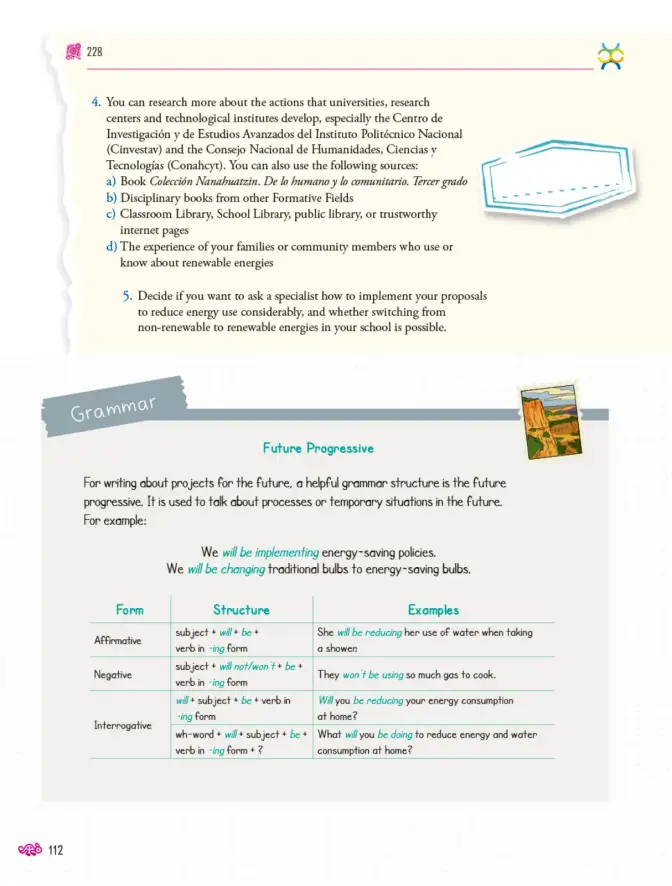
For writing about projects for the future, a helpful grammar structure is the future progressive. It is used to talk about processes or temporary situations in the future. For example:

We will be implementing energy-saving policies. We will be changing traditional bulbs to energy-saving bulbs.

Form Structure Examples
Affirmative subject + will + be + verb in -ing form She will be reducing her use of water when taking a shower.
Negative subject + will not/won't + be + verb in -ing form They won't be using so much gas to cook.
Interrogative will + subject + be + verb in -ing form Will you be reducing your energy consumption at home?
Interrogative (wh-) wh-word + will + subject + be + verb in -ing form + ? What will you be doing to reduce energy and water consumption at home?

Ejemplos resueltos

We will be implementing energy-saving policies.

Afirmativa: sujeto we + will be + verbo implement en -ing.

They won't be using so much gas to cook.

Negativa: sujeto they + won't be + verbo use en -ing.

What will you be doing to reduce energy and water consumption at home?

Interrogativa wh-: what + will + sujeto you + be + verbo do en -ing.

Tabla

Form Structure Examples
Affirmative subject + will + be + verb in -ing form She will be reducing her use of water when taking a shower.
Negative subject + will not/won't + be + verb in -ing form They won't be using so much gas to cook.
Interrogative will + subject + be + verb in -ing form Will you be reducing your energy consumption at home?
Interrogative (wh-) wh-word + will + subject + be + verb in -ing form + ? What will you be doing to reduce energy and water consumption at home?

Diagrama

mindmap
  root((Future Progressive))
    Forma
      will + be + verb-ing
    Usos
      Procesos futuros
      Situaciones temporales
    Formas
      Afirmativa
      Negativa
      Interrogativa
      Wh- questions

Fórmulas y ecuaciones

\text{subject} + \text{will} + \text{be} + \text{verb-}ing

\text{subject} + \text{will not/won't} + \text{be} + \text{verb-}ing

\text{will} + \text{subject} + \text{be} + \text{verb-}ing

\text{wh-word} + \text{will} + \text{subject} + \text{be} + \text{verb-}ing + ?

Glosario (4)

future progressive
Tiempo verbal que expresa acciones en desarrollo en un momento futuro.
renewable energies
Fuentes de energía que se regeneran naturalmente, como la solar o la eólica.
energy-saving
Que reduce el consumo de energía.
specialist
Persona con conocimiento experto en un área.

Preguntas para practicar

What will you be doing to reduce energy consumption at school?

We will be turning off lights when leaving the classroom and we will be using natural light during the day.

Why is the future progressive useful for writing projects?

Because it describes actions in progress at a future time, which fits project planning and temporary future situations.

Temas y conceptos clave

Future ProgressiveEnergías renovablesProyectos escolares sustentableswill be + verb-ingprocesos futurossituaciones temporales futurasCinvestavConahcyt

Fuentes y referencias

  • Cinvestav
  • Conahcyt
  • Colección Nanahuatzin. De lo humano y lo comunitario. Tercer grado
¿Te fue útil esta página?

Figuras de la página (2)

Recuadro hexagonal con líneas punteadas para escribir una respuesta.
Figura 1 image
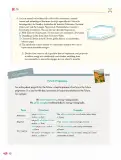
Ilustración de un paisaje con acantilados y vegetación.
Figura 2 image

Preguntas que la gente también hace

¿Cómo se forma el future progressive en inglés?
Consulta la solución completa arriba o explora el libro entero para temas relacionados.
¿Cuál es la diferencia entre will y will be + ing?
Consulta la solución completa arriba o explora el libro entero para temas relacionados.
¿Qué instituciones en México investigan energías renovables?
Consulta la solución completa arriba o explora el libro entero para temas relacionados.
📌 Antes de leer esto
  • • Uso básico del futuro con will
  • • Formación del gerundio (-ing)
  • • Vocabulario sobre energía y medio ambiente
Siguiente tema sugerido
Future progressive en preguntas wh- y redacción de proyectos ambientales
📝 Transcripción de la página (texto seleccionable) 1953 caracteres
  1. You can research more about the actions that universities, research centers and technological institutes develop, especially the Centro de Investigación y de Estudios Avanzados del Instituto Politécnico Nacional (Cinvestav) and the Consejo Nacional de Humanidades, Ciencias y Tecnolog´as (Conahcyt). You can also use the following sources:

a) Book Colección Nanabuatzin. De lo humano y lo comunitario. Tercer grado b) Disciplinary books from other Formative Fields

c) Classroom Library, School Library, public library, or trustworthy internet pages

d) The experience of your families or community members who use or know about renewable energies

  1. Decide if you want to ask a specialist how to implement your proposals to reduce energy use considerably, and whether switching from non-renewable to renewable energies in your school is possible.

Grammar

Future Progressive

For writing about projects for the future, a helpful grammar structure is the future progressive. It is used to talk about processes or temporary situations in the future.For example:

We will be implementing energy-saving policies.We will be changing traditional bulbs to energy-saving bulbs.

228

×

![](page=0,bbox=[866, 246, 1153, 398])

![](page=0,bbox=[939, 688, 1049, 828])

FormStructureExamples
Affirmativesubject + will+ be + venb in -ing formShe will be reducing her use of water when taking a showen:
Negativesubject + will not/won't+ + be + venb in -ing formThey won't be using so much gas to cook.
Interrogativewill + subject + be + verb in -ing formWill you be reducing your energy consumption at home?
wh-wond + wil+ subject + be + venb in -ingform + ?What will you be doing to reduce energy and water consumption at home?

112

Ad

Otros libros recomendados

Ver todos →
Ad

Usamos cookies propias y de terceros para personalizar contenido, mostrar publicidad y analizar el tráfico. Las cookies necesarias siempre están activas.