














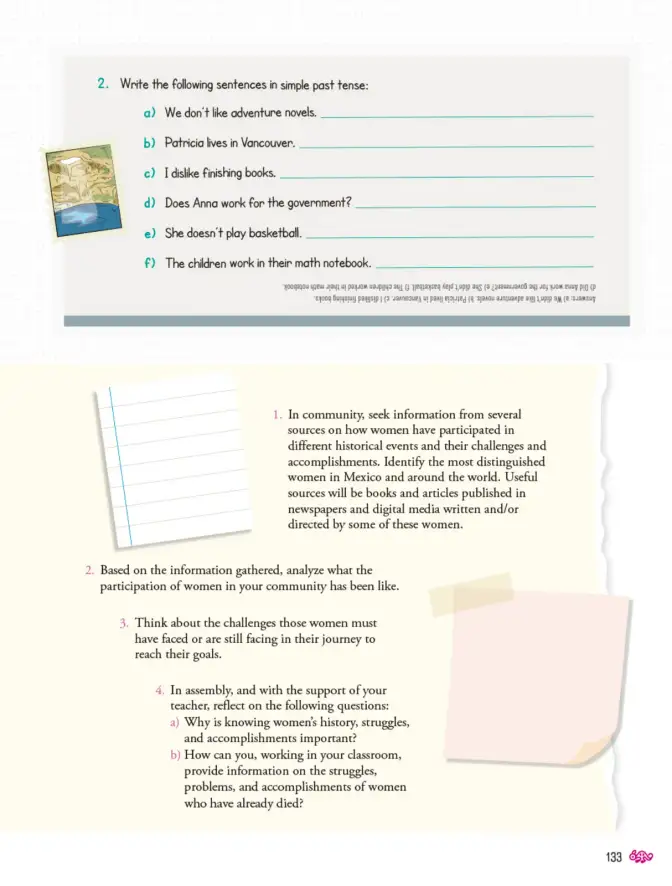
Write the following sentences in simple past tense.
Enunciado: We don't like adventure novels.
- Identifico el verbo principal: like (verbo regular).
- La oración está en presente simple negativa con don't; en pasado se usa didn't + verbo en forma base.
- Transformación: We didn't like adventure novels.
We didn't like adventure novels.
Enunciado: Patricia lives in Vancouver.
- Verbo principal: lives (tercera persona singular de live).
- En pasado simple, el verbo regular live forma lived y no cambia con la persona.
- Transformación: Patricia lived in Vancouver.
Patricia lived in Vancouver.
Enunciado: I dislike finishing books.
- Verbo principal: dislike (verbo regular).
- En pasado simple se agrega -d: disliked.
- Transformación: I disliked finishing books.
I disliked finishing books.
Enunciado: Does Anna work for the government?
- Pregunta en presente simple con auxiliar does.
- En pasado, el auxiliar es did y el verbo principal vuelve a su forma base: work.
- Transformación: Did Anna work for the government?
Did Anna work for the government?
Enunciado: She doesn't play basketball.
- Oración negativa en presente simple con doesn't.
- En pasado se usa didn't + verbo en forma base: play.
- Transformación: She didn't play basketball.
She didn't play basketball.
Enunciado: The children work in their math notebook.
- Verbo principal: work (verbo regular).
- En pasado simple se agrega -ed: worked.
- Transformación: The children worked in their math notebook.
Actividad 1
In community, seek information from several sources on how women have participated in different historical events and their challenges and accomplishments. Identify the most distinguished women in Mexico and around the world.
Respuesta orientativa: Se puede investigar en libros, artículos de periódico y medios digitales sobre mujeres como Sor Juana Inés de la Cruz, Josefa Ortiz de Domínguez, Frida Kahlo, Malala Yousafzai o Marie Curie. El objetivo es reconocer su participación en la historia, los retos que enfrentaron y sus logros.
Actividad 2
Based on the information gathered, analyze what the participation of women in your community has been like.
Respuesta orientativa: En la comunidad, las mujeres participan en la escuela, el trabajo, la política y las actividades culturales. Aunque han ganado espacios, todavía enfrentan desigualdades y obstáculos que limitan su desarrollo pleno.
Actividad 3
Think about the challenges those women must have faced or are still facing in their journey to reach their goals.
Respuesta orientativa: Muchas mujeres han enfrentado discriminación, falta de acceso a la educación, violencia y prejuicios sociales. A pesar de ello, han logrado avances importantes en derechos, ciencia, arte y política.
Actividad 4
In assembly, and with the support of your teacher, reflect on the following questions:
The children worked in their math notebook.
Why is knowing women's history, struggles, and accomplishments important?
Respuesta orientativa: Conocer la historia de las mujeres permite valorar sus aportes, combatir estereotipos y promover la igualdad de género. También inspira a las nuevas generaciones a luchar por sus metas.
How can you, working in your classroom, provide information on the struggles, problems, and accomplishments of women who have already died?
Respuesta orientativa: Se pueden elaborar murales, exposiciones, trípticos o presentaciones digitales con biografías y logros de mujeres históricas. También se puede organizar una feria informativa en la escuela para compartir lo investigado.