Ejercicio 1
Contenido de la página
Esta página enseña el Simple Past Tense (pasado simple) en inglés. Se usa para hablar de acciones o situaciones que ocurrieron y terminaron en el pasado.
 MisLibrosTexto
 Prueba nacional
TransformarPor universidad (27)
 ESPE — Universidad de las Fuerzas Armadas ESPE
 ESPOCH — Escuela Superior Politécnica de Chimborazo
 ESPOL — Escuela Superior Politécnica del Litoral IKIAM — Universidad Regional Amazónica Ikiam
 UCE — Universidad Central del Ecuador
 UCUENCA — Universidad de Cuenca UEA — Universidad Estatal Amazónica
 UEB — Universidad Estatal de Bolívar
 UG — Universidad de Guayaquil
 ULEAM — Universidad Laica Eloy Alfaro de Manabí
 UNACH — Universidad Nacional de Chimborazo
 UNAE — Universidad Nacional de Educación
 UNEMI — Universidad Estatal de Milagro
 UNESUM — Universidad Estatal del Sur de Manabí UNL — Universidad Nacional de Loja
 UPEC — Universidad Politécnica Estatal del Carchi
 UPSE — Universidad Estatal Península de Santa Elena UTA — Universidad Técnica de Ambato UTB — Universidad Técnica de Babahoyo UTC — Universidad Técnica de Cotopaxi
 UTELVT — Universidad Técnica Luis Vargas Torres de Esmeraldas
 UTEQ — Universidad Técnica Estatal de Quevedo
 UTM — Universidad Técnica de Manabí UTMACH — Universidad Técnica de Machala UTN — Universidad Técnica del Norte MisLibrosTexto
Pasado simple: afirmativa = verbo en pasado (went, bought); negativa = didn't + verbo base; interrogativa = Did + sujeto + verbo base. Los irregulares no usan -ed.
Uérakua anapu uantakua. Projects and Readings. Libro de Educación Telesecundaria Grado 1° Ciclo Escolar 2025 - 2026
Esta página enseña el Simple Past Tense (pasado simple) en inglés. Se usa para hablar de acciones o situaciones que ocurrieron y terminaron en el pasado.
Se usa el verbo en pasado. Hay dos tipos:
Ejemplos de la página:
Estructura: sujeto + did not (didn't) + verbo en forma base + complemento.
Estructura: Did + sujeto + verbo en forma base + complemento + ?
| Form | Structure | Examples | Use |
|---|---|---|---|
| Affirmative | subject/pronoun + main verb in past form + object | She ate too much cake. / I heard a noise in the other room. / They came early. | Acciones que ocurrieron y terminaron en el pasado. |
| Negative | subject/pronoun + did + not + main verb in base form + object | You did not (didn't) tell me what happened to him. / It did not (didn't) fly because it had a broken wing. | Cosas que NO ocurrieron en el pasado. |
| Interrogative | did + subject/pronoun + main verb in base form + object + ? | Did you go to the cinema last night? / Why did you say something so horrible? | Preguntar sobre cosas que ocurrieron y terminaron en el pasado. |
Respuesta orientativa: El pasado simple se forma con el verbo en pasado en afirmativa, y con did/didn't + verbo base en negativa e interrogativa. Los verbos irregulares no siguen la regla de -ed y deben memorizarse.
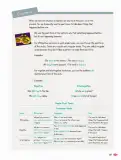
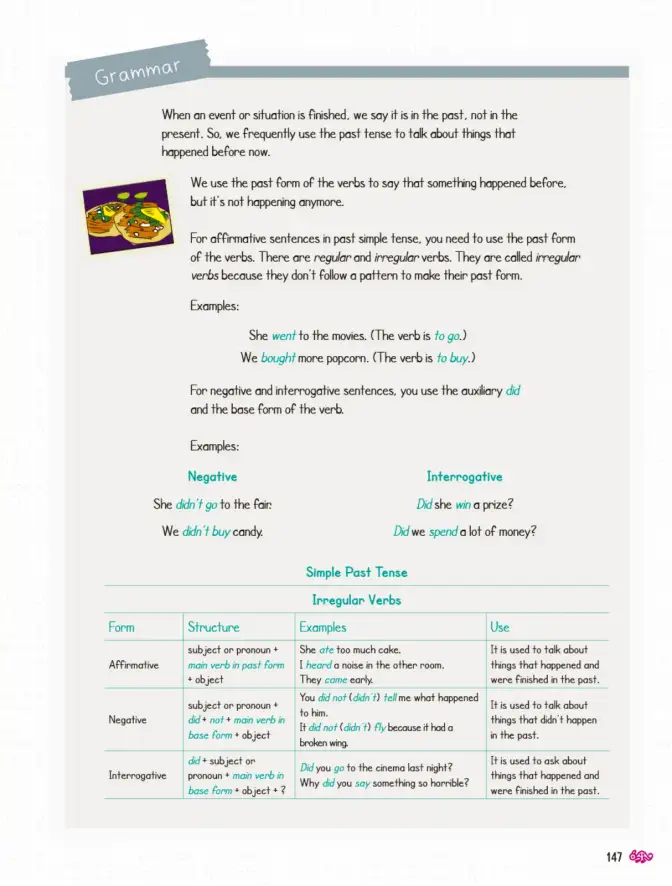
When an event or situation is finished, we say it is in the past, not in the present. So, we frequently use the past tense to talk about things that happened before now.
We use the past form of the verbs to say that something happened before, but it's not happening anymore.
For affirmative sentences in past simple tense, you need to use the past form of the verbs. There are regular and irregular verbs. They are called irregular verbs because they don't follow a pattern to make their past form.
For negative and interrogative sentences, you use the auxiliary did and the base form of the verb.
Negative
Interrogative
| Form | Structure | Examples | Use |
|---|---|---|---|
| Affirmative | subject or pronoun + main verb in past form + object | She ate too much cake. / I heard a noise in the other room. / They came early. | It is used to talk about things that happened and were finished in the past. |
| Negative | subject or pronoun + did + not + main verb in base form + object | You did not (didn't) tell me what happened to him. / It did not (didn't) fly because it had a broken wing. | It is used to talk about things that didn't happen in the past. |
| Interrogative | did + subject or pronoun + main verb in base form + object + ? | Did you go to the cinema last night? / Why did you say something so horrible? | It is used to ask about things that happened and were finished in the past. |
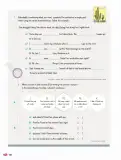
She ___ (go) to the movies.
Verbo irregular go → pasado went. She went to the movies.
We ___ (buy) more popcorn.
Verbo irregular buy → pasado bought. We bought more popcorn.
She ___ (not/go) to the fair.
Negativa: didn't + base form. She didn't go to the fair.
___ she ___ (win) a prize?
Interrogativa: Did + sujeto + base form. Did she win a prize?
| Form | Structure | Examples | Use |
|---|---|---|---|
| Affirmative | subject or pronoun + main verb in past form + object | She ate too much cake. / I heard a noise in the other room. / They came early. | It is used to talk about things that happened and were finished in the past. |
| Negative | subject or pronoun + did + not + main verb in base form + object | You did not (didn't) tell me what happened to him. / It did not (didn't) fly because it had a broken wing. | It is used to talk about things that didn't happen in the past. |
| Interrogative | did + subject or pronoun + main verb in base form + object + ? | Did you go to the cinema last night? / Why did you say something so horrible? | It is used to ask about things that happened and were finished in the past. |
flowchart TD
  A[Simple Past Tense] --> B[Affirmative]
  A --> C[Negative]
  A --> D[Interrogative]
  B --> B1[Regular verbs: +ed]
  B --> B2[Irregular verbs: special form]
  C --> C1[did not / didn't + base form]
  D --> D1[Did + subject + base form + ?]
Affirmative: subject + main verb in past form + object
Negative: subject + did + not + main verb in base form + object
Interrogative: did + subject + main verb in base form + object + ?
Why are some verbs called irregular?
They are called irregular because they do not follow the regular pattern of adding -ed to form the past tense; their past form changes completely, as in go → went or buy → bought.
When do we use the auxiliary did?
We use did in negative and interrogative sentences in the simple past. In negatives it is followed by not (didn't) and the base form of the verb; in questions it goes before the subject.

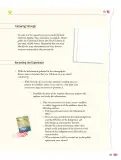
When an event or situation is finished, we say it is in the past, not in the present. So, we frequently use the past tense to talk about things that happened before now.
We use the past form of the verbs to say that something happened before,but it's not happening anymore.
For affirmative sentences in past simple tense, you need to use the past form of the verbs. There are regular and irregular verbs. They are called inregular verbs because they don't follow a pattern to make their past form.
She went to the movies.(The verb is to go.)We boughtmore popcorn. (The verb is to buy.)
For negative and interrogative sentences, you use the auxiliary did and the base form of the verb.
Examples:
Negative She didn't go to the fair.We didn't buy candy.
Interrogative Did she win a prize?Did we spend a lot of money?
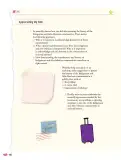
Grammar

Simple Past Tense
| Form | Structure | Examples | Use |
| Affirmative | subject or pronoun + main verb in past form + object | She ate too much cake. I hearda noise in the other room. They came early. | It is used to talk about things that happened and wene finished in the past. |
| Negative | subject or pronoun + did+not+ main verb in base form + object | You did not (didn't) tell me what happened to him. It did not (didn't) fly becauseit had a broken wing. | It is used to talk about things that didn't happen in the past. |
| Interrogative | did+ subject on pronoun + main verb in base form + object+? | Did you go to the cinema last night? Why did you say something so hornible? | It is used to ask about things that happened and were finished in the past. |
147
乐

Historia del pueblo mexicano. Multigrado Libro de Educación Telesecundaria Grado 1° Ciclo Escolar 2025 - 2026
SEP/CONALITEG
331 págs.
Colección Ximhai. Lenguajes. Libro de Educación Telesecundaria Grado 1° Ciclo Escolar 2025 - 2026
SEP/CONALITEG
323 págs.
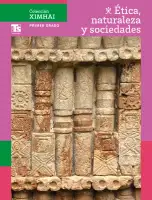
Colección Ximhai. Ética, naturaleza y sociedades. Libro de Educación Telesecundaria Grado 1° Ciclo Escolar 2025 - 2026
SEP/CONALITEG
355 págs.
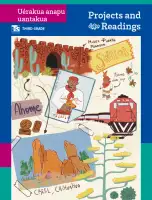
Uérakua anapu uantakua. Projects and Readings. Libro de Educación Telesecundaria Grado 3° Ciclo Escolar 2025 - 2026
SEP/CONALITEG
187 págs.

Uérakua anapu uantakua. Projects and Readings. Libro de Educación Telesecundaria Grado 2° Ciclo Escolar 2025 - 2026
SEP/CONALITEG
171 págs.
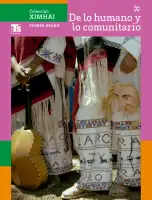
Colección Ximhai. De lo humano y lo comunitario. Libro de Educación Telesecundaria Grado 1° Ciclo Escolar 2025 - 2026
SEP/CONALITEG
259 págs.

Colección Ximhai. Nuestro libro de Proyectos. Tomo II. Libro de Educación Telesecundaria Grado 1° Ciclo Escolar 2025 - 2026
SEP/CONALITEG
267 págs.
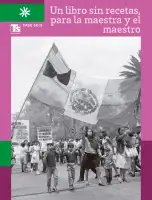
Un libro sin recetas para la maestra y el maestro. Fase 6. Libro de Educación Telesecundaria Grado 1°, 2°, 3° Ciclo Escolar 2025 - 2026
SEP/CONALITEG
203 págs.
Usamos cookies propias y de terceros para personalizar contenido, mostrar publicidad y analizar el tráfico. Las cookies necesarias siempre están activas.