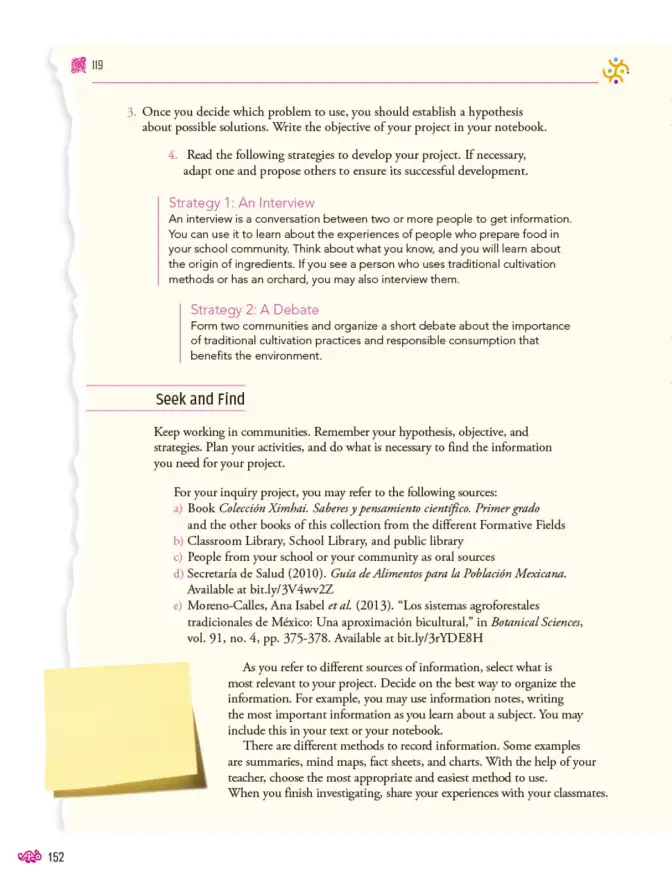
- Once you decide which problem to use, you should establish a hypothesis about possible solutions. Write the objective of your project in your notebook.
4.Read the following strategies to develop your project. If necessary,adapt one and propose others to ensure its successful development.
Strategy 1: An Interview
An interview is a conversation between two or more people to get information.You can use it to learn about the experiences of people who prepare food in your school community. Think about what you know, and you will learn about the origin of ingredients. If you see a person who uses traditional cultivation methods or has an orchard, you may also interview them.
Strategy 2: A Debate
Form two communities and organize a short debate about the importance of traditional cultivation practices and responsible consumption that benefits the environment.
Seek and Find
Keep working in communities. Remember your hypothesis, objective, and strategies. Plan your activities, and do what is necessary to find the information you need for your project.
For your inquiry project, you may refer to the following sources:
a) Book Colección Ximhai. Saberes y pensamiento cientifico. Primer grado and the other books of this collection from the different Formative Fields b) Classroom Library, School Library, and public library
c) People from your school or your community as oral sources
d) Secretar´a de Salud (2010). Guia de Alimentos para la Población Mexicana.Available at bit.ly/3V4wv2Z
e)Moreno-Calles, Ana Isabel et al. (2013). "Los sistemas agroforestales tradicionales de México: Una aproximación bicultural," in Botanical Sciences,vol. 91, no. 4, pp. 375-378. Available at bit.ly/3rYDE8H
As you refer to different sources of information, select what is most relevant to your project. Decide on the best way to organize the information. For example, you may use information notes, writing the most important information as you learn about a subject. You may include this in your text or your notebook.
There are different methods to record information. Some examples are summaries, mind maps, fact sheets, and charts. With the help of your teacher, choose the most appropriate and easiest method to use.When you finish investigating, share your experiences with your classmates.
1

A
152