















Saltar al contenido
MisLibrosTexto
Ad

Art and Cultural Manifestations in the English Language

📄 ejercicios ingles 🎓 otro · 1° TELESECUNDARIA México 🇲🇽 MX 🗣 Español
Página 176
176 de 187
Página 176 de Uérakua anapu uantakua. Projects and Readings.  Libro de Educación Telesecundaria Grado 1°  Ciclo Escolar 2025 - 2026
Anterior Página 176 / 187 Siguiente

Respuesta rápida

3.a) El inglés es lengua global usada en música, internet y comercio. 3.b) Me gustaría conversar, entender canciones y pronunciar bien. 4) Compartir respuestas en equipo. 1.a) Anuncios, canciones, productos, expresiones. 1.b) Diagrama con concepto central y ejemplos.

📚 exercise ingles ⭐⭐ Dificultad 2/5 ⏱ 8 min lectura

Solución — Página 176

Uérakua anapu uantakua. Projects and Readings. Libro de Educación Telesecundaria Grado 1° Ciclo Escolar 2025 - 2026

3
Ejercicio 3

Individually, but keeping in mind that you are part of a community, answer in your notebook the following questions.

a
Parte 3.a

What do you know about the English language?

  1. El inglés es una lengua germánica occidental que se originó en Inglaterra y hoy es idioma oficial o cooficial en más de 50 países.
  2. Es la lengua más estudiada como segundo idioma en el mundo y funciona como lingua franca en ciencia, tecnología, comercio y turismo.
  3. En México se usa en ámbitos como el comercio fronterizo, el turismo, la música y las plataformas digitales.
  4. Su alfabeto tiene 26 letras y su gramática se basa en el orden sujeto-verbo-objeto.

Respuesta orientativa: I know that English is a global language spoken in many countries, used in music, movies, the internet and business. It has 26 letters and many words come from Latin and German. In my community I hear it in songs, advertisements and product labels.

b
Parte 3.b

What would you like to know about the English language?

  1. Conviene formular metas concretas: vocabulario cotidiano, pronunciación, tiempos verbales básicos o comprensión de canciones.
  2. También es válido preguntar por la historia del idioma, sus variantes (británico, americano) y su relación con el español.

Respuesta orientativa: I would like to learn how to have a basic conversation, understand song lyrics, and pronounce words correctly. I also want to know why English has so many words similar to Spanish and how it became a global language.


4
Ejercicio 4

In community, share your answers with your classmates and listen to theirs.

  1. Se organiza el grupo en equipos de 3 o 4 integrantes.
  2. Cada estudiante lee en voz alta una de sus respuestas del ejercicio 3.
  3. Los compañeros escuchan sin interrumpir y luego aportan una idea nueva o una pregunta.
  4. El equipo anota en el cuaderno las coincidencias y diferencias entre sus respuestas.

Respuesta orientativa: Al compartir, se identifican intereses comunes (hablar, escuchar música, viajar) y se enriquece la visión personal con la de los demás; escuchar a los compañeros también es una forma de practicar la comprensión oral en inglés.

Retrieval

a
Parte 4.a

Individually, consider some cultural or artistic manifestations in the English language you have witnessed in your community.

  1. Manifestaciones artísticas: canciones en inglés escuchadas en la radio o en internet, películas y series subtituladas, grafitis o murales con frases en inglés, danzas urbanas con música en inglés.
  2. Manifestaciones culturales: anuncios publicitarios con eslóganes en inglés, etiquetas de productos importados, personas que usan expresiones en inglés ("ok", "bye", "sorry"), menús de restaurantes de comida rápida.
  3. Se anotan al menos cuatro ejemplos en el cuaderno, indicando dónde se observaron.

Respuesta orientativa: En mi comunidad he visto anuncios en inglés en tiendas, escuchado canciones en inglés en la tienda de abarrotes, leído etiquetas de productos como "made in China" y oído a jóvenes usar palabras como "bro" o "cool".

b
Parte 4.b

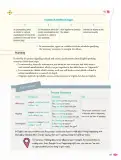
Then, in communities and with the help of your teacher, make a diagram in your notebook of the kinds of cultural and artistic manifestations in English you identified.

  1. Se dibuja en el cuaderno un organizador gráfico con un óvalo central.
  2. En el centro se escribe: "Cultural and Artistic Manifestations in the English Language".
  3. Alrededor se colocan cuatro o más recuadros con los ejemplos identificados.
  4. Se une cada recuadro con el óvalo mediante una línea.

Respuesta orientativa: El diagrama debe mostrar la relación entre el concepto central y los ejemplos; puede incluir tantos recuadros como manifestaciones se hayan identificado.

mindmap
  root((Cultural and Artistic Manifestations in the English Language))
    An advertisement
    A trendy song
    A product
    A close person who uses expressions in that language
    A movie or series
    A mural or graffiti

Contenido de la página

Art is everywhere: in an open space, on a street, in a market, or at a park. Pay attention to your surroundings, and you will find out for yourself. Painting, literature, music, dance, and sculpture are examples of art created by one or more persons to express feelings, ideas, and emotions. On the other hand, cultural manifestations help people and communities build their identity: gastronomy, traditional clothing, and language, among others.

Art uses language as a means for expressing through literature or music. Thus, you can learn about diverse languages and cultures, as artistic and cultural manifestations make them more accessible. In this case, we will focus on the English language.

  1. Individually, but keeping in mind that you are part of a community, answer in your notebook the following questions:

a) What do you know about the English language?

b) What would you like to know about the English language?

  1. In community, share your answers with your classmates and listen to theirs.

Retrieval

  1. To establish the difference between cultural and artistic manifestations, follow these steps:

a) Individually, but keeping in mind your classmates' opinions, consider some cultural or artistic manifestations in the English language you have witnessed in your community.

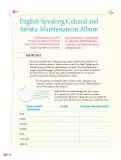
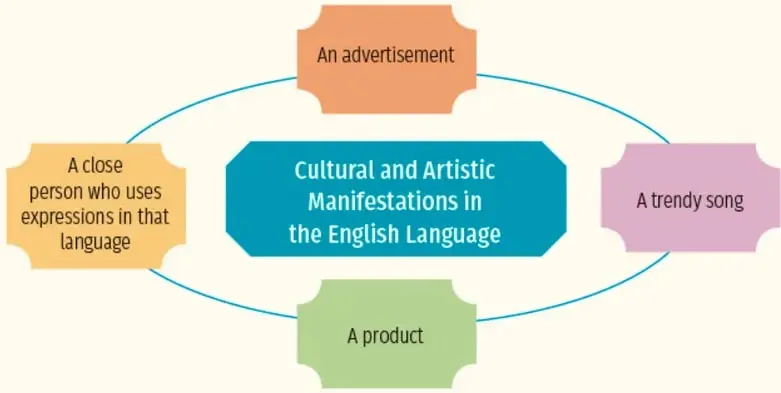
b) Then, in communities and with the help of your teacher, make a diagram in your notebook of the kinds of cultural and artistic manifestations in English you identified. Use the following example:

[Diagrama: óvalo central con el texto "Cultural and Artistic Manifestations in the English Language" y cuatro recuadros alrededor: "An advertisement", "A close person who uses expressions in that language", "A trendy song", "A product".]

Ejemplos resueltos

Make a diagram of the kinds of cultural and artistic manifestations in English you identified in your community.

Se elabora un organizador gráfico tipo mapa mental con el concepto central "Cultural and Artistic Manifestations in the English Language" y ramas con ejemplos: An advertisement, A trendy song, A product, A close person who uses expressions in that language.

Diagrama

mindmap
  root((Cultural and Artistic Manifestations in the English Language))
    An advertisement
    A trendy song
    A product
    A close person who uses expressions in that language
    A movie or series
    A mural or graffiti

Glosario (7)

Art
Expresión creativa de sentimientos, ideas y emociones mediante pintura, literatura, música, danza o escultura.
Cultural manifestations
Prácticas y expresiones de un pueblo que construyen su identidad, como la gastronomía, la vestimenta tradicional y el idioma.
Artistic manifestations
Obras o expresiones creativas como la pintura, la música, la danza o la literatura.
Identity
Conjunto de rasgos que definen a una persona o comunidad.
Community
Grupo de personas que comparten un espacio, intereses o cultura.
Advertisement
Anuncio publicitario que promociona un producto o servicio.
Trendy song
Canción de moda o popular en un momento determinado.

Preguntas para practicar

What do you know about the English language?

I know that English is a global language spoken in many countries, used in music, movies, the internet and business. It has 26 letters and many words come from Latin and German. In my community I hear it in songs, advertisements and product labels.

What would you like to know about the English language?

I would like to learn how to have a basic conversation, understand song lyrics, and pronounce words correctly. I also want to know why English has so many words similar to Spanish and how it became a global language.
What cultural or artistic manifestations in English have you witnessed in your community?

In my community I have seen advertisements in English in stores, heard songs in English in shops, read product labels like 'made in China', and heard young people use words like 'bro' or 'cool'.

Temas y conceptos clave

Art and cultureEnglish languageCultural and artistic manifestationsCommunity identityArtCultureCultural manifestationsArtistic manifestationsEnglish languageIdentityCommunity
¿Te fue útil esta página?

Figuras de la página (3)

Ilustración de un jaguar sobre un fondo verde con un sello postal morado.
Figura 1 image
Recuadro con líneas punteadas simulando una hoja de cuaderno.
Figura 2 image
Diagrama con un óvalo central azul con el texto 'Cultural and Artistic Manifestations in the English Language' y cuatro recuadros de colores alrededor: naranja 'An advertisement', amarillo 'A close person who uses expressions in that language', rosa 'A trendy song', verde 'A product'.
Figura 3 image

Preguntas que la gente también hace

¿Qué son las manifestaciones culturales y artísticas en inglés?
Consulta la solución completa arriba o explora el libro entero para temas relacionados.
¿Cómo hacer un diagrama de manifestaciones culturales en inglés?
Consulta la solución completa arriba o explora el libro entero para temas relacionados.
¿Qué ejemplos de manifestaciones artísticas en inglés hay en mi comunidad?
Consulta la solución completa arriba o explora el libro entero para temas relacionados.
📌 Antes de leer esto
  • • Vocabulario básico en inglés
  • • Identificación de elementos culturales de la comunidad
  • • Elaboración de organizadores gráficos sencillos
Siguiente tema sugerido
Reading and interpreting short texts in English about cultural manifestations
📝 Transcripción de la página (texto seleccionable) 1621 caracteres

Art is everywhere: in an open space, on a street, in a market, or at a park.Pay attention to your surroundings, and you will find out for yourself. Painting,literature, music, dance, and sculpture are examples of art created by one or more persons to express feelings, ideas, and emotions. On the other hand, cultural manifestations help people and communities build their identity: gastronomy,traditional clothing, and language, among others.

Art uses language as a means for expressing through literature or music. Thus, you can learn about diverse languages and cultures,as artistic and cultural manifestations make them more accessible.In this case, we will focus on the English language.

  1. Individually, but keeping in mind that you are part of a community, answer in your notebook the following questions:a) What do you know about the English language?

b) What would you like to know about the English language?

  1. In community, share your answers with your classmates and listen to theirs.

Retrieval

  1. To establish the difference between cultural and artistic manifestations, follow these steps:

a) Individually, but keeping in mind your classmates' opinions,consider some cultural or artistic manifestations in the English language you have witnessed in your community.

b) Then, in communities and with the help of your teacher,make a diagram in your notebook of the kinds of cultural and artistic manifestations in English you identified. Use the following example:

100

![](page=0,bbox=[121, 365, 319, 638])

![](page=0,bbox=[841, 713, 1133, 928])

![](page=0,bbox=[221, 1066, 1002, 1459])

175

乐

Ad

Otros libros recomendados

Ver todos →
Ad

Usamos cookies propias y de terceros para personalizar contenido, mostrar publicidad y analizar el tráfico. Las cookies necesarias siempre están activas.